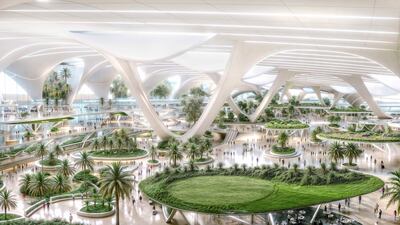
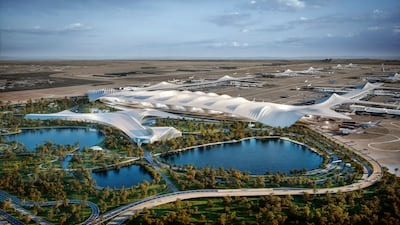
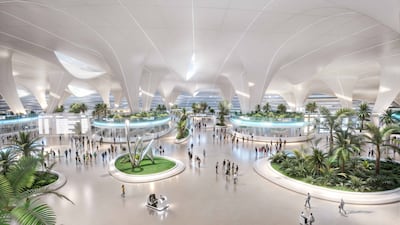
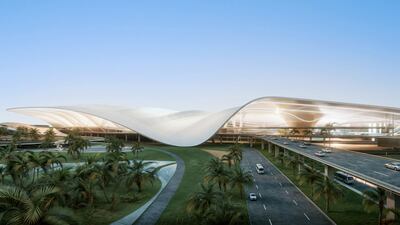
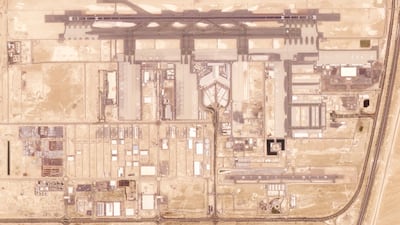
Cutting-edge aviation technology from AI to electric aircraft will help to reimagine passengers' journeys through Dubai's new $35bn passenger terminal at Al Maktoum International Airport.
A “massive leap” in aviation technology at the new terminal will dismantle the old ways of processing passengers through airports and get rid of choke-points through the hub for faster travel, Paul Griffiths, chief executive of Dubai Airports, told The National on Monday.
“Airports have a habit of legacy processes but we're determined to engineer this out. There will be huge investments in automation to make the customer service ethos better and to improve the quality of what we deliver. We've only scratched the service of what AI will deliver in this,” he said.
“Watch this space. The operating model of the airport will be very different from what we have seen.”
A surge in demand for air travel is placing “extraordinary pressure” on existing and new airports, national borders and airline resources, according to an April white paper on biometrics by Sita, an IT provider for the air transport industry.
The existing paper-based and manual travel infrastructure and legacy processes “simply won’t be able to cope”, according to the paper.
The solution is to leverage the power of facial and fingerprint biometrics to create a smoother and safer air travel experience, it said. Advanced technology will also help to solve other aviation industry challenges such as space constraints, specialist staff shortages and evolving passenger wants.
The global demand for travel is rising and biometrics is at the “forefront of this transformation” as the number of air travellers is set to double to eight billion annually by 2040, up from four billion in 2019, according to projections by the International Air Transport Association (Iata).
Dubai Airports has already made investments in biometric technology to funnel more people through Dubai International Airport faster, with the aim of increasing its capacity to 120 million passengers annually.
The first phase of the new passenger terminal at Al Maktoum Airport is expected to be ready within 10 years, with the capacity to accommodate 150 million passengers annually.
The new airport terminal, spread across 70 square kilometres, will feature 400 aircraft gates, five parallel runways and new aviation technology.
That technology will focus on “the ability to eliminate legacy processes that we've had to endure for so long,” Mr Griffiths said.
“I can't think of another commodity that makes you book and then you go to the airport and reaffirm that you want that product.”
Future-proofing the new airport
Operator Dubai Airports is now in the detail design phase of the project during which decisions must be made on the hub's final configuration, operations, relationship with ground transport, customer service plan, F&B and retail strategy.
“With the design process, it is imperative that we rethink what the fundamentals of airports are: they are a way of ensuring the smooth and seamless transition from ground to air, that’s the whole rationale of having an airport,” Mr Griffiths said.
“We are taking a long, hard look at that in the design process.”
This also means that internal and external rail networks, road transport, electric aircraft technology, executive jets and budget airlines will be “incredibly important” elements for the efficiency of the new terminal, he said.
Dubai has signed an agreement with US-based electric aircraft maker Joby Aviation to launch passenger air taxi services in the emirate, which Joby expects to start as early as next year.
Built into the new airport terminal design is the flexibility to incorporate technology currently available today and emerging tech that develops over the years.
“Flexibility, imagination and collaboration are what we need to make it work effectively,” Mr Griffiths said.
The new terminal design, despite its ability to accommodate more runway movements, will take into account sustainable operations, the Dubai Airports boss said.
“We are all learning from climate change and there’s an acceptance that you cannot regard heavy rain as a minor event. We need to invest in systems and infrastructure to deal with climate change,” he said.
This will entail major investments in sustainability in terms of solar power, waste treatment, biofuels and a “huge number of initiatives” to combat the impact of climate change, Mr Griffiths said.
Dubai International Airport (DXB), the world's largest hub by international traffic for 10 consecutive years, struggled to clear a backlog of flights after a record-breaking rainstorm in the UAE earlier this month.
DXB resumed normal operations days after the storm flooded taxiways, forcing flight diversions, delays and cancellations.

COMPANY PROFILE
Company name: SimpliFi
Started: August 2021
Founder: Ali Sattar
Based: UAE
Industry: Finance, technology
Investors: 4DX, Rally Cap, Raed, Global Founders, Sukna and individuals
Tamkeen's offering
- Option 1: 70% in year 1, 50% in year 2, 30% in year 3
- Option 2: 50% across three years
- Option 3: 30% across five years
Timeline
2012-2015
The company offers payments/bribes to win key contracts in the Middle East
May 2017
The UK SFO officially opens investigation into Petrofac’s use of agents, corruption, and potential bribery to secure contracts
September 2021
Petrofac pleads guilty to seven counts of failing to prevent bribery under the UK Bribery Act
October 2021
Court fines Petrofac £77 million for bribery. Former executive receives a two-year suspended sentence
December 2024
Petrofac enters into comprehensive restructuring to strengthen the financial position of the group
May 2025
The High Court of England and Wales approves the company’s restructuring plan
July 2025
The Court of Appeal issues a judgment challenging parts of the restructuring plan
August 2025
Petrofac issues a business update to execute the restructuring and confirms it will appeal the Court of Appeal decision
October 2025
Petrofac loses a major TenneT offshore wind contract worth €13 billion. Holding company files for administration in the UK. Petrofac delisted from the London Stock Exchange
November 2025
180 Petrofac employees laid off in the UAE
In numbers: China in Dubai
The number of Chinese people living in Dubai: An estimated 200,000
Number of Chinese people in International City: Almost 50,000
Daily visitors to Dragon Mart in 2018/19: 120,000
Daily visitors to Dragon Mart in 2010: 20,000
Percentage increase in visitors in eight years: 500 per cent
Key facilities
- Olympic-size swimming pool with a split bulkhead for multi-use configurations, including water polo and 50m/25m training lanes
- Premier League-standard football pitch
- 400m Olympic running track
- NBA-spec basketball court with auditorium
- 600-seat auditorium
- Spaces for historical and cultural exploration
- An elevated football field that doubles as a helipad
- Specialist robotics and science laboratories
- AR and VR-enabled learning centres
- Disruption Lab and Research Centre for developing entrepreneurial skills
Ten tax points to be aware of in 2026
1. Domestic VAT refund amendments: request your refund within five years
If a business does not apply for the refund on time, they lose their credit.
2. E-invoicing in the UAE
Businesses should continue preparing for the implementation of e-invoicing in the UAE, with 2026 a preparation and transition period ahead of phased mandatory adoption.
3. More tax audits
Tax authorities are increasingly using data already available across multiple filings to identify audit risks.
4. More beneficial VAT and excise tax penalty regime
Tax disputes are expected to become more frequent and more structured, with clearer administrative objection and appeal processes. The UAE has adopted a new penalty regime for VAT and excise disputes, which now mirrors the penalty regime for corporate tax.
5. Greater emphasis on statutory audit
There is a greater need for the accuracy of financial statements. The International Financial Reporting Standards standards need to be strictly adhered to and, as a result, the quality of the audits will need to increase.
6. Further transfer pricing enforcement
Transfer pricing enforcement, which refers to the practice of establishing prices for internal transactions between related entities, is expected to broaden in scope. The UAE will shortly open the possibility to negotiate advance pricing agreements, or essentially rulings for transfer pricing purposes.
7. Limited time periods for audits
Recent amendments also introduce a default five-year limitation period for tax audits and assessments, subject to specific statutory exceptions. While the standard audit and assessment period is five years, this may be extended to up to 15 years in cases involving fraud or tax evasion.
8. Pillar 2 implementation
Many multinational groups will begin to feel the practical effect of the Domestic Minimum Top-Up Tax (DMTT), the UAE's implementation of the OECD’s global minimum tax under Pillar 2. While the rules apply for financial years starting on or after January 1, 2025, it is 2026 that marks the transition to an operational phase.
9. Reduced compliance obligations for imported goods and services
Businesses that apply the reverse-charge mechanism for VAT purposes in the UAE may benefit from reduced compliance obligations.
10. Substance and CbC reporting focus
Tax authorities are expected to continue strengthening the enforcement of economic substance and Country-by-Country (CbC) reporting frameworks. In the UAE, these regimes are increasingly being used as risk-assessment tools, providing tax authorities with a comprehensive view of multinational groups’ global footprints and enabling them to assess whether profits are aligned with real economic activity.
Contributed by Thomas Vanhee and Hend Rashwan, Aurifer
Mohammed bin Zayed Majlis
TOUCH RULES
Touch is derived from rugby league. Teams consist of up to 14 players with a maximum of six on the field at any time.
Teams can make as many substitutions as they want during the 40 minute matches.
Similar to rugby league, the attacking team has six attempts - or touches - before possession changes over.
A touch is any contact between the player with the ball and a defender, and must be with minimum force.
After a touch the player performs a “roll-ball” - similar to the play-the-ball in league - stepping over or rolling the ball between the feet.
At the roll-ball, the defenders have to retreat a minimum of five metres.
A touchdown is scored when an attacking player places the ball on or over the score-line.
Why your domicile status is important
Your UK residence status is assessed using the statutory residence test. While your residence status – ie where you live - is assessed every year, your domicile status is assessed over your lifetime.
Your domicile of origin generally comes from your parents and if your parents were not married, then it is decided by your father. Your domicile is generally the country your father considered his permanent home when you were born.
UK residents who have their permanent home ("domicile") outside the UK may not have to pay UK tax on foreign income. For example, they do not pay tax on foreign income or gains if they are less than £2,000 in the tax year and do not transfer that gain to a UK bank account.
A UK-domiciled person, however, is liable for UK tax on their worldwide income and gains when they are resident in the UK.
Benefits of first-time home buyers' scheme
- Priority access to new homes from participating developers
- Discounts on sales price of off-plan units
- Flexible payment plans from developers
- Mortgages with better interest rates, faster approval times and reduced fees
- DLD registration fee can be paid through banks or credit cards at zero interest rates
Who has lived at The Bishops Avenue?
- George Sainsbury of the supermarket dynasty, sugar magnate William Park Lyle and actress Dame Gracie Fields were residents in the 1930s when the street was only known as ‘Millionaires’ Row’.
- Then came the international super rich, including the last king of Greece, Constantine II, the Sultan of Brunei and Indian steel magnate Lakshmi Mittal who was at one point ranked the third richest person in the world.
- Turkish tycoon Halis Torprak sold his mansion for £50m in 2008 after spending just two days there. The House of Saud sold 10 properties on the road in 2013 for almost £80m.
- Other residents have included Iraqi businessman Nemir Kirdar, singer Ariana Grande, holiday camp impresario Sir Billy Butlin, businessman Asil Nadir, Paul McCartney’s former wife Heather Mills.
Hunting park to luxury living
- Land was originally the Bishop of London's hunting park, hence the name
- The road was laid out in the mid 19th Century, meandering through woodland and farmland
- Its earliest houses at the turn of the 20th Century were substantial detached properties with extensive grounds
Specs
Engine: Duel electric motors
Power: 659hp
Torque: 1075Nm
On sale: Available for pre-order now
Price: On request
The Saudi Cup race card
1 The Jockey Club Local Handicap (TB) 1,800m (Dirt) $500,000
2 The Riyadh Dirt Sprint (TB) 1,200m (D) $1.500,000
3 The 1351 Turf Sprint 1,351m (Turf) $1,000,000
4 The Saudi Derby (TB) 1600m (D) $800,000
5 The Neom Turf Cup (TB) 2,100m (T) $1,000,000
6 The Obaiya Arabian Classic (PB) 2,000m (D) $1,900,000
7 The Red Sea Turf Handicap (TB) 3,000m (T) $2,500,000
8 The Saudi Cup (TB) 1,800m (D) $20,000,000
World record transfers
1. Kylian Mbappe - to Real Madrid in 2017/18 - €180 million (Dh770.4m - if a deal goes through)
2. Paul Pogba - to Manchester United in 2016/17 - €105m
3. Gareth Bale - to Real Madrid in 2013/14 - €101m
4. Cristiano Ronaldo - to Real Madrid in 2009/10 - €94m
5. Gonzalo Higuain - to Juventus in 2016/17 - €90m
6. Neymar - to Barcelona in 2013/14 - €88.2m
7. Romelu Lukaku - to Manchester United in 2017/18 - €84.7m
8. Luis Suarez - to Barcelona in 2014/15 - €81.72m
9. Angel di Maria - to Manchester United in 2014/15 - €75m
10. James Rodriguez - to Real Madrid in 2014/15 - €75m
Defence review at a glance
• Increase defence spending to 2.5% of GDP by 2027 but given “turbulent times it may be necessary to go faster”
• Prioritise a shift towards working with AI and autonomous systems
• Invest in the resilience of military space systems.
• Number of active reserves should be increased by 20%
• More F-35 fighter jets required in the next decade
• New “hybrid Navy” with AUKUS submarines and autonomous vessels
UAE’s revised Cricket World Cup League Two schedule
August, 2021: Host - United States; Teams - UAE, United States and Scotland
Between September and November, 2021 (dates TBC): Host - Namibia; Teams - Namibia, Oman, UAE
December, 2021: Host - UAE; Teams - UAE, Namibia, Oman
February, 2022: Hosts - Nepal; Teams - UAE, Nepal, PNG
June, 2022: Hosts - Scotland; Teams - UAE, United States, Scotland
September, 2022: Hosts - PNG; Teams - UAE, PNG, Nepal
February, 2023: Hosts - UAE; Teams - UAE, PNG, Nepal