


Qatar Airways has reported a 45 per cent increase in revenue in its last fiscal year, despite a drop in net profit, after its passenger numbers received a big boost from the Fifa World Cup that was hosted by the Gulf state in 2022.
Revenue rose to 76.3 billion Qatari riyals ($21 billion) in the 2022-2023 fiscal year, with passenger revenue rising by 100 per cent annually, the airline said on Wednesday.
Qatar Airways carried 31.7 million passengers, an increase of 71 per cent over the previous year.
Capacity increased by 31 per cent, driven by 9 per cent higher yields and a load factor of 80 per cent – both the highest in the airline’s history, it said.
Meanwhile, the airline's net profit fell by more than 21 per cent to 4.4 billion riyals during the period, compared with 5.6 billion riyals in the previous year.
Earnings before interest, taxes, depreciation and amortisation (ebitda) were higher than the previous year by 110 million riyals, it said.
“Qatar’s transportation sector is an emblem of its interconnectivity, connecting people from around the world and increasing business connections throughout the region,” said Saad Al-Kaabi, Minister of State for Energy and Qatar Airways group chairman.
“Qatar is proud to have hosted fans from around the world during the Fifa World Cup Qatar 2022, delivering one of the best Fifa World Cups in history.”
The Gulf country's hosting of the $220 billion grand sporting event spurred tourism, with its economy receiving a huge boost.
The overall attendance at World Cup matches was 3.4 million, the Qatar News Agency reported.
Qatar Airways, the event's partner, operated about 14,000 flights that brought in more than 1.4 million passengers to the country over the period of the tournament, it said.
-

Drones spell out ‘Welcome to Qatar’ to mark the start of the Fifa World Cup. Reuters -

Qatar spent more than $200 billion during the past decade to stage Fifa World Cup. Bloomberg -

The Qatar Financial Centre skyline. Bloomberg -

The Stadium 974 in Doha is made with 974 recycled shipping containers, 44,089 seats and tons of modular steel. Several Fifa World Cup matches were played here. Photo: Qatar Media Portal -
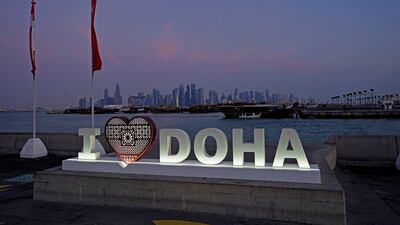
The Doha skyline. PA -
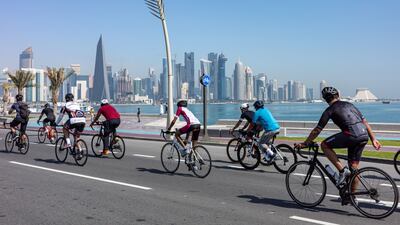
Cyclists ride along the Doha Corniche. Bloomberg -

Boats with sails showing the flags of Argentina and France ahead of their Fifa World Cup final match. Getty -

Boats with sails showing the flags of Argentina, France, Morocco and Croatia ahead of their Fifa World Cup matches. Getty -

Doha skyline is seen from aboard the luxury liner 'MSC World Europa' which was used as a floating hotel for football fans. Photo: Saptarshi Bandopadhyay -

The Katara Cultural Village in Doha where the semi-final match between Argentina and Croatia was played. PA -
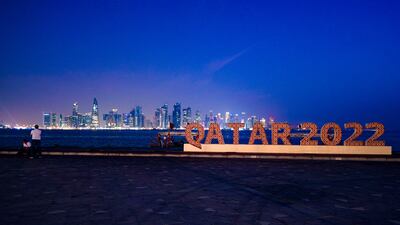
The Doha skyline at night. -

The Doha skyline. PA -

Drones depicting the Fifa World Cup trophy. Reuters -

A building in Doha displays an animation of a football on its facade. Getty -
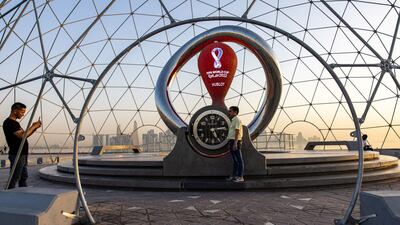
Visitors take photographs alongside Fifa World Cup countdown installation. Bloomberg -

Traditional dhow boats moored in Doha harbour. Bloomberg -

The Museum of Islamic Art at sunset. Bloomberg -
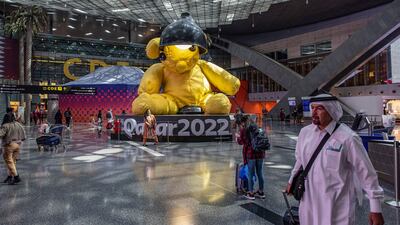
Travellers inside the departures terminal at Hamad International Airport in Doha. Bloomberg -
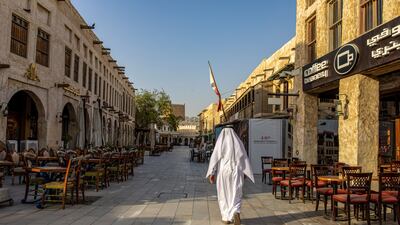
Empty cafes in the Souq Waqif area of Doha during the Fifa World Cup. Bloomberg


The airline also expanded its network to more than 160 destinations in the 2022-2023 fiscal year amid a rebound in travel demand.
Qatar Airways resumed operations to 13 destinations and launched two new routes to Dusseldorf in Germany and Santorini in Greece during the period.
The Doha-based airline could increase its number of destinations to 190, from 177, depending on aircraft deliveries from Boeing and Airbus, Akbar Al Baker, group chief executive of Qatar Airways, said in May.
The carrier is experiencing a delay in the delivery of Boeing 787 and 777x aircraft, he said.
Qatar Airways expects to take delivery of A350s and A321neos from Airbus in the “distant future” after the two companies settled a dispute over A350 jets in February, Mr Al Baker said.
“We had an amicable settlement with Airbus and the aircraft deliveries that were cancelled have been reinstated.”
The global aviation industry is recording a surge in travel demand as Covid-19 restrictions have been lifted around the world.
International passenger traffic grew by 48 per cent annually in April after China reopened its borders to travellers, the International Air Transport Association said in its latest report.
Industry-wide revenue passenger-kilometres also increased by about 46 per cent to hit 90.5 per cent of pre-Covid levels, it said.
“This year’s strong financial results are attributed to the strong passenger demand recovery and the team’s ability to cater to this demand, aided by our continuing network growth,” said Mr Al Baker.
“Profitability has been driven by a 100 per cent increase in passenger revenues in the last year. Load factors exceeding 80 per cent, and the current yield levels are the highest in our history.”

