


The UAE Regulations Lab has issued a licence for electric cargo aircraft as the country seeks to accelerate the shift towards eco-friendly transport and enhance the sustainability of the air cargo industry.
This licence was issued in collaboration with logistics company United Parcel Service to test electric vertical take-off and landing aircraft in the UAE, said a statement from the Government Media Office on Tuesday.
It will “contribute to reducing the carbon footprint by encouraging the adoption of clean energy and harnessing the potential of technology and innovation in redefining the future of the logistics sector and its impact on the environment and climate”, the media office said.
The licence also provides a strong legislative structure to operate a new generation of cargo aircraft that use clean energy, it added.
“The UAE is keen to adopt international best practices and advanced technologies in the air cargo industry,” Abdulla bin Touq, Minister of Economy and chairman of the General Civil Aviation Authority, said.
“Our country has become one of the most developed countries in the efficiency of air cargo operations. The application of the electric air cargo system will impact this sector positively, in accordance with the best standards of sustainability.”
The global all-electric aircraft sector is expected to grow by 14 per cent to about $20 billion by 2030, up from $6 billion in 2021, a study last year by Dublin-based consultancy Research and Markets found.
Industry stakeholders are developing core aircraft components and adopting technologies to transition the sector into a more sustainable means of air transport and cut carbon emissions, the study said.
Air taxis will begin flying in Dubai within three years, Sheikh Mohammed bin Rashid, Vice President and Ruler of Dubai, said during the World Government Summit in Dubai last month.
Sheikh Mohammed added that he had approved designs for air taxi stations.
The RegLab, launched in 2019, seeks to “align regulation speed with innovation speed” by facilitating the development of regulations that keep pace with developments in sectors such as mobility, health, 3D printing technologies and artificial intelligence, the media office said.
Its latest aircraft licence will “provide the legal provision on a temporary basis to advance the UAE’s journey towards net zero emissions by 2050”, Mr bin Touq said.
The UAE is seeking to increase investments in the eco-friendly air transport sector and enhance its contribution to the country’s gross domestic product, the minister added.
Under the licence, UPS will be able to start its cargo operations through a new sustainable aircraft that conforms to the specifications and standards adopted internationally in the electric air cargo and transport system.
The GCAA possesses the capabilities and the necessary legislation to provide a safe operating environment for electric cargo aircraft through the issuance of regulations concerned with licensing runways for electric aircraft, as well as those related to airworthiness and operation, its director general Saif Al Suwaidi said.
While the entry of electric cargo flights could lead to congestion of airspace, this will also provide ease and flexibility of movement, lower noise and operate on clean energy, he said.
UPS has committed to 100 per cent carbon neutrality by 2050. The company will source 30 per cent of its aviation fuel from sustainable sources by 2035.
Dubai's first flying taxi stations - in pictures
-

An artist's impression of air taxis over the Dubai skyline. All photos: Dubai Government Media Office -
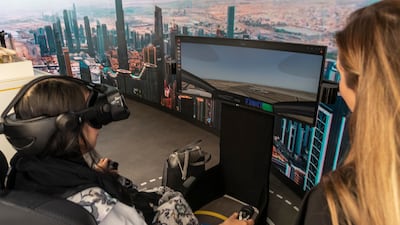
The RTA, Joby Aviation and Skyports give attendees at the government summit a glimpse of what their flying taxis will look like. Antonie Robertson / The National -
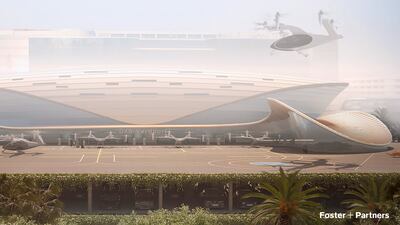
Designs for 'vertiports' — air taxi stations — have been approved by the Dubai government -
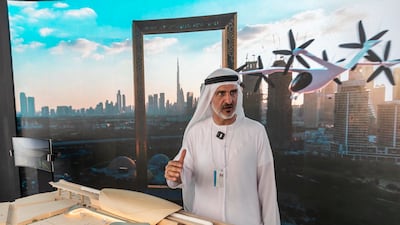
Ahmed Bahrozyan, head of the Public Transport Agency at Dubai's Roads and Transport Authority. Antonie Robertson / The National -
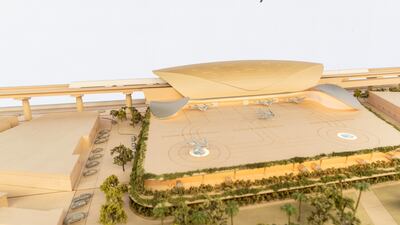
There would be four skyports in Dubai, including this one linked to a Dubai metro station. Antonie Robertson/The National -

Air taxis will begin flying in the emirate within three years -
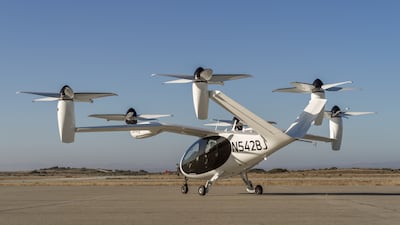
Many companies are already looking to make vertical take-off and landing vehicles a part of daily life -
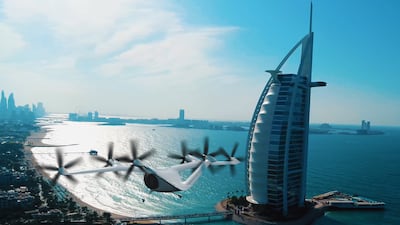
Dubai is set to become the world's first city with a fully developed network of vertiports -
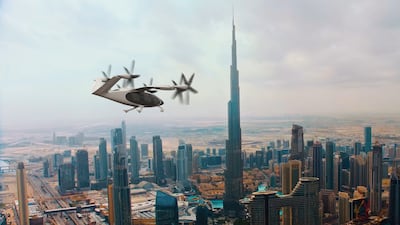
The emirate has been working with Skyports Infrastructure and Joby Aviation to develop the infrastructure -
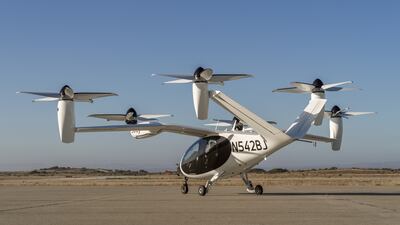
Each aircraft will carry a pilot and up to four passengers, with a range of 241km and a top speed of 300kph



