

The planned merger of Air India and Vistara will create a stronger airline that will be better positioned to compete in the international market, analysts have said.
However, the union will also add to the pressure on domestic carriers that are grappling with severe headwinds.
Over the next few years, Air India is likely to emerge as a global network carrier in terms of size, scale and standards of service, according to Capa India, an aviation consultancy.
“This merger will bring corporate strength to the sector, which will have a positive impact on the entire ecosystem,” Capa says.
On Tuesday, Tata Group, which completed its purchase of Air India earlier this year in a $2.2 billion deal, announced plans to merge the former national carrier with Vistara.
Vistara is an Indian airline owned by Tata in a joint venture with Singapore Airlines.
Tata will hold nearly 75 per cent of the entity, while Singapore Airlines will own the remaining stake. Singapore Airlines is to invest $252 million in Air India under the deal.
The move comes as India’s aviation industry tries to recover from the impact of Covid-19 pandemic on airlines worldwide, while at the same time trying to manage high expenses, including fuel costs — made even more expensive due to a sharp depreciation in the Indian rupee against the US dollar.

Adding to the tough market environment, competition is mounting with the launch of Akasa Air — backed by the late India billionaire stock investor Rakesh Jhunjhunwala — in August this year.
The new entrant describes itself as an ultra-low cost carrier.
Jet Airways — once India’s biggest private airline, which went out of business in April 2019 — under the new ownership, is also planning to return to the skies. Its launch, however, has been delayed.

Last month, the airline’s chief executive Sanjiv Kapoor confirmed on Twitter that one third of its staff had been affected by cost-cutting measures, including a temporary pay reduction. However, he stressed that no employees had been laid off.
India's domestic aviation sector is dominated by leader IndiGo, while other airlines include AirAsia India — which is also co-owned by the Tata group — and SpiceJet.
The growing competition is concerning, analysts say.
“If we take a look at the domestic airlines, almost everyone is in the red,” says Anurag Singh, managing director of Primus Partners, an Indian advisory company based in New Delhi.
Airlines with lower market share are the most vulnerable, he says.
“Not all of them will survive now,” Mr Singh says. “Whether they will merge or whether they die ... is something that we will [have to wait and] see.”
In the airline industry, economies of scale enjoyed by bigger carriers are critical, according to Mr Singh.
“It’s the larger airlines that are able to drive down the cost per passenger mile and hence they have a slight advantage in the market,” he says.
The planned merger of Air India and Vistara, which, Tata has said, is expected to be completed by March 2024, could add to the turbulence in the sector for smaller rivals.

“With both IndiGo and Air India having [the vast majority of] the market share, they have a slightly upper hand,” Mr Singh says.
Once the merger has been through the necessary regulatory clearances and comes into effect, the combined market share of Air India and IndiGo in the domestic sector is projected to reach up to 80 per cent, according to a research note by Capa India.
“The competitive dynamics are moving towards a two-pillar system around the Air India group and IndiGo,” it says.
Air India will also grow internationally with the merger, according to Capa.
“This will redraw market and consumer power in the international arena back to Indian carriers, which has historically been dominated by foreign airlines,” it says.
The move will also put Air India in a stronger position to compete with Gulf carriers, industry experts say.
With the consolidation, Air India will have a fleet of 218 aircraft, and it already has access to coveted landing slots in cities including London and New York.
“The merger will allow the group to benefit from the increase in number of aircraft, routes and support systems while streamlining operating costs, for example, staffing, fuel and maintenance, thereby improving profitability,” says Waseem Pangarkar, senior partner at Mumbai-based MZM Legal.
“India’s aviation market should benefit from the merger, as it will aid the ongoing sectoral consolidation, and improved profitability might encourage cheaper fares, which could force competitors to match rates, effectively capping fares across the sector.”
-
-

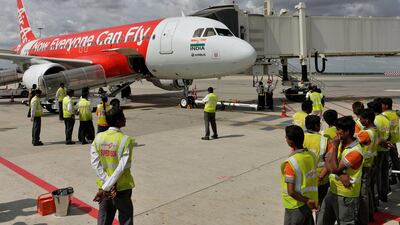
Tony Fernandes, the group chief executive officer of AirAsia. Jasper Juinen/Bloomberg


Tata and Singapore Airlines have agreed to inject fresh capital into Air India over the next couple of years, if needed.
Earlier this year, Bloomberg News reported that Air India is looking to order up to 300 narrow-body planes, in what would be one of the largest orders in commercial history.
All this is part of the turnaround process for the airline, which, over the years, bled taxpayers’ money and faded from its former glory. Air India was started by Tata's founder JRD Tata in 1932 under the name Tata Airlines before it was nationalised about 20 years later.
“Air India is focusing on growing both its network and fleet, revamping its customer proposition, enhancing safety, reliability and on-time performance,” N Chandrasekaran, chairman of Tata Sons, said in a statement while announcing the merger with Vistara.
Singapore Airlines has highlighted that the move gives it the opportunity to participate in one of the world's fastest growing aviation markets, with chief executive Goh Choon Phong saying that its aim is to help “restore [Air India] to its position as a leading airline on the global stage”.
Vistara chief executive Vinod Kannan said that Air India has “a rich legacy that pioneered civil aviation in India”, adding that “there is enormous potential for an airline group with the scale and network of the combined entity".
But even with Air India and Vistara joining forces, the task of transforming the airline will be a tough journey. Profitability has long been a challenge for India's aviation sector.
The industry has proved to be a turbulent operating environment because of fierce rivalry and high costs, with the collapse of Kingfisher Airlines in 2012, and Jet Airways going out of business in 2019 — despite the fact that these were carriers that were popular among consumers, and commanded strong market shares during their peaks.
Vistara and Air India's combined domestic market share stood at 18 per cent in October, according to official data, which leaves them trailing behind budget carrier IndiGo, which captured almost 57 per cent of the market in the month.
India, however, still offers enormous opportunity when it comes to air travel, with passenger numbers only expected to grow as middle-class incomes rise.
“The biggest growth driver of aviation in India is the extremely low penetration,” says Sameer Kaul, managing director and chief executive of TrustPlutus Wealth Managers.
“Current penetration of air passenger traffic stands at just about 2 per cent of the total population. This is a low number as compared to other countries.”
Although the merger could put additional pressure on smaller rivals, clouding their outlook, there could be a silver lining on the horizon, Mr Kaul says.
“Given the current oligopolistic structure of the industry in India, we believe the prospects of the aviation industry could brighten if some weaker players exit[ed] the market,” he says.

