


Cepsa, a Mubadala group company, and Etihad Airways have signed a preliminary agreement to accelerate the decarbonisation of air transport by researching and producing sustainable aviation fuels (SAF).
These fuels will be produced from circular raw materials that do not compete with food resources, such as used cooking oils, non-food animal waste or biodegradable waste from various industries.
They will make it possible to reduce aircraft emissions by up to 80 per cent compared with conventional kerosene, Etihad said in a statement on Wednesday.
The partnership will also work on the development of new energy alternatives, such as renewable hydrogen and the electrification of Etihad’s ground fleets, which include supply vehicles, baggage loading and unloading operations and aircraft assistance.
“Aviation decarbonisation is the biggest challenge facing our industry and the development of commercially viable sustainable aviation fuel is a key requirement to meet the industry sustainability target," said Adam Boukadida, Etihad Aviation Group's chief financial officer.
"Our MoU with Cepsa allows us to tackle the first challenge, building demand for SAF, which in turn, encourages further production and increases availability to eventually lower costs and enable further SAF uptake from the wider industry. It’s a snowball effect, which is essential if we’re to overcome the main challenges standing in the way of a commercially viable solution.”
___________________________
Etihad's new A350 jet - in pictures
-
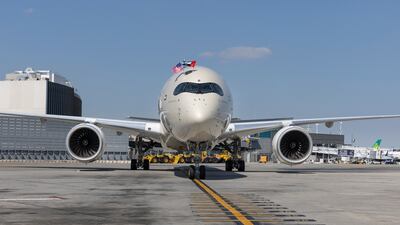
Etihad's Sustainble50 lands in New York, marking the launch of A350 flights from Abu Dhabi to the US. All photos: Etihad Airways -

The Sustainable50 is the first of five A350s destined for the Abu Dhabi airline. -
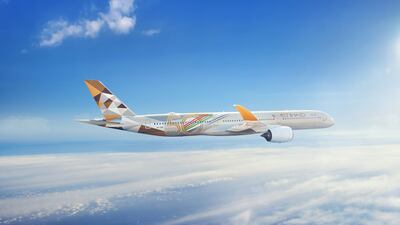
The ultra-efficient jet is part of the airline industry's programme working to reduce carbon emissions and make flying more sustainable. -
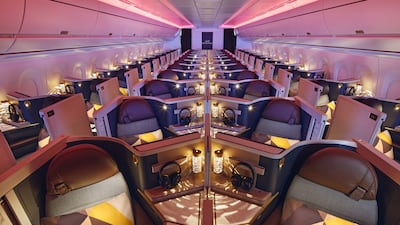
Etihad's new A350-100 has a dynamic LED lighting system with more than 16 million colours. -
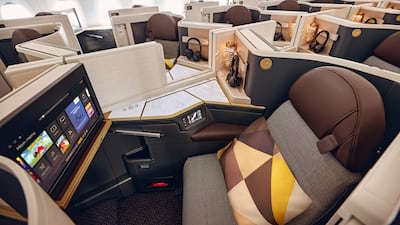
Etihad's new business class cabin on the new A350-1000. -
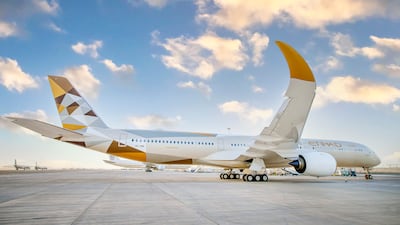
Etihad's A350 has winglet-type devices to reduce aerodynamic drag. -

'The National' was onboard Etihad's inaugural A350-1000 flight to Paris. -
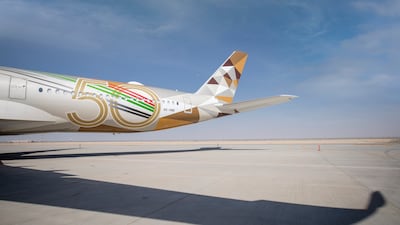
The aircraft has a custom livery that pays tribute to the UAE's golden jubilee and Etihad's commitment to net-zero carbon emissions by 2050.


___________________________
Cepsa is one of the main producers and suppliers of aviation fuels in the Spanish market. It is aiming to become a leader in the clean energy sector and to spearhead the decarbonisation of air transport by producing 2.5 million tonnes of biofuel annually by 2030 and producing 800,000 tonnes of SAF every year.
Etihad's sustainability initiative includes the Greenliner programme, using the airline’s fleet of Boeing 787 Dreamliners as flying test beds, as well as the Sustainable50 A350-1000 launched earlier this year.
The use of SAFs is the main tool to decarbonise the global aviation industry over the next five to 10 years, but production needs to extend beyond high-income countries to meet demand for jet fuel, the World Bank said last week.
Their production must expand outside countries in the Organisation for Economic Co-operation and Development (OECD) to meet growing jet fuel demand and reduce the industry's carbon emissions, the Washington-based lender said in a report.
Meanwhile, Etihad Cargo, the cargo and logistics arm of Etihad Aviation Group, is preparing to launch a new state-of-the-art pharmaceutical cool chain facility in partnership with Etihad Airport Services and Abu Dhabi Airports.
The launch of the expanded, dedicated pharmaceutical hub will double Abu Dhabi Airport’s cool chain storage capacity and enhance the airport’s capabilities for the storage, handling and transportation of cool chain products.
"This joint venture located at Etihad Cargo’s hub at Abu Dhabi International Airport provides the perfect location to link the Middle East to not only Asia and Europe, but also the US and Africa, so life-saving medicines and the latest treatments can be transported seamlessly around the world to those that need them the most," said Martin Drew, senior vice president of global sales and cargo at Etihad Aviation Group.
The additional 3,000-square-metre facility comprises the latest technology and features, including bulk loading docks with levellers, high-speed roll-up shutters, insulation and a real-time temperature monitoring system.

