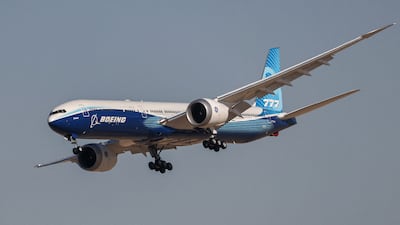
A federal prosecutor said that a former Boeing test pilot lied to regulators about changes to a critical flight-control system on the 737 Max to reduce the cost of pilot training and save the company tens of millions of dollars.
However, a defence lawyer said Boeing engineers kept Mark A. Forkner in the dark about changes to the system, which played a role in two crashes that killed 346 people.
Mr Forkner went on trial in US district court in Fort Worth on four charges of fraud. He is the only person facing criminal charges in the case, which brought widespread condemnation to Boeing.
As the trial started with jury selection and opening statements, Mr Forkner spoke only briefly, when the judge asked for his plea.
“I am not guilty,” he said, standing and turning to face the jury.
Based on court filings by both sides, the trial is likely to feature testimony from technical experts and also internal Boeing communications to shed light on discussions about the Max inside the company. Prosecutors will also attempt to use Mr Forkner's own text messages against him, especially one in which he said, “so I basically lied to the regulators [unknowingly].”
“The defendant had contempt for these regulators, and he mocked these regulators,” prosecutor Scott Armstrong told jurors, adding that as Mr Forkner learnt more about changes to the flight-control system called MCAS, “He doubled down on the lies.”
Defence lawyer David Gerger said his side will show jurors that Boeing engineers withheld information from Mr Forkner. And it wasn't Mr Forkner who set out to save the company money by minimising pilot-training requirements, that objective came down directly from Boeing's board of directors, he said.
The defendant had contempt for these regulators, and he mocked these regulators. He doubled down on the lies
Scott Armstrong,
prosecutor
The opening statements came after the selection of a jury of 11 men and one woman, plus four alternates. An American Airlines pilot was dismissed; so was a man who said he had flown several times on Boeing Maxes.
Judge Reed O'Connor made it clear there was no way to disqualify every potential juror who had read or seen news accounts about the Boeing Max. He quizzed several people whether they could set aside their notions of the issue and focus on evidence that will be presented when testimony starts on Monday.
Until he left in 2018, Mr Forkner was Boeing's chief technical pilot for the Max, which gave him a key role in evaluating the differences between the Max and previous 737s, and deciding how much training pilots needed to fly the new version.
According to the indictment, Mr Forkner knew about changes that made a key flight-control system activate more often than originally planned, but he withheld that knowledge from Federal Aviation Administration regulators. As a result, information about the new flight-control system, MCAS, was deleted from an FAA report and aircraft manuals. Most pilots didn't know about it.
MCAS activated on faulty sensor readings minutes before crashes in 2018 off the coast of Indonesia and 2019 in Ethiopia. It repeatedly pushed the noses of the planes down, and pilots were unable to regain control.
The indictment does not blame the crashes on Mr Forkner, but his lawyers said he would not be facing criminal charges if the crashes had not occurred.
“The investigation could have landed on Boeing, or its senior executives who were once ‘subjects’ but now are witnesses at trial,” the defence lawyers wrote in a filing. Fear of being associated with the crashes caused witnesses “to curry favour with the prosecution”, they said.
The list of witnesses for the prosecution includes three Boeing employees, government experts, and representatives from two big Boeing customers: Southwest Airlines and American Airlines.
The defence could call more than two dozen current or former Boeing employees, including several test pilots and Curtis Ewbank, an engineer who quit after alleging that his bosses rejected safety improvements to the Max on cost grounds. Mr Forkner is listed as a potential witness.
Boeing reached a settlement with federal officials to avoid prosecution for conspiracy. The company paid a $244 million fine as part of the January 2021 agreement.
Separately, families of passengers who died in the crashes are asking another federal judge in Fort Worth to undo the Boeing settlement and consider criminal charges against the company and top executives, who they say put profit above safety.
Family members argue that Chicago-based Boeing rushed a new version of the 737 into production because European rival Airbus was far ahead of it in developing a more fuel-efficient plane. MCAS was added to the Max to accommodate new, larger engines on the 50-year-old 737 design.
“The 737 has had its day,” said Adrian Toole, a British man whose daughter Joanna died in the second Max crash. “The whole thing should have been scrapped, and they should have put a new plane on the drawing board.”

UAE squad
Rohan Mustafa (captain), Ashfaq Ahmed, Ghulam Shabber, Rameez Shahzad, Mohammed Boota, Mohammed Usman, Adnan Mufti, Shaiman Anwar, Ahmed Raza, Imran Haider, Qadeer Ahmed, Mohammed Naveed, Amir Hayat, Zahoor Khan
Bharatanatyam
A ancient classical dance from the southern Indian state of Tamil Nadu. Intricate footwork and expressions are used to denote spiritual stories and ideas.
NO OTHER LAND
Director: Basel Adra, Yuval Abraham, Rachel Szor, Hamdan Ballal
Stars: Basel Adra, Yuval Abraham
Rating: 3.5/5
Mercer, the investment consulting arm of US services company Marsh & McLennan, expects its wealth division to at least double its assets under management (AUM) in the Middle East as wealth in the region continues to grow despite economic headwinds, a company official said.
Mercer Wealth, which globally has $160 billion in AUM, plans to boost its AUM in the region to $2-$3bn in the next 2-3 years from the present $1bn, said Yasir AbuShaban, a Dubai-based principal with Mercer Wealth.
“Within the next two to three years, we are looking at reaching $2 to $3 billion as a conservative estimate and we do see an opportunity to do so,” said Mr AbuShaban.
Mercer does not directly make investments, but allocates clients’ money they have discretion to, to professional asset managers. They also provide advice to clients.
“We have buying power. We can negotiate on their (client’s) behalf with asset managers to provide them lower fees than they otherwise would have to get on their own,” he added.
Mercer Wealth’s clients include sovereign wealth funds, family offices, and insurance companies among others.
From its office in Dubai, Mercer also looks after Africa, India and Turkey, where they also see opportunity for growth.
Wealth creation in Middle East and Africa (MEA) grew 8.5 per cent to $8.1 trillion last year from $7.5tn in 2015, higher than last year’s global average of 6 per cent and the second-highest growth in a region after Asia-Pacific which grew 9.9 per cent, according to consultancy Boston Consulting Group (BCG). In the region, where wealth grew just 1.9 per cent in 2015 compared with 2014, a pickup in oil prices has helped in wealth generation.
BCG is forecasting MEA wealth will rise to $12tn by 2021, growing at an annual average of 8 per cent.
Drivers of wealth generation in the region will be split evenly between new wealth creation and growth of performance of existing assets, according to BCG.
Another general trend in the region is clients’ looking for a comprehensive approach to investing, according to Mr AbuShaban.
“Institutional investors or some of the families are seeing a slowdown in the available capital they have to invest and in that sense they are looking at optimizing the way they manage their portfolios and making sure they are not investing haphazardly and different parts of their investment are working together,” said Mr AbuShaban.
Some clients also have a higher appetite for risk, given the low interest-rate environment that does not provide enough yield for some institutional investors. These clients are keen to invest in illiquid assets, such as private equity and infrastructure.
“What we have seen is a desire for higher returns in what has been a low-return environment specifically in various fixed income or bonds,” he said.
“In this environment, we have seen a de facto increase in the risk that clients are taking in things like illiquid investments, private equity investments, infrastructure and private debt, those kind of investments were higher illiquidity results in incrementally higher returns.”
The Abu Dhabi Investment Authority, one of the largest sovereign wealth funds, said in its 2016 report that has gradually increased its exposure in direct private equity and private credit transactions, mainly in Asian markets and especially in China and India. The authority’s private equity department focused on structured equities owing to “their defensive characteristics.”
About Proto21
Date started: May 2018
Founder: Pir Arkam
Based: Dubai
Sector: Additive manufacturing (aka, 3D printing)
Staff: 18
Funding: Invested, supported and partnered by Joseph Group
SHADOWS%20AND%20LIGHT%3A%20THE%20EXTRAORDINARY%20LIFE%20OF%20JAMES%20MCBEY
%3Cp%3EAuthor%3A%20Alasdair%20Soussi%3C%2Fp%3E%0A%3Cp%3EPages%3A%20300%3C%2Fp%3E%0A%3Cp%3EPublisher%3A%20Scotland%20Street%20Press%3C%2Fp%3E%0A%3Cp%3EAvailable%3A%20December%201%3C%2Fp%3E%0A
COMPANY%20PROFILE%20
%3Cp%3E%3Cstrong%3EName%3A%3C%2Fstrong%3E%20Haltia.ai%0D%3Cbr%3E%3Cstrong%3EStarted%3A%3C%2Fstrong%3E%202023%0D%3Cbr%3E%3Cstrong%3ECo-founders%3A%3C%2Fstrong%3E%20Arto%20Bendiken%20and%20Talal%20Thabet%0D%3Cbr%3E%3Cstrong%3EBased%3A%3C%2Fstrong%3E%20Dubai%2C%20UAE%0D%3Cbr%3E%3Cstrong%3EIndustry%3A%3C%2Fstrong%3E%20AI%0D%3Cbr%3E%3Cstrong%3ENumber%20of%20employees%3A%3C%2Fstrong%3E%2041%0D%3Cbr%3E%3Cstrong%3EFunding%3A%3C%2Fstrong%3E%20About%20%241.7%20million%0D%3Cbr%3E%3Cstrong%3EInvestors%3A%3C%2Fstrong%3E%20Self%2C%20family%20and%20friends%26nbsp%3B%3C%2Fp%3E%0A
The National Archives, Abu Dhabi
Founded over 50 years ago, the National Archives collects valuable historical material relating to the UAE, and is the oldest and richest archive relating to the Arabian Gulf.
Much of the material can be viewed on line at the Arabian Gulf Digital Archive - https://www.agda.ae/en
Expert input
If you had all the money in the world, what’s the one sneaker you would buy or create?
“There are a few shoes that have ‘grail’ status for me. But the one I have always wanted is the Nike x Patta x Parra Air Max 1 - Cherrywood. To get a pair in my size brand new is would cost me between Dh8,000 and Dh 10,000.” Jack Brett
“If I had all the money, I would approach Nike and ask them to do my own Air Force 1, that’s one of my dreams.” Yaseen Benchouche
“There’s nothing out there yet that I’d pay an insane amount for, but I’d love to create my own shoe with Tinker Hatfield and Jordan.” Joshua Cox
“I think I’d buy a defunct footwear brand; I’d like the challenge of reinterpreting a brand’s history and changing options.” Kris Balerite
“I’d stir up a creative collaboration with designers Martin Margiela of the mixed patchwork sneakers, and Yohji Yamamoto.” Hussain Moloobhoy
“If I had all the money in the world, I’d live somewhere where I’d never have to wear shoes again.” Raj Malhotra
SERIE A FIXTURES
Saturday Benevento v Atalanta (2pm), Genoa v Bologna (5pm), AC Milan v Torino (7.45pm)
Sunday Roma v Inter Milan (3.30pm), Udinese v Napoli, Hellas Verona v Crotone, Parma v Lazio (2pm), Fiorentina v Cagliari (9pm), Juventus v Sassuolo (11.45pm)
Monday Spezia v Sampdoria (11.45pm)
WORLD CUP FINAL
England v South Africa
Yokohama International Stadium, Tokyo
Saturday, kick-off 1pm (UAE)
MATCH INFO
Juventus 1 (Dybala 45')
Lazio 3 (Alberto 16', Lulic 73', Cataldi 90 4')
Red card: Rodrigo Bentancur (Juventus)