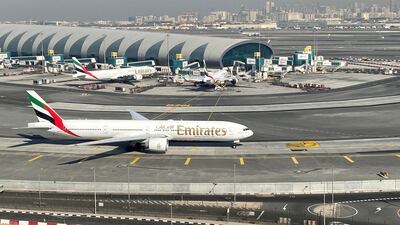
Dubai International Airport in December retained its position as the world's busiest for international passengers, overtaking major hubs such as London Heathrow, as passenger traffic surged during the peak holiday travel period.
The monthly rankings by aviation consultancy OAG were calculated using airlines' international seat capacity and international flight frequency in December 2021, compared with the same month in 2019 before the onset of the Covid-19 pandemic.
Dubai held on to the top spot with 3.54 million seats, about one million more than the next busiest airport, London Heathrow, OAG said in its monthly World's Busiest Airports report.
Amsterdam Schiphol, Paris Charles de Gaulle and Istanbul Airport rounded off the top five busiest international airports, the data showed.
Dubai International's Terminal 3 was expected to serve more than 1.6 million passengers in the second half of December during the month's peak seasonal travel period, operator Dubai Airports said last month.
The emirate's airport operator raised its forecast for annual passenger traffic for 2021 by two million, anticipating that traveller numbers will reach 28.7 million. Dubai Airports is projecting 57 million passengers for 2022.
After the reopening of the final phase of Concourse A at Terminal 3, Dubai International is operating at full capacity after 20 months of reduced operations because of the pandemic. Dubai World Central, the emirate's second airport, will reopen its passenger terminal in May.
Increased passenger traffic has also buoyed airport retail sales. Dubai Duty Free annual sales surged 40 per cent to Dh3.56 billion ($970 million) in 2021.
There were fewer European airports in the top 10 busiest international airports in December, down to six from eight in November. Frankfurt dropped from fifth to the sixth busiest. Dublin dropped out of the top 10, replaced by Miami in 10th place.
Atlanta's Hartsfield-Jackson retained its dominance in December in the world's top 10 busiest global airports ranking that takes into account domestic and international capacity. Dubai does not have a domestic air travel market.
Dubai recorded a capacity increase of 15 per cent in December from the previous month, adding almost 500,000 seats in December, and has moved up to the second busiest global airport in December from seventh position in November, OAG said.
Dallas Fort Worth International Airport, China's Guangzhou Baiyun International Airport and Delhi's Indira Gandhi International Airport rounded off the top five busiest global hubs.
Dubai strengthened its position in December with six of the top 10 busiest international airline routes operating to and from the emirate, OAG said in a separate report.
The busiest international airline route globally for the Dubai airport in December was between Dubai and Riyadh, followed by Cairo-Jeddah and Dubai-London Heathrow.
Dubai-Jeddah, Dubai-Kuwait and Dubai-Karachi were also among the top 10 busiest international airline routes, OAG data showed.

The%20specs%20
%3Cp%3E%3Cstrong%3EEngine%3A%20%3C%2Fstrong%3E2.0-litre%204cyl%20turbo%0D%3Cbr%3E%3Cstrong%3EPower%3A%20%3C%2Fstrong%3E261hp%20at%205%2C500rpm%0D%3Cbr%3E%3Cstrong%3ETorque%3A%20%3C%2Fstrong%3E400Nm%20at%201%2C750-4%2C000rpm%0D%3Cbr%3E%3Cstrong%3ETransmission%3A%20%3C%2Fstrong%3E7-speed%20dual-clutch%20auto%0D%3Cbr%3E%3Cstrong%3EFuel%20consumption%3A%20%3C%2Fstrong%3E10.5L%2F100km%0D%3Cbr%3E%3Cstrong%3EOn%20sale%3A%20%3C%2Fstrong%3ENow%0D%3Cbr%3E%3Cstrong%3EPrice%3A%20%3C%2Fstrong%3EFrom%20Dh129%2C999%20(VX%20Luxury)%3B%20from%20Dh149%2C999%20(VX%20Black%20Gold)%3C%2Fp%3E%0A
COMPANY PROFILE
Initial investment: Undisclosed
Investment stage: Series A
Investors: Core42
Current number of staff: 47
COMPANY PROFILE
Name: Kumulus Water
Started: 2021
Founders: Iheb Triki and Mohamed Ali Abid
Based: Tunisia
Sector: Water technology
Number of staff: 22
Investment raised: $4 million
Mercer, the investment consulting arm of US services company Marsh & McLennan, expects its wealth division to at least double its assets under management (AUM) in the Middle East as wealth in the region continues to grow despite economic headwinds, a company official said.
Mercer Wealth, which globally has $160 billion in AUM, plans to boost its AUM in the region to $2-$3bn in the next 2-3 years from the present $1bn, said Yasir AbuShaban, a Dubai-based principal with Mercer Wealth.
“Within the next two to three years, we are looking at reaching $2 to $3 billion as a conservative estimate and we do see an opportunity to do so,” said Mr AbuShaban.
Mercer does not directly make investments, but allocates clients’ money they have discretion to, to professional asset managers. They also provide advice to clients.
“We have buying power. We can negotiate on their (client’s) behalf with asset managers to provide them lower fees than they otherwise would have to get on their own,” he added.
Mercer Wealth’s clients include sovereign wealth funds, family offices, and insurance companies among others.
From its office in Dubai, Mercer also looks after Africa, India and Turkey, where they also see opportunity for growth.
Wealth creation in Middle East and Africa (MEA) grew 8.5 per cent to $8.1 trillion last year from $7.5tn in 2015, higher than last year’s global average of 6 per cent and the second-highest growth in a region after Asia-Pacific which grew 9.9 per cent, according to consultancy Boston Consulting Group (BCG). In the region, where wealth grew just 1.9 per cent in 2015 compared with 2014, a pickup in oil prices has helped in wealth generation.
BCG is forecasting MEA wealth will rise to $12tn by 2021, growing at an annual average of 8 per cent.
Drivers of wealth generation in the region will be split evenly between new wealth creation and growth of performance of existing assets, according to BCG.
Another general trend in the region is clients’ looking for a comprehensive approach to investing, according to Mr AbuShaban.
“Institutional investors or some of the families are seeing a slowdown in the available capital they have to invest and in that sense they are looking at optimizing the way they manage their portfolios and making sure they are not investing haphazardly and different parts of their investment are working together,” said Mr AbuShaban.
Some clients also have a higher appetite for risk, given the low interest-rate environment that does not provide enough yield for some institutional investors. These clients are keen to invest in illiquid assets, such as private equity and infrastructure.
“What we have seen is a desire for higher returns in what has been a low-return environment specifically in various fixed income or bonds,” he said.
“In this environment, we have seen a de facto increase in the risk that clients are taking in things like illiquid investments, private equity investments, infrastructure and private debt, those kind of investments were higher illiquidity results in incrementally higher returns.”
The Abu Dhabi Investment Authority, one of the largest sovereign wealth funds, said in its 2016 report that has gradually increased its exposure in direct private equity and private credit transactions, mainly in Asian markets and especially in China and India. The authority’s private equity department focused on structured equities owing to “their defensive characteristics.”
Bawaal%20
%3Cp%3E%3Cstrong%3EDirector%3A%3C%2Fstrong%3E%20Nitesh%20Tiwari%3C%2Fp%3E%0A%3Cp%3E%3Cstrong%3EStars%3A%3C%2Fstrong%3E%20Varun%20Dhawan%2C%20Janhvi%20Kapoor%3C%2Fp%3E%0A%3Cp%3E%3Cstrong%3ERating%3A%3C%2Fstrong%3E%201%2F5%3C%2Fp%3E%0A
THE%20STRANGERS'%20CASE
%3Cp%3E%3Cstrong%3EDirector%3C%2Fstrong%3E%3A%20Brandt%20Andersen%3Cbr%3E%3Cstrong%3EStarring%3A%20%3C%2Fstrong%3EOmar%20Sy%2C%20Jason%20Beghe%2C%20Angeliki%20Papoulia%3Cbr%3E%3Cstrong%3ERating%3A%3C%2Fstrong%3E%204%2F5%3C%2Fp%3E%0A
UAE squad to face Ireland
Ahmed Raza (captain), Chirag Suri (vice-captain), Rohan Mustafa, Mohammed Usman, Mohammed Boota, Zahoor Khan, Junaid Siddique, Waheed Ahmad, Zawar Farid, CP Rizwaan, Aryan Lakra, Karthik Meiyappan, Alishan Sharafu, Basil Hameed, Kashif Daud, Adithya Shetty, Vriitya Aravind
