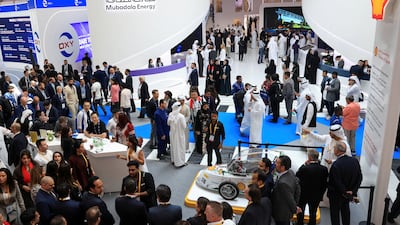

Asia will send its largest delegation yet to Adipec when the energy exhibition opens in Abu Dhabi on Monday.
The exhibition and conference, which runs from November 2 to 5, has drawn a record 2,260 exhibiting companies. More than 181,000 visitors have pre-registered, alongside 40 government ministers and nearly 12,000 conference delegates, organisers said.
"The industry's commitment to Adipec is clear," Christopher Hudson, president of dmg events, which organises the event, told The National.
"We have a record-breaking 2,260 exhibiting companies, with the exhibition venue fully sold out and additional structures built to accommodate demand."
The record turnout comes as governments and energy companies reassess supply chains, export routes and investment priorities after months of disruption to global oil and gas markets.
Asia in focus
Asia, the region most exposed to disruptions in Gulf energy supplies, will send its strongest delegation yet, with 353 companies and six national pavilions from China, India, Japan, Malaysia, Singapore and South Korea.
Exhibitors include China's Sinopec, CNPC and CNOOC, battery maker CATL, Malaysia's Petronas, Thailand's PTTEP, and Japan's Inpex and Mitsubishi Heavy Industries. Executives from India's ONGC Videsh, Inpex and Petronas are among the conference speakers.
Before the war, nearly nine in every 10 barrels of crude and condensate shipped through the Strait of Hormuz went to Asia, according to the US Energy Information Administration. China alone accounted for 38 per cent.
The drop in traffic through the strait in late February triggered what the International Energy Agency described as the largest supply disruption in the history of the oil market, exposing Asia's dependence on Gulf energy and forcing governments to seek alternative supplies.
The fallout has extended beyond crude markets, triggering cooking gas shortages in India and emergency measures across Southeast Asia, while raising questions about how the region can secure reliable energy supplies as demand continues to grow.
For Asian buyers, the gathering offers an opportunity to engage directly with Gulf producers on supply security, infrastructure investment and longer-term partnerships at a time when traditional trade routes remain vulnerable.

"Asia is at the centre of global energy demand growth," Abdulmunim Al Kindy, chairman of Adipec, said this month.
He described the event as a link between that demand and the "supply, capital and technology needed to support it".
The opening day features a ministerial session, "The power shift: strengthening energy security in a changing world", with UAE energy minister Suhail Al Mazrouei, joined by German economy and energy minister Katherina Reiche, Turkish energy minister Alparslan Bayraktar and Egyptian petroleum minister Karim Badawi.
"2026 has demonstrated a fundamental truth: energy security is economic stability," Mr Al Kindy said.
Deals in view
Last year's event tracked 49,131 deals worth $53 billion, according to organisers, who expect a fresh wave of announcements and investment commitments this year.
The gathering comes as Gulf producers seek to strengthen export infrastructure, restore disrupted energy flows and sustain investment in production capacity despite the war.
For Abu Dhabi, the record participation also underscores its role as a meeting point for energy producers, major consuming nations and investors at a time when supply security has become an economic and strategic priority.
"Adipec is where the industry does business, partnerships take shape and decisions become action," Mr Hudson said.

