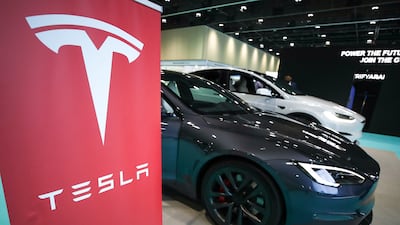
The price of the standard Tesla Model 3 is down by about 17 per cent so far this year. AFP

Why Elon Musk's Tesla continues to cut electric car prices


Alvin R Cabral
  • English
  • Arabic

Tesla revealed another round of price cuts for its vehicles in the US on Thursday, the seventh time this year that the world's biggest electric car maker has made such a move.

A variety of factors have prompted the Texas-based company to slash its prices in recent months.

Which Tesla models had their prices cut?

Tesla slashed the prices of its Model 3 and Model Y vehicles in the US by up to 4.2 per cent, according to its website.

The prices of the base and long-range Model 3 were cut by $1,250 and are now at $38,990 and $45,990, respectively, while the performance model's price was cut by $2,250 to $50,990.

For the Model Y, the prices of its long-range and performance options were reduced by $2,000 to $48,490 and $52,490, respectively. The Model Y's rear-wheel drive variant, which was reintroduced this week, stayed at $43,990.

The standard Model 3's price is now down by about 17 per cent so far this year while the Model Y's long-range option has dropped by more than a quarter.

The Model 3's price drop also comes in the run-up to deliveries of its revamped standard version, which are expected to start in the fourth quarter.

Tesla did not change the prices of its top-end Model S and Model X vehicles.

Why is Tesla cutting prices?

Two main reasons: To boost a slowing electric vehicle market and, crucially for Tesla, to fend off the competition, both from legacy car makers and up-and-coming challengers.

Global car makers are in a race to electrify their vehicles as they press forwards with strategies to drive the next phase of mobility.

This means billions of dollars in investment, apart from the creation of new jobs, pledges to meet sustainability goals and several new vehicle models that are being introduced to make the shift to the next generation of transport faster.

Car makers are promoting their respective strategies. General Motors and Volkswagen are investing billions in EVs in support of climate change goals while Stellantis plans for its European sales to be fully electric by 2030 and Toyota is ramping up production as it tries to catch up with its peers.

Despite the intense competition, industry rivals are also co-operating. Tesla has teamed up with a number of car makers, including Rivian Automotive, Polestar, GM and Ford, to allow drivers to use its charging networks across North America.

Hyundai Motor and Kia also said on Thursday that they had decided to adopt Tesla charging technology in the US.

In China, a crucial battleground for EVs, Tesla cut the price of its Model Y vehicles by $1,900 in August. The company triggered a price war in the world's second-largest economy last year that left smaller EV makers with no choice but to follow suit.

What is Elon Musk's stance on this?

The last time he spoke formally on price cuts, Tesla co-founder Elon Musk said the move was based on market conditions.

During a conference call in July, about two weeks after announcing record second-quarter deliveries, Mr Musk signalled that he would continue to cut Tesla prices during “turbulent times”.

“One day it seems like the world economy is falling apart, next day it's fine. I don't know what the hell is going on … we're in, I would call it, turbulent times,” the world's wealthiest person said at the time.

“I think it makes it does make sense to sacrifice margins in favour of making more vehicles.”

Have the price cuts worked?

To a certain extent, yes – as evidenced by Tesla's record second quarter this year.

The company delivered 466,140 vehicles – an annual surge of 83 per cent – in the three months ended June, beating analyst estimates.

Analysts surveyed by Bloomberg had expected Tesla to ship 448,350 cars in the quarter.

However, the company's deliveries fell by 6.7 per cent on a three-month basis in the third quarter as production was hampered by “planned downtime” at its factories.

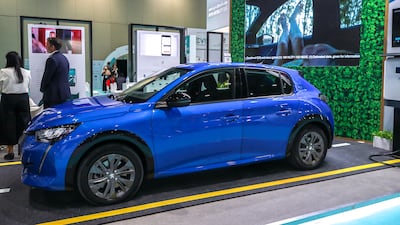
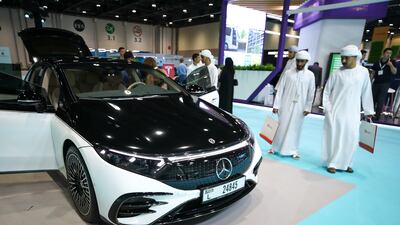
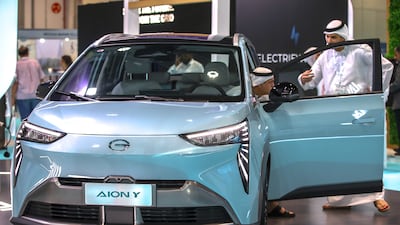
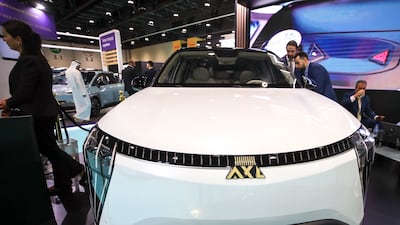
  • A host of vehicles are on display at the Electric Vehicle Innovation Summit
    A host of vehicles are on display at the Electric Vehicle Innovation Summit
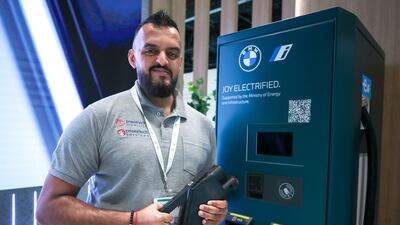
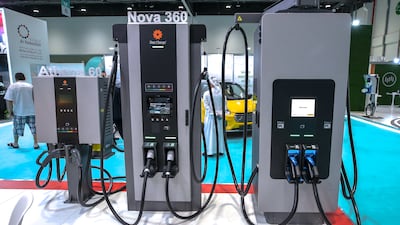
  • Quench, who produce electric vehicle chargers. The UAE plans to increase the number of EV charging stations to 800 by the end of the year.
    Quench, who produce electric vehicle chargers. The UAE plans to increase the number of EV charging stations to 800 by the end of the year.
  • A visitor looks at the interiors of the Zhidou D2s EV on display at the Electric Vehicle Innovation Summit, ADNEC. Victor Besa / The National
    A visitor looks at the interiors of the Zhidou D2s EV on display at the Electric Vehicle Innovation Summit, ADNEC. Victor Besa / The National
  • Visitors look at the interior of a Tesla EV on display. All photos: Victor Besa / The National
    Visitors look at the interior of a Tesla EV on display. All photos: Victor Besa / The National
  • Vinay Premachandran, director of Powertech Mobility, at the Electric Vehicle Innovation Summit
    Vinay Premachandran, director of Powertech Mobility, at the Electric Vehicle Innovation Summit
  • Asiastar, a Chinese bus company, and their EV display at the Electric Vehicle Innovation Summit
    Asiastar, a Chinese bus company, and their EV display at the Electric Vehicle Innovation Summit
  • The demand for EVs in the UAE is on the rise
    The demand for EVs in the UAE is on the rise
  • Key players and influential business leaders have converged at the summit.
    Key players and influential business leaders have converged at the summit.
  • More than 5,000 professionals representing leading companies in the EV industry are in Abu Dhabi
    More than 5,000 professionals representing leading companies in the EV industry are in Abu Dhabi
  • The UAE was ranked eighth in the world when it came to readiness for electric mobility
    The UAE was ranked eighth in the world when it came to readiness for electric mobility
  • The Electric Vehicle Innovation Summit aims to bring industry leaders together.
    The Electric Vehicle Innovation Summit aims to bring industry leaders together.
  • Experts are attending the Electric Vehicle Innovation Summit in Abu Dhabi
    Experts are attending the Electric Vehicle Innovation Summit in Abu Dhabi
  • The demand for EVs in the UAE is on the rise, with a projected annual growth rate of 30 per cent until 2028.
    The demand for EVs in the UAE is on the rise, with a projected annual growth rate of 30 per cent until 2028.

Tesla delivered 435,059 vehicles in the July-September period, missing analyst estimates of 461,640 vehicles.

Manufacturers of electric cars are expected to deliver about 15 million units globally in 2023 as regulations meant to curb emissions tighten, Gartner said in a September report.

The projected figure of 14.98 million would be a surge of about 35 per cent, compared with 2022, which would represent about 97 per cent of all EV shipments this year, with the rest being 218,337 vans, 202,733 buses and 30,162 lorries, the US research firm said.


How The Debt Panel's advice helped readers in 2019

December 11: 'My husband died, so what happens to the Dh240,000 he owes in the UAE?'

JL, a housewife from India, wrote to us about her husband, who died earlier this month. He left behind an outstanding loan of Dh240,000 and she was hoping to pay it off with an insurance policy he had taken out. She also wanted to recover some of her husband’s end-of-service liabilities to help support her and her son.

“I have no words to thank you for helping me out,” she wrote to The Debt Panel after receiving the panellists' comments. “The advice has given me an idea of the present status of the loan and how to take it up further. I will draft a letter and send it to the email ID on the bank’s website along with the death certificate. I hope and pray to find a way out of this.”

November 26:  ‘I owe Dh100,000 because my employer has not paid me for a year’

SL, a financial services employee from India, left the UAE in June after quitting his job because his employer had not paid him since November 2018. He owes Dh103,800 on four debts and was told by the panellists he may be able to use the insolvency law to solve his issue. 

SL thanked the panellists for their efforts. "Indeed, I have some clarity on the consequence of the case and the next steps to take regarding my situation," he says. "Hopefully, I will be able to provide a positive testimony soon."

October 15: 'I lost my job and left the UAE owing Dh71,000. Can I return?'

MS, an energy sector employee from South Africa, left the UAE in August after losing his Dh12,000 job. He was struggling to meet the repayments while securing a new position in the UAE and feared he would be detained if he returned. He has now secured a new job and will return to the Emirates this month.

“The insolvency law is indeed a relief to hear,” he says. "I will not apply for insolvency at this stage. I have been able to pay something towards my loan and credit card. As it stands, I only have a one-month deficit, which I will be able to recover by the end of December." 

'Midnights'
%3Cp%3E%3Cstrong%3EArtist%3A%3C%2Fstrong%3E%20Taylor%20Swift%26nbsp%3B%3C%2Fp%3E%0A%3Cp%3E%3Cstrong%3ELabel%3A%3C%2Fstrong%3E%20Republic%20Records%3C%2Fp%3E%0A%3Cp%3E%3Cstrong%3ERating%3A%3C%2Fstrong%3E%204%2F5%3C%2Fp%3E%0A
AL%20BOOM
%3Cp%20style%3D%22text-align%3Ajustify%3B%22%3E%26nbsp%3B%26nbsp%3B%26nbsp%3BDirector%3AAssad%20Al%20Waslati%26nbsp%3B%3C%2Fp%3E%0A%3Cp%20style%3D%22text-align%3Ajustify%3B%22%3E%0DStarring%3A%20Omar%20Al%20Mulla%2C%20Badr%20Hakami%20and%20Rehab%20Al%20Attar%0D%3Cbr%3E%0D%3Cbr%3EStreaming%20on%3A%20ADtv%0D%3Cbr%3E%0D%3Cbr%3ERating%3A%203.5%2F5%0D%3Cbr%3E%0D%3Cbr%3E%3C%2Fp%3E%0A

First Person
Richard Flanagan
Chatto & Windus 

Ten tax points to be aware of in 2026

1. Domestic VAT refund amendments: request your refund within five years

If a business does not apply for the refund on time, they lose their credit.

2. E-invoicing in the UAE

Businesses should continue preparing for the implementation of e-invoicing in the UAE, with 2026 a preparation and transition period ahead of phased mandatory adoption. 

3. More tax audits

Tax authorities are increasingly using data already available across multiple filings to identify audit risks. 

4. More beneficial VAT and excise tax penalty regime

Tax disputes are expected to become more frequent and more structured, with clearer administrative objection and appeal processes. The UAE has adopted a new penalty regime for VAT and excise disputes, which now mirrors the penalty regime for corporate tax.

5. Greater emphasis on statutory audit

There is a greater need for the accuracy of financial statements. The International Financial Reporting Standards standards need to be strictly adhered to and, as a result, the quality of the audits will need to increase.

6. Further transfer pricing enforcement

Transfer pricing enforcement, which refers to the practice of establishing prices for internal transactions between related entities, is expected to broaden in scope. The UAE will shortly open the possibility to negotiate advance pricing agreements, or essentially rulings for transfer pricing purposes. 

7. Limited time periods for audits

Recent amendments also introduce a default five-year limitation period for tax audits and assessments, subject to specific statutory exceptions. While the standard audit and assessment period is five years, this may be extended to up to 15 years in cases involving fraud or tax evasion. 

8. Pillar 2 implementation 

Many multinational groups will begin to feel the practical effect of the Domestic Minimum Top-Up Tax (DMTT), the UAE's implementation of the OECD’s global minimum tax under Pillar 2. While the rules apply for financial years starting on or after January 1, 2025, it is 2026 that marks the transition to an operational phase.

9. Reduced compliance obligations for imported goods and services

Businesses that apply the reverse-charge mechanism for VAT purposes in the UAE may benefit from reduced compliance obligations. 

10. Substance and CbC reporting focus

Tax authorities are expected to continue strengthening the enforcement of economic substance and Country-by-Country (CbC) reporting frameworks. In the UAE, these regimes are increasingly being used as risk-assessment tools, providing tax authorities with a comprehensive view of multinational groups’ global footprints and enabling them to assess whether profits are aligned with real economic activity. 

Contributed by Thomas Vanhee and Hend Rashwan, Aurifer

Updated: October 06, 2023, 9:20 AM