World Economic Forum president Borge Brende and forum managing director Saadia Zahidi ahead of the annual meeting, to be held in the Swiss town of Davos from January 16 to 20. EPA

Davos 2023: Action on recession fears to top annual meeting agenda


Mustafa Alrawi
  • English
  • Arabic

Officials and economists in Davos will assess the severity of an expected global economic recession and chart ways to mitigate its impact when they meet this week during the World Economic Forum Annual Meeting in the Swiss mountain resort.

Among those attending will be Kristalina Georgieva, International Monetary Fund's managing director, Christine Lagarde, president of the European Central Bank, Bruno Le Maire, France’s Minister of Economy and economists Larry Summers and Raghuram Rajan.

Issues including soaring food and energy prices around the world and the outlook for Europe's economy will be front and centre.

“We're actually going to kick off the week on Monday with our chief economists outlook that lays out the agenda for 2023 ... the risk of recession, what may happen in terms of inflation, in terms of interest rates, and where some of the greatest opportunities lie in terms of various geographies in the global economy,” Saadia Zahidi, managing director and head of social and economic agendas at the forum, said last week.

“We will be looking also at that recession risk in the shorter term. But I think it still lies within the hands of the policymakers and leaders that will be gathered next week to put in place the right kind of growth agenda and ensure there's as little damage as possible, and a much faster recovery.”

The global economy is set for a sharp downturn this year, according to the latest projection from the World Bank.

Growth is projected to decline to 1.7 per cent in 2023, from the 3 per cent forecast six months ago, the Washington-based lender said in its latest Global Economic Prospects report released on Tuesday.

This is the third weakest pace of growth in about three decades, reflecting global monetary tightening, the effects of the Ukraine-Russia war, high inflation levels, worsening financial conditions and weaker growth in the US, China and the euro area.

"Weakness in growth and business investment will compound the already devastating reversals in education, health, poverty and infrastructure and the increasing demands from climate change," World Bank president David Malpass said last week.

The bank called for increased support for low-income countries to deal with food and energy shocks, people displaced by conflicts, and a growing risk of debt crises.

The International Monetary Fund’s latest outlook is also expected later this month.

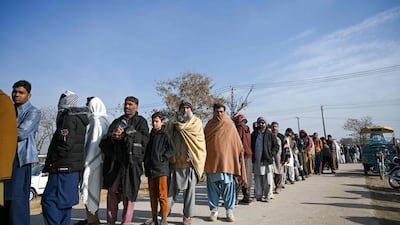
  • People queue to buy wheat flour at government-controlled prices in Islamabad. Pakistan's economy has been hit hard by a political crisis, as well as devastating floods and the global energy crisis, with the rupee plummeting and inflation at decades-high levels. AFP
    People queue to buy wheat flour at government-controlled prices in Islamabad. Pakistan's economy has been hit hard by a political crisis, as well as devastating floods and the global energy crisis, with the rupee plummeting and inflation at decades-high levels. AFP
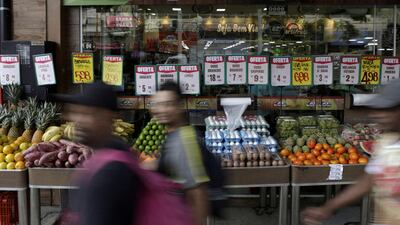
  • A market in Rio de Janeiro. Brazil's inflation ended 2022 with a sharp slowdown from double-digit peaks seen throughout the year. Reuters
    A market in Rio de Janeiro. Brazil's inflation ended 2022 with a sharp slowdown from double-digit peaks seen throughout the year. Reuters
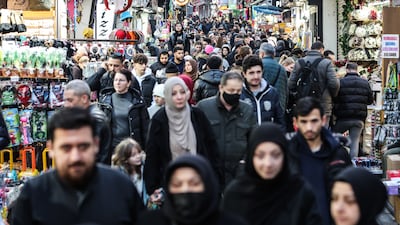
  • A market in Istanbul. Turkey's inflation at the end of 2022 stood at 64. 27 per cent, the country's Statistical Institute said, while the independent group of inflation researchers ENAG calculated it at 137. 55 per cent. EPA
    A market in Istanbul. Turkey's inflation at the end of 2022 stood at 64. 27 per cent, the country's Statistical Institute said, while the independent group of inflation researchers ENAG calculated it at 137. 55 per cent. EPA
  • A Walmart in New Jersey. According to a poll, US Republicans and Democrats have distinct views of what’s most important for the government to address amid high inflation. More Republicans name gas and food prices, energy and immigration, while Democrats focus on health care, climate change and poverty. AP
    A Walmart in New Jersey. According to a poll, US Republicans and Democrats have distinct views of what’s most important for the government to address amid high inflation. More Republicans name gas and food prices, energy and immigration, while Democrats focus on health care, climate change and poverty. AP
  • A used car sales lot in California. US Federal Reserve officials have indicated it’s possibly too early to declare victory over inflation. AFP
    A used car sales lot in California. US Federal Reserve officials have indicated it’s possibly too early to declare victory over inflation. AFP
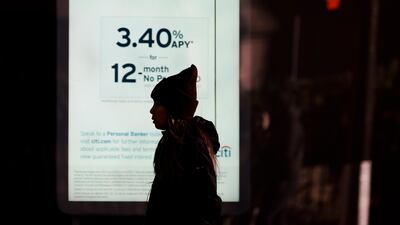
  • A person walks by a sign showing interest rates at a bank in New York. EPA
    A person walks by a sign showing interest rates at a bank in New York. EPA
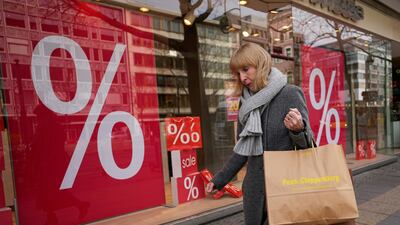
  • A woman walks with purchases past a store in Berlin. In December, consumer price growth across the Euro zone slowed to 9.2 per cent from 10.1 per cent a month earlier, Eurostat data showed last week. AP
    A woman walks with purchases past a store in Berlin. In December, consumer price growth across the Euro zone slowed to 9.2 per cent from 10.1 per cent a month earlier, Eurostat data showed last week. AP
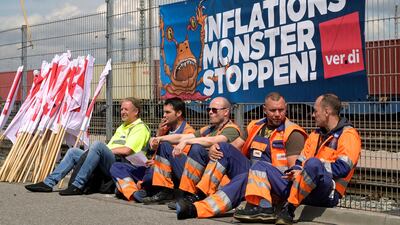
  • Workers sit in front of a banner reading "Stop the Inflation Monster" at the Burchardkai Container Terminal as they go on strike for higher wages at the harbour in Hamburg, Germany. Reuters
    Workers sit in front of a banner reading "Stop the Inflation Monster" at the Burchardkai Container Terminal as they go on strike for higher wages at the harbour in Hamburg, Germany. Reuters
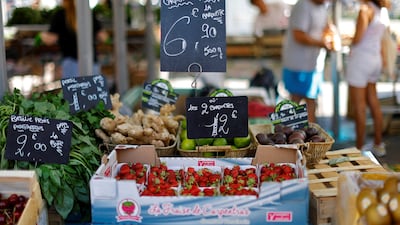
  • Price tags at a market in Nice, France. Reuters
    Price tags at a market in Nice, France. Reuters
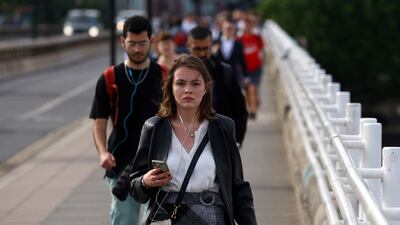
  • Commuters cross Waterloo Bridge in London. The British Retail Consortium said spending in store chains rose by 6.9 per cent in annual terms in December, but this was a long way off consumer price inflation, which hit 10.7 per cent in November. Reuters
    Commuters cross Waterloo Bridge in London. The British Retail Consortium said spending in store chains rose by 6.9 per cent in annual terms in December, but this was a long way off consumer price inflation, which hit 10.7 per cent in November. Reuters
  • Jobseekers in Johannesburg. South Africa’s governing party wants the central bank’s mandate broadened to shore up the economy and promote employment in addition to its existing task of tackling inflation. Reuters
    Jobseekers in Johannesburg. South Africa’s governing party wants the central bank’s mandate broadened to shore up the economy and promote employment in addition to its existing task of tackling inflation. Reuters
  • Social grant recipients stand in a queue outside a post office, as joblessness takes its toll in Meadowlands, South Africa. Reuters
    Social grant recipients stand in a queue outside a post office, as joblessness takes its toll in Meadowlands, South Africa. Reuters

In the US, the world's biggest economy, problems are also plaguing the technology sector — for years a fast-growth industry — with job losses under way at the biggest companies, including Amazon and Facebook parent Meta.

“There's a complex picture here ... we have to sort of embrace the full understanding of that complexity. On the one hand ... we're seeing some major headlines around certain parts of the tech sector. But much of what we'll be trying to look at next week is the emerging opportunity to deploy technology across multiple sectors, including agriculture, including education, including energy," said Ms Zahidi.

"And that actually means technology is much more ubiquitous across multiple sectors. And there's a huge opportunity there for further job creation, for further growth, especially in emerging markets, and a much more positive outlook."

To ensure this, she said, there will need to be investment to support sustainable, inclusive and resilient economic growth.

"A group of leaders from the public and the private sector will be coming together to address exactly that question, designing a framework and starting to align around that new agenda. That also includes thinking more about the markets of tomorrow, the specific areas of investment, everything from power storage, to education technologies that can create the right, resilient, sustainable and inclusive growth of the future,” said Ms Zahidi.

There will also need to be a focus on people, including on education and developing skills, otherwise "none of these opportunities can really play out, and nor will we have the kind of societal resilience that is needed to be prepared for future inevitable shocks".

The forum's 'Reskilling Revolution' initiative aims to give one billion people access to better education, skills and economic opportunity by 2030.

“We'll be announcing that we have actually crossed the milestone that we had set for ourselves three years ago, which was to reach a billion people by 2030, we should at this stage be 30 per cent of the target. And we will actually go well beyond that,” she said.

However, the picture for jobs remains uneven around the world.

“We're looking at very tight labour markets in much of the Western world. But in many emerging and developing economies, there needs to be a much greater focus on work quality, on living wages, and on putting in place job creating investments, especially for youth," Ms Zahidi said.


The more serious side of specialty coffee

While the taste of beans and freshness of roast is paramount to the specialty coffee scene, so is sustainability and workers’ rights.

The bulk of genuine specialty coffee companies aim to improve on these elements in every stage of production via direct relationships with farmers. For instance, Mokha 1450 on Al Wasl Road strives to work predominantly with women-owned and -operated coffee organisations, including female farmers in the Sabree mountains of Yemen.

Because, as the boutique’s owner, Garfield Kerr, points out: “women represent over 90 per cent of the coffee value chain, but are woefully underrepresented in less than 10 per cent of ownership and management throughout the global coffee industry.”

One of the UAE’s largest suppliers of green (meaning not-yet-roasted) beans, Raw Coffee, is a founding member of the Partnership of Gender Equity, which aims to empower female coffee farmers and harvesters.

Also, globally, many companies have found the perfect way to recycle old coffee grounds: they create the perfect fertile soil in which to grow mushrooms. 

Real estate tokenisation project

Dubai launched the pilot phase of its real estate tokenisation project last month.

The initiative focuses on converting real estate assets into digital tokens recorded on blockchain technology and helps in streamlining the process of buying, selling and investing, the Dubai Land Department said.

Dubai’s real estate tokenisation market is projected to reach Dh60 billion ($16.33 billion) by 2033, representing 7 per cent of the emirate’s total property transactions, according to the DLD.

How much sugar is in chocolate Easter eggs?
  • The 169g Crunchie egg has 15.9g of sugar per 25g serving, working out at around 107g of sugar per egg
  • The 190g Maltesers Teasers egg contains 58g of sugar per 100g for the egg and 19.6g of sugar in each of the two Teasers bars that come with it
  • The 188g Smarties egg has 113g of sugar per egg and 22.8g in the tube of Smarties it contains
  • The Milky Bar white chocolate Egg Hunt Pack contains eight eggs at 7.7g of sugar per egg
  • The Cadbury Creme Egg contains 26g of sugar per 40g egg
COMPANY%20PROFILE
%3Cp%3E%3Cstrong%3ECompany%20name%3A%3C%2Fstrong%3E%20Revibe%20%0D%3Cbr%3E%3Cstrong%3EStarted%3A%3C%2Fstrong%3E%202022%0D%3Cbr%3E%3Cstrong%3EFounders%3A%3C%2Fstrong%3E%20Hamza%20Iraqui%20and%20Abdessamad%20Ben%20Zakour%20%0D%3Cbr%3E%3Cstrong%3EBased%3A%3C%2Fstrong%3E%20UAE%20%0D%3Cbr%3E%3Cstrong%3EIndustry%3A%3C%2Fstrong%3E%20Refurbished%20electronics%20%0D%3Cbr%3E%3Cstrong%3EFunds%20raised%20so%20far%3A%3C%2Fstrong%3E%20%2410m%20%0D%3Cbr%3E%3Cstrong%3EInvestors%3A%20%3C%2Fstrong%3EFlat6Labs%2C%20Resonance%20and%20various%20others%0D%3C%2Fp%3E%0A

Mercer, the investment consulting arm of US services company Marsh & McLennan, expects its wealth division to at least double its assets under management (AUM) in the Middle East as wealth in the region continues to grow despite economic headwinds, a company official said.

Mercer Wealth, which globally has $160 billion in AUM, plans to boost its AUM in the region to $2-$3bn in the next 2-3 years from the present $1bn, said Yasir AbuShaban, a Dubai-based principal with Mercer Wealth.

Within the next two to three years, we are looking at reaching $2 to $3 billion as a conservative estimate and we do see an opportunity to do so,” said Mr AbuShaban.

Mercer does not directly make investments, but allocates clients’ money they have discretion to, to professional asset managers. They also provide advice to clients.

“We have buying power. We can negotiate on their (client’s) behalf with asset managers to provide them lower fees than they otherwise would have to get on their own,” he added.

Mercer Wealth’s clients include sovereign wealth funds, family offices, and insurance companies among others.

From its office in Dubai, Mercer also looks after Africa, India and Turkey, where they also see opportunity for growth.

Wealth creation in Middle East and Africa (MEA) grew 8.5 per cent to $8.1 trillion last year from $7.5tn in 2015, higher than last year’s global average of 6 per cent and the second-highest growth in a region after Asia-Pacific which grew 9.9 per cent, according to consultancy Boston Consulting Group (BCG). In the region, where wealth grew just 1.9 per cent in 2015 compared with 2014, a pickup in oil prices has helped in wealth generation.

BCG is forecasting MEA wealth will rise to $12tn by 2021, growing at an annual average of 8 per cent.

Drivers of wealth generation in the region will be split evenly between new wealth creation and growth of performance of existing assets, according to BCG.

Another general trend in the region is clients’ looking for a comprehensive approach to investing, according to Mr AbuShaban.

“Institutional investors or some of the families are seeing a slowdown in the available capital they have to invest and in that sense they are looking at optimizing the way they manage their portfolios and making sure they are not investing haphazardly and different parts of their investment are working together,” said Mr AbuShaban.

Some clients also have a higher appetite for risk, given the low interest-rate environment that does not provide enough yield for some institutional investors. These clients are keen to invest in illiquid assets, such as private equity and infrastructure.

“What we have seen is a desire for higher returns in what has been a low-return environment specifically in various fixed income or bonds,” he said.

“In this environment, we have seen a de facto increase in the risk that clients are taking in things like illiquid investments, private equity investments, infrastructure and private debt, those kind of investments were higher illiquidity results in incrementally higher returns.”

The Abu Dhabi Investment Authority, one of the largest sovereign wealth funds, said in its 2016 report that has gradually increased its exposure in direct private equity and private credit transactions, mainly in Asian markets and especially in China and India. The authority’s private equity department focused on structured equities owing to “their defensive characteristics.”

Updated: January 16, 2023, 6:41 AM