

High gold prices and economic uncertainty have led to a surge in recycling of the precious metal in India, one of the world's largest consumers of bullion, industry sources say.
Eleven per cent of India's gold supply over the past five years has come from “old gold”, with consumers selling off or exchanging their jewellery for recycling, according to the World Gold Council.
“The gold recycling trend has grown in the past few years because, looking at the pricing of gold, it is increasing,” says Pramod Godha, a partner at Shantivijay Jewels, which has its store in Delhi and a factory in Mumbai.
Gold prices have risen more than 45 per cent over the past five years to about $1,827 an ounce. The metal is considered a safe haven and a hedge against inflation.
“When the gold price jumps, people tend to sell their gold holdings either to gain from the price rise or to avoid spending on new gold jewellery,” the World Gold Council said in its report.
India's economy took a beating during the coronavirus pandemic, as the country slipped into a historic recession in 2020 because of strict lockdown curbs. This economic environment also deterred many consumers from making gold purchases and prompted them to generate value from the holdings they had, jewellers say.
Gold recycling involves melting the metal and refining it into its purest form. This can be done using jewellery — which the vast majority of recycled gold comes from — and scrap gold.
-
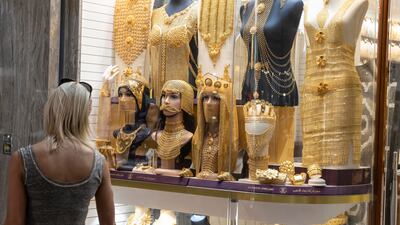
The Gold Souk in Deira on the banks of the Dubai Creek. An agreement between the UAE and India is expected to boost trade in gold, benefitting jewellers and shoppers. All photos: Antonie Robertson / The National -

Chandu Siroya, managing director of Siroya Jewellers, says the UAE India trade pact is a win-win for both countries. -

Import duties have been removed for jewellery exported to the UAE from India. -

India has agreed to a one per cent concession on duty on gold imports from the UAE for up to 120 tonnes of gold in the first year, rising to 200 tonnes in five years. -
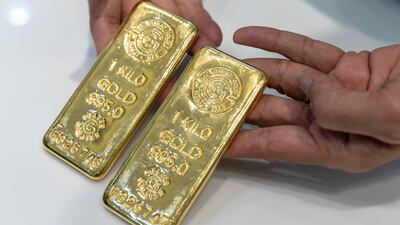
The UAE accounts for 80 per cent of India’s plain gold jewellery exports and 20 per cent of studded jewellery exports. -
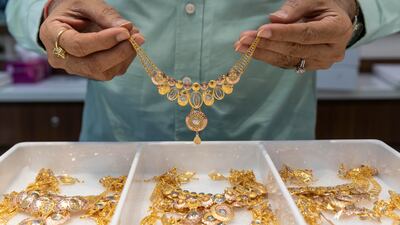
Some of the jewellery from India, Italy and Turkey on display at Siroya Jewellers in Dubai. -
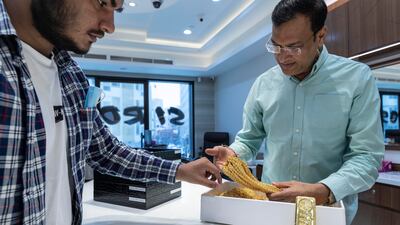
A jeweller examines a necklace at Siroya Jewellers in Dubai. -
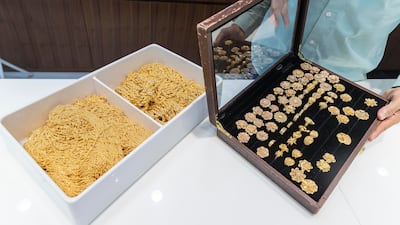
Dubai is set to become a major gateway for Indian jewellery to the world, because of the economic agreement. -
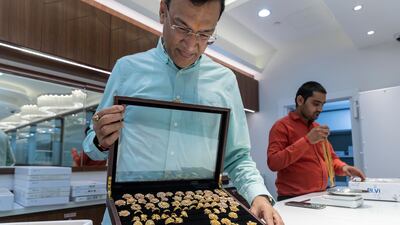
The family-owned Siroya Jewellers is one of Dubai’s biggest wholesalers, supplying jewellery to more than 30 countries. -
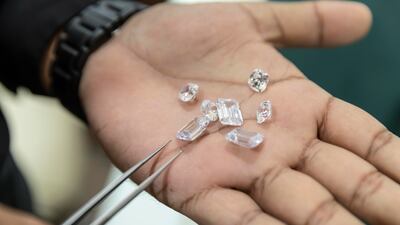
Gem and jewellery exports to the UAE declined to US$1.18 billion in 2020-2021 during the Covid-19 pandemic. -
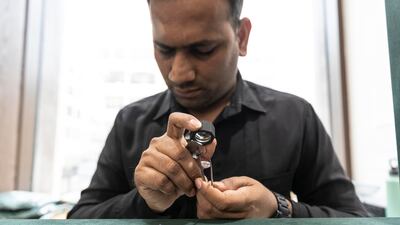
With the duty waiver, India's Gem and Jewellery Export Promotion Council has said exports of gold from India to the UAE are expected to grow to US$10 billion in 2023.


India ranks fourth globally in terms of the quantity of gold recycling, with the country's refining capacity of the precious metal increasing by 1,500 tonnes, or 500 per cent, between 2013 and 2021, the World Gold Council said in a report this month.
“India’s demand for gold shows no sign of abating, and while demand outweighs supply, recycling will continue to be key,” authors of the report wrote.
The country's gold consumption had a resurgence last year, having been hit hard by the pandemic in 2020.
India's gold demand jumped to 797.3 tonnes in 2021, up from 446.4 tonnes the previous year, according to World Gold Council data. The majority of this consumption is in the form of jewellery, which accounted for 610.9 tonnes in 2021, while investments accounted for the rest.
Gold plays an important role in India culturally. It is an integral part of weddings and several religious festivals.
Many families in India also buy gold to store wealth outside the financial system. This has become widespread since many people in the country, especially in rural areas, also do not have bank accounts or access to lenders.
“Gold has always been an essential part of the south Asian culture, so without doubt it will always be in demand,” says Shikha Singhal, the founder of Neelima Jewels, based in Udaipur in Rajasthan.
“India is a country that loves gold both as investment and luxury. For centuries people have worn gold in India excessively.”
This love for gold has long irked the Indian government, however, because imports of gold widen the country's trade deficit on one hand, and on the other, they are idle investments and do not contribute to the economy.
India has taken steps in recent years to try to reduce gold imports and bring the precious metal into the formal financial system, through rises on import duties and a sovereign gold bonds scheme.
“If the gold recycling share rises, it will benefit both the bullion sector and the Indian economy by lowering the current account deficit,” says Renisha Chainani, head of research at Augmont, which offers services from refining to retailing of gold.
-

This passenger who travelled on a Dubai to Delhi flight was found to have smuggled melted gold taped to his bald head. He wore a wig to conceal it. Photo: Delhi Customs -
Customs officers at Delhi airport on April 17 seized 15 gold bars concealed in the socks of a passenger who disembarked a flight from Dubai. The bars weighed 1,747 grams and would be worth more than $100,000, meaning the passenger was avoiding paying thousands of dollars in import tax. Photo: Delhi Customs -
Delhi Customs said a passenger who came off a flight from Dubai was found to have melted down this 443 gram bar of gold into a paste and wrapped it around his legs. Photo: Delhi Customs -
A huge gold chain was confiscated from a passenger who was wearing more than the permitted gold allowance. He was further found to have tried to smuggle several bars through Delhi airport to avoid paying thousands of dollars in import duty. Photo: Delhi Customs -
A customs officer tears open a hidden compartment of a suitcase to find a large amount of undeclared currency in Saudi riyals and UAE dirhams. The passenger, who landed in Delhi on a flight from Dubai, was detained. Photo: Delhi Customs

Looking ahead, the precious metal is not expected to lose its allure anytime soon.
“Gold is and will always be a precious metal. We feel its value will only go up because of the increase in mining costs and the scarcity of it,” Ms Singhal says.
With domestic gold mining falling far short of India's enormous appetite for the metal, the country is forced to depend on costly imports, and recycling of gold presents an attractive alternative to this.
The recycling trend in India is being driven by gold price movements, future price expectations and the economic backdrop, the World Gold Council's report says.
The depreciating Indian rupee, which hit record lows this month, has pushed the gold rate even higher in India because the imported metal is bought in US dollars.
The pandemic has also prompted a change in consumer behaviour in India, with people more inclined to spend their disposable income on experiences rather than material possessions, such as jewellery, Ms Singhal says.
“This has definitely changed the jewellery market as sales has been affected, now people want to spend more on an event than just buying jewellery like until the late 2000s,” she says.
“So recycling gold has become a very common thing now as people are being smart about their investments.”
According to the World Gold Council, in the short term, a 1 per cent increase in the price of gold pushes recycling up by 0.6 per cent.
But positive gross domestic product growth in the same year pushes recycling down by 0.3 per cent, its analysis reveals.
Mr Godha says gold recycling generates attractive revenue for his business because they levy charges on jewellery and reap a profit when they recycle gold into other products.
His company also goes to great lengths to recover even the finest particles of the precious metal, he says.
“We have a factory and we try to recover whatever is possible at the end of the month,” Mr Godha says.
From collecting particles when the workers wash their hands, to sweeping the floors, even tiny gold specks are gathered.
“Even when the filers are setting and polishing, we give them clothes that we wash and recover whatever minute particles are stuck in their clothes.”
Dishi Somani, the founder of Delhi-based Dishis Designer Jewellery, says recycling gold “is more cost-effective and affordable”, especially when it comes to jewellery.
She and many other jewellers also welcome the fact that it is much more environmentally-friendly than mining supplies of gold.
Demand for recycling is also being driven by “shifting fashion trends, as younger generation buyers are replacing their jewellery items more regularly”, Ms Chainani says.
“Recycling is a key part of the gold supply chain,” she says.
The Indian government is also taking steps to boost and standardise gold recycling.
Measures introduced under its revamped Gold Monetisation Scheme include sourcing guidelines and enabling jewellers to act as collection and purity testing centres, along with custom duty cuts on gold doré — which is unrefined — compared with refined bullion.
“India has the potential to emerge as a competitive refining hub if the next phase of bullion market reforms promotes responsible sourcing, exports of bars and consistent supply of doré or scrap,” says Somasundaram PR, regional chief executive, India, at the World Gold Council.
But the domestic recycling market is still unorganised, he says.
Gold recycling also faces headwinds, as improving economic growth will reduce distress sales.
“Higher incomes following stronger economic growth will reduce outright selling,” Mr Somasundaram says.
Another challenge preventing the recycling sector from shining to its full potential is that “refineries are reluctant to buy direct from jewellers who deal largely in cash as source verification is impossible”, the World Gold Council's report shows.
But if such issues are resolved, the sector has the potential to create more jobs and help meet the country's demand for gold, industry experts agree.

