


Inter-city space travel could take away market share from long-haul business jet flights in the future, as it gradually becomes more mainstream and cheaper, according to a report.
Space travel is picking up momentum amid better safety measures and lower launch costs, with recent flights taken by “tourists” such as billionaires Richard Branson and Jeff Bezos, the founder of Virgin and Amazon, respectively.
As commercial passengers become more comfortable with the prospect of space travel, cheaper inter-city, long-haul passenger travel on “Domestic Earth” routes will be enabled, the report by Citi said.
“The high ticket price would mean it is unlikely to take market share from long-haul wide-body flights — but it could take market share from long-haul business jet flights,” it said.
The report estimates that it would cost about $100,000 to $200,000 for a long-haul, inter-city rocket trip.
“With an occupancy of one to six passengers, this gives a range of $20,000 to $200,000 per ticket, with an average ticket price of [roughly] $100,000,” the report said.
“This compares to a Gulfstream G650, which costs [about] $5,000 per hour, or $30,000 on a nearly six-hour trip, and is typically flown with only one to two passengers.
“This makes inter-city rocket travel a viable premium alternative to long-haul business jet travel for ultra-high net worth individuals, with a much quicker travel time.”
-
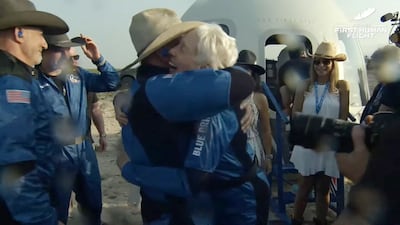
Billionaire businessman Jeff Bezos embraces veteran aviator Wally Funk after Blue Origin’s reusable New Shepard craft capsule returned from space on Tuesday, July 20, 2021. -

Jeff Bezos, Funk and and gap-year student Oliver Daemen, 18, disembark after Blue Origin’s reusable New Shepard capsule returned from space. -
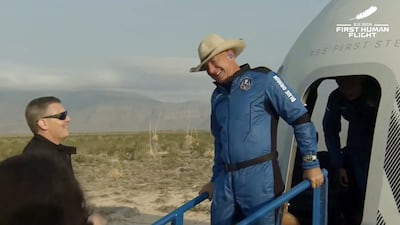
Jeff Bezos disembarks after the flight. -

New Shepard touches down on Earth. -

New Shepard approaches the ground. -
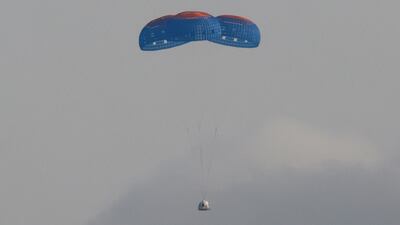
The capsule carrying Jeff Bezos and three crew members returns to Texas by parachute. -
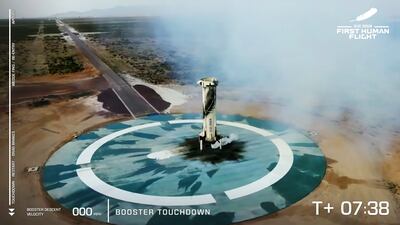
The booster rocket returns to the launch pad. -
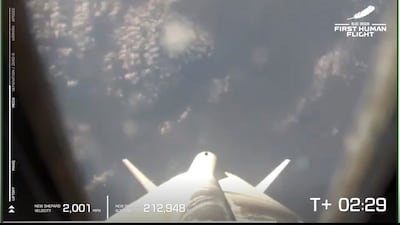
The rocket lifts off. -
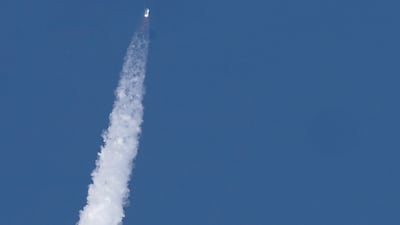
The launch viewed from far. -
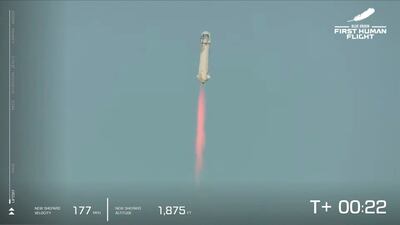
The rocket is launched on the world’s first unpiloted suborbital flight. -
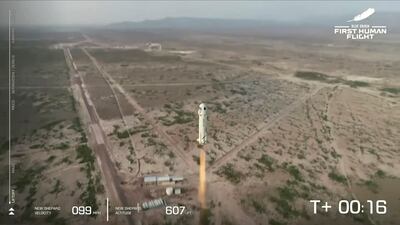
It took off from Blue Origin’s launch site, near Van Horn in western Texas, US. -
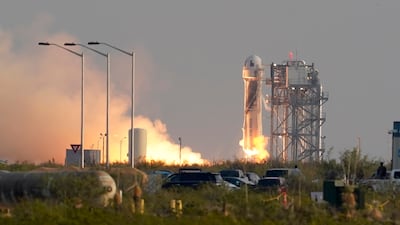
Blue Origin’s New Shepard rocket is launched from its spaceport. -
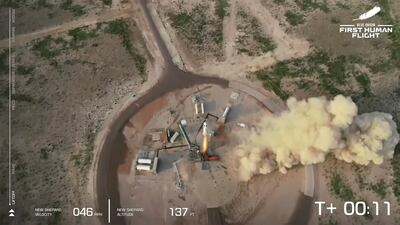
The rocket lift-off. -
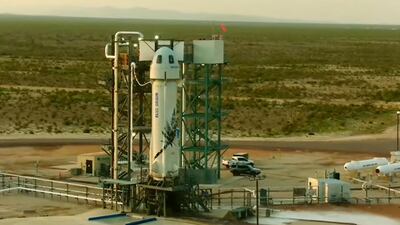
The launch pad. Blue Origin’s first crewed mission was an 11-minute flight from Texas and back. Reaching an altitude of 106 kilometres, it coincided with the 52nd anniversary of the first Moon landing. -
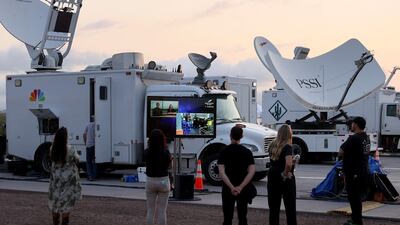
People watch on a television screen as the rocket sits on the launch pad. -

The crew members prepare for the flight. -
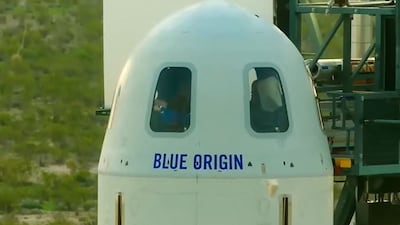
The crew members prepare for the flight. -
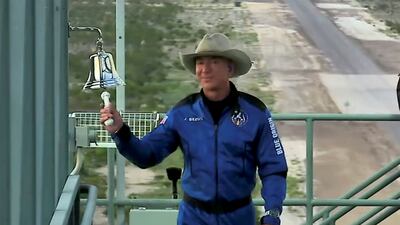
Jeff Bezos, the founder of Amazon.com, rings a bell before boarding the flight. -
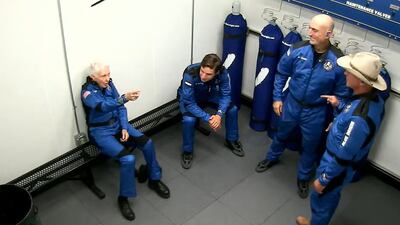
This still image taken from video by Blue Origin shows Funk, Daemen and the Bezos brothers before they leave for the flight. -

A monitor in a zone reserved for the media shows Wally Funk being interviewed. -
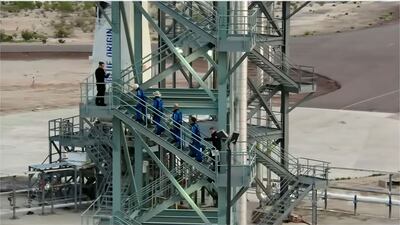
This still image taken from video by Blue Origin shows Funk, Jeff and Mark Bezos, and Daemen as they ascend the crew tower for the flight. -
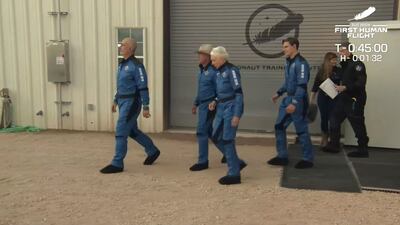
This still image taken from video by Blue Origin shows, from left, Mark Bezos, Jeff Bezos, Wally Funk and Oliver Daemen as they travel to the launch pad. -

Jeff Bezos, his brother Mark Bezos, a private equity executive, Wally Funk and Oliver Daemen pose in an undated photograph.


The market for inter-city space passenger travel could be worth close to $7 billion in terms of revenue for operators by 2040, assuming that it can capture about 20 per cent of the long-haul business jet market, Citi forecasts.
On the potential for competition with long-haul wide-body flights, Citi does not believe the pricing will be competitive enough unless it reaches SpaceX Starship's target of $10 a kilogram.
Today’s launch costs are at $1,500 per kg but about 30 times less than the launch cost of Nasa’s Space Shuttle in 1981.
“We forecast that launch costs will fall another 95 per cent [roughly], to [around] $100 per kg by 2040, driven by reusability, scale, lower input costs and cost-efficient production methods,” Citi said.
Several companies have been pursuing space tourism in recent years as demand gathers pace.
Virgin Galactic had more than 600 passengers signed up at a price of $250,000 each for a flight to the edge of space. However, it stopped sales in 2014 after a fatal accident on one of its test flights.
After the successful flight of the VSS Unity in July 2021, which included Mr Branson, the company has since reopened ticket sales, starting at $450,000 a seat.
Mr Branson beat Blue Origin founder Jeff Bezos in their billionaire space race by a few days.
Blue Origin announced the next six people it will launch on its New Shepard rocket but has yet to release a flight date for the NS-21 mission or disclose how much the passengers paid.
In March, its fourth manned flight landed successfully in rural west Texas after taking half a dozen passengers for a 10-minute suborbital joyride.
Past crew members have included Star Trek actor William Shatner and morning TV host Michael Strahan.
Axiom Space has plans to build a private space station and arrange commercial trips using SpaceX’s Dragon Capsule, while SpaceX has also agreed to fly several commercial passengers, including Japanese billionaire Yusaku Maezawa, around the Moon in 2023.

