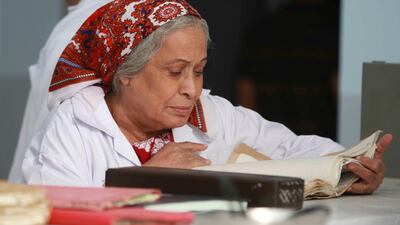

A Kuwaiti drama is causing regional controversy this Ramadan. Um Haroon, which is being screened daily on MBC 1 throughout the holy month, is set in the 1940s in what is now modern-day Kuwait, and sheds an intriguing light on the Gulf's past Jewish communities.
It follows the life of the titular character, who is a Jewish obstetrician (played by Kuwaiti television and theatre stalwart Hayat Al Fahad) who finds her once pluralistic community turning against her and is increasingly marginalised from the tight-knit neighbourhood due to a combination of seismic news events, an interfaith romance and an inter-generational conflict between her and her children.
Despite the sheer melodrama on offer, critics picked the show apart on political grounds. With only five episodes aired, the series has already been accused of whitewashing Israeli crimes against Palestinians and trying to rewrite history.
A particular scene that takes place in the 36th minute of the first episode sparked the accusation of altering history. It depicts Um Haroon and fellow adherents listening to a radio report that heralds the establishment of Israel in 1948. The point of contention is a line in the news report that states the nation was created “at the completion of the British mandate on the land of Israel”, instead of what critics say was originally the territory of Palestine.
Former Palestinian health minister Basem Naim took to Facebook on Saturday, April 25 to decry what he describes as the justification “of the Zionist presence on the land of Palestine" and "the crimes of ethnic cleansing against the Palestinians”.
In addition to the alleged historical inaccuracy, Um Haroon has also been accused of painting a benign portrayal of the Jewish community in the region, without addressing Israeli injustices against the Palestinian people.
Popular Kuwaiti writer and cultural commentator Dalaa Al Moufti took to social media to bash the series on artistic grounds, labelling the plotline as "naive" and the dialogue writing as "superficial".
While Al Fahad, 71, did not comment on those specific accusations, the actress – who caused outrage earlier this month after suggesting expatriates should be deported from Kuwait amid the coronavirus pandemic – defended the series in an official statement from the television network.
She said it is a piece of fictional work that aims to tell a personal – not political – story. "The Jewish people lived in this region and this cannot be denied as a historical fact," she said, adding that the drama is more focused on the development of Um Haroon's character, as opposed to providing political commentary on the Middle East.
"It presents Um Haroon as a character that is peaceful, kind and who lived in this geographic area," the actress continued. "Um Haroon's character allows her to gain the trust of the villagers from all faiths – Muslims, Christians and Jewish."

Meanwhile, Um Haroon has received praise from others. While the Arabic-language UAE newspaper Al Bayan reserved its judgment on the television show, they hailed Al Fahad's performance as "remarkable".
The prominent Saudi columnist, Hussein Shobokshi, also applauded the series for challenging regional misconceptions surrounding the history of the Gulf in an interview with Al Arabiya news channel this week.
“The Arabic television viewer, particularly the Khaleeji audience, is not used to seeing a strong Jewish character, unless they are in evil roles, whether it is from Islamic history or the present era,” he said.

"In Egyptian, Lebanese, Syrian or Iraqi films, which focused on the period before the 1940s, you can see Jewish characters living in Arab societies and portrayed favourably … when it comes to the Kuwait and Bahraini dramas [which cover that same period of time] there are no Jewish characters, despite their communities lived in that area for a long time," Shobokshi added.
It was precisely that aspect that convinced Al Fahad to sign up for the role of Um Haroon. “The presence of characters from the Jewish religion in such a project is an idea that has not been explored before,” said the theatre veteran. “This makes this work completely fresh for the viewers.”
Um Haroon is not the only show this Ramadan that has explored the complex relationship between Israel and the Arab world. Saudi comedy Makhraj 7, featuring one of the kingdom's biggest stars Nasser Al Qasabi, aired an episode on Sunday, April 26 that ingeniously tackled the Arab Israeli conflict through the prism of video game.
Outraged that his Saudi son teamed up the game with a youth from Israel online, Dokhi (played by Al Qasabi) does some soul searching in order to overcome what he views as a "disaster". The episode ends with each family member expressing different viewpoints on the conflict, thus bringing home the point that not all Saudis or Arabs, hold the same view.
'Um Haroon' is shown nightly at 11pm on MBC 1

