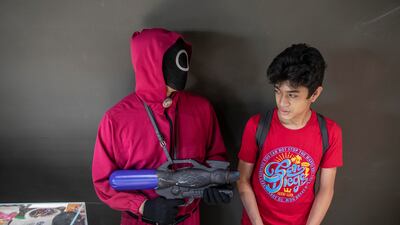
On Instagram, Indian actor Anupam Tripathi's follower numbers jumped from 3,000 to more than 3 million "in a matter of days" following the September release of Squid Game, Netflix's most-watched show in history. If there's a barometer to measure a previously unknown actor's rise to stardom in our social media-driven age, then this is it.
Tripathi, 32, who plays Abdul Ali, a Pakistani migrant who will go to any lengths to support his family, is one of the South Korean survival drama's breakout stars. Impressing fans of the record-breaking show with his fluent Korean and acting chops, as well as his character's heartbreaking storyline, the stage-trained actor says it's been his "ultimate dream" to star in a film back home in India.
A theatrical beginning
Born in Delhi, where he also grew up, Tripathi's primary interest was classical music. But a small role as a slave in the play Spartacus changed all that. Tripathi joined the Behroop Theatre Group from 2006 to 2010, where he was mentored by the late playwright Shahid Anwar.
“I enjoyed every bit of it, because in going in front of the audience and expressing myself, it was so fascinating to become somebody and then again become myself,” he told Variety of his theatre years.
Tripathi had intended to go to the National School of Drama, which has produced some of India's finest actors, but when an arts major scholarship he had applied for at the Korea National University of Arts was accepted, he changed course and headed to Seoul instead.
He took some time to settle in South Korea
"When I came to Korea, I cried like a baby for three and a half months. I wanted to go back home," Tripathi told Film Companion. "My passport was in the office, that's why I was not able to leave."
But the aspiring actor persevered and, although language was initially an issue, he mastered Korean in less than two years.
"Things started getting better with the language and with the people," he recalled. "My friends, my classmates, my seniors ... everybody was so warm to me."
Upon graduating, Tripathi appeared in several films and series for three years, including the hit film Ode to My Father, the hit series Descendants of the Sun and the 2021 film Space Sweepers. “There was no small role for me, I kept on going in this field,” he told Variety.
Hitting the gym for 'Squid Game'
Tripathi was contacted by a South Korean casting agency in 2020 for the role that would make him a global star. Fluent in Korean by then, he first met the show's casting director before being introduced to Squid Game writer and director Hwang Dong-hyuk who briefed him about the role of Abdul Ali.
Tripathi said he didn't have "the correct body shape" for the role when he was cast.
“I gained 5 or 6 kilograms and at least looked like somebody who has some power," he told Variety.
The Hindi speaker also says that he had to watch YouTube videos and documentaries about Pakistani migrants in South Korea to fine-tune his Urdu and learn their mannerisms.
“I tried to go as close as I could to the character. I kept on thinking it’s going to be released in 190 countries, so how can I connect with the audience as a character," he said.
He shot the show for much of 2020, with a month's break in between owing to the Covid-19 pandemic.
“I really enjoyed working with this team, it was wonderful. The sets are majestic, magical – you go there, you become the character. That’s the kind of stage they have created," he told Variety. "It helped everybody to evolve better. It was not that easy a process. But everybody was together. Ali came out from there and now everybody’s talking about it. I feel happy.”
Overnight success
Squid Game's runaway international popularity has taken many South Koreans by surprise, most of all some of the show's fresh faces, including Tripathi.
"I still remember the day of the release, till 4pm my life was OK, but after 5pm, everybody started talking about my role, and I saw the love pouring on Instagram,” Tripathi told India's Hindustan Times. His followers "went from 3,000 to three million in a matter of days".
“The love that I am getting after the show is growing every day," he said. "It feels great to be part of such a historical thing. At the same time, it [fame] is also new to me. So I am still observing myself, trying to express myself and enjoy it as much as I can.”
Next: making it big in India
While a sequel to Squid Game is still being considered, Tripathi is setting his sights on making it big back home in India.
"This was just the starting point for me. Let’s see how far I can move on in a better way as an actor or on my craft," he told Variety. "I’ve only done theatre in India, but I want to see and explore how I will do in my own language. That is my ultimate dream – to perform in front of my own home and own audience.”
TEACHERS' PAY - WHAT YOU NEED TO KNOW
Pay varies significantly depending on the school, its rating and the curriculum. Here's a rough guide as of January 2021:
- top end schools tend to pay Dh16,000-17,000 a month - plus a monthly housing allowance of up to Dh6,000. These tend to be British curriculum schools rated 'outstanding' or 'very good', followed by American schools
- average salary across curriculums and skill levels is about Dh10,000, recruiters say
- it is becoming more common for schools to provide accommodation, sometimes in an apartment block with other teachers, rather than hand teachers a cash housing allowance
- some strong performing schools have cut back on salaries since the pandemic began, sometimes offering Dh16,000 including the housing allowance, which reflects the slump in rental costs, and sheer demand for jobs
- maths and science teachers are most in demand and some schools will pay up to Dh3,000 more than other teachers in recognition of their technical skills
- at the other end of the market, teachers in some Indian schools, where fees are lower and competition among applicants is intense, can be paid as low as Dh3,000 per month
- in Indian schools, it has also become common for teachers to share residential accommodation, living in a block with colleagues
Winners
Best Men's Player of the Year: Kylian Mbappe (PSG)
Maradona Award for Best Goal Scorer of the Year: Robert Lewandowski (Bayern Munich)
TikTok Fans’ Player of the Year: Robert Lewandowski
Top Goal Scorer of All Time: Cristiano Ronaldo (Manchester United)
Best Women's Player of the Year: Alexia Putellas (Barcelona)
Best Men's Club of the Year: Chelsea
Best Women's Club of the Year: Barcelona
Best Defender of the Year: Leonardo Bonucci (Juventus/Italy)
Best Goalkeeper of the Year: Gianluigi Donnarumma (PSG/Italy)
Best Coach of the Year: Roberto Mancini (Italy)
Best National Team of the Year: Italy
Best Agent of the Year: Federico Pastorello
Best Sporting Director of the Year: Txiki Begiristain (Manchester City)
Player Career Award: Ronaldinho
MORE ON TURKEY'S SYRIA OFFENCE
Disposing of non-recycleable masks
- Use your ‘black bag’ bin at home
- Do not put them in a recycling bin
- Take them home with you if there is no litter bin
- No need to bag the mask
Ten tax points to be aware of in 2026
1. Domestic VAT refund amendments: request your refund within five years
If a business does not apply for the refund on time, they lose their credit.
2. E-invoicing in the UAE
Businesses should continue preparing for the implementation of e-invoicing in the UAE, with 2026 a preparation and transition period ahead of phased mandatory adoption.
3. More tax audits
Tax authorities are increasingly using data already available across multiple filings to identify audit risks.
4. More beneficial VAT and excise tax penalty regime
Tax disputes are expected to become more frequent and more structured, with clearer administrative objection and appeal processes. The UAE has adopted a new penalty regime for VAT and excise disputes, which now mirrors the penalty regime for corporate tax.
5. Greater emphasis on statutory audit
There is a greater need for the accuracy of financial statements. The International Financial Reporting Standards standards need to be strictly adhered to and, as a result, the quality of the audits will need to increase.
6. Further transfer pricing enforcement
Transfer pricing enforcement, which refers to the practice of establishing prices for internal transactions between related entities, is expected to broaden in scope. The UAE will shortly open the possibility to negotiate advance pricing agreements, or essentially rulings for transfer pricing purposes.
7. Limited time periods for audits
Recent amendments also introduce a default five-year limitation period for tax audits and assessments, subject to specific statutory exceptions. While the standard audit and assessment period is five years, this may be extended to up to 15 years in cases involving fraud or tax evasion.
8. Pillar 2 implementation
Many multinational groups will begin to feel the practical effect of the Domestic Minimum Top-Up Tax (DMTT), the UAE's implementation of the OECD’s global minimum tax under Pillar 2. While the rules apply for financial years starting on or after January 1, 2025, it is 2026 that marks the transition to an operational phase.
9. Reduced compliance obligations for imported goods and services
Businesses that apply the reverse-charge mechanism for VAT purposes in the UAE may benefit from reduced compliance obligations.
10. Substance and CbC reporting focus
Tax authorities are expected to continue strengthening the enforcement of economic substance and Country-by-Country (CbC) reporting frameworks. In the UAE, these regimes are increasingly being used as risk-assessment tools, providing tax authorities with a comprehensive view of multinational groups’ global footprints and enabling them to assess whether profits are aligned with real economic activity.
Contributed by Thomas Vanhee and Hend Rashwan, Aurifer
INFO
What: DP World Tour Championship
When: November 21-24
Where: Jumeirah Golf Estates, Dubai
Tickets: www.ticketmaster.ae.
Mercer, the investment consulting arm of US services company Marsh & McLennan, expects its wealth division to at least double its assets under management (AUM) in the Middle East as wealth in the region continues to grow despite economic headwinds, a company official said.
Mercer Wealth, which globally has $160 billion in AUM, plans to boost its AUM in the region to $2-$3bn in the next 2-3 years from the present $1bn, said Yasir AbuShaban, a Dubai-based principal with Mercer Wealth.
“Within the next two to three years, we are looking at reaching $2 to $3 billion as a conservative estimate and we do see an opportunity to do so,” said Mr AbuShaban.
Mercer does not directly make investments, but allocates clients’ money they have discretion to, to professional asset managers. They also provide advice to clients.
“We have buying power. We can negotiate on their (client’s) behalf with asset managers to provide them lower fees than they otherwise would have to get on their own,” he added.
Mercer Wealth’s clients include sovereign wealth funds, family offices, and insurance companies among others.
From its office in Dubai, Mercer also looks after Africa, India and Turkey, where they also see opportunity for growth.
Wealth creation in Middle East and Africa (MEA) grew 8.5 per cent to $8.1 trillion last year from $7.5tn in 2015, higher than last year’s global average of 6 per cent and the second-highest growth in a region after Asia-Pacific which grew 9.9 per cent, according to consultancy Boston Consulting Group (BCG). In the region, where wealth grew just 1.9 per cent in 2015 compared with 2014, a pickup in oil prices has helped in wealth generation.
BCG is forecasting MEA wealth will rise to $12tn by 2021, growing at an annual average of 8 per cent.
Drivers of wealth generation in the region will be split evenly between new wealth creation and growth of performance of existing assets, according to BCG.
Another general trend in the region is clients’ looking for a comprehensive approach to investing, according to Mr AbuShaban.
“Institutional investors or some of the families are seeing a slowdown in the available capital they have to invest and in that sense they are looking at optimizing the way they manage their portfolios and making sure they are not investing haphazardly and different parts of their investment are working together,” said Mr AbuShaban.
Some clients also have a higher appetite for risk, given the low interest-rate environment that does not provide enough yield for some institutional investors. These clients are keen to invest in illiquid assets, such as private equity and infrastructure.
“What we have seen is a desire for higher returns in what has been a low-return environment specifically in various fixed income or bonds,” he said.
“In this environment, we have seen a de facto increase in the risk that clients are taking in things like illiquid investments, private equity investments, infrastructure and private debt, those kind of investments were higher illiquidity results in incrementally higher returns.”
The Abu Dhabi Investment Authority, one of the largest sovereign wealth funds, said in its 2016 report that has gradually increased its exposure in direct private equity and private credit transactions, mainly in Asian markets and especially in China and India. The authority’s private equity department focused on structured equities owing to “their defensive characteristics.”
More coverage from the Future Forum
Sweet%20Tooth
%3Cp%3E%3Cstrong%3ECreator%3A%20%3C%2Fstrong%3EJim%20Mickle%3Cbr%3E%3Cstrong%3EStarring%3A%20%3C%2Fstrong%3EChristian%20Convery%2C%20Nonso%20Anozie%2C%20Adeel%20Akhtar%2C%20Stefania%20LaVie%20Owen%3Cbr%3E%3Cstrong%3ERating%3A%20%3C%2Fstrong%3E2.5%2F5%3C%2Fp%3E%0A
Fines for littering
In Dubai:
Dh200 for littering or spitting in the Dubai Metro
Dh500 for throwing cigarette butts or chewing gum on the floor, or littering from a vehicle.
Dh1,000 for littering on a beach, spitting in public places, throwing a cigarette butt from a vehicle
In Sharjah and other emirates
Dh500 for littering - including cigarette butts and chewing gum - in public places and beaches in Sharjah
Dh2,000 for littering in Sharjah deserts
Dh500 for littering from a vehicle in Ras Al Khaimah
Dh1,000 for littering from a car in Abu Dhabi
Dh1,000 to Dh100,000 for dumping waste in residential or public areas in Al Ain
Dh10,000 for littering at Ajman's beaches
Dhadak
Director: Shashank Khaitan
Starring: Janhvi Kapoor, Ishaan Khattar, Ashutosh Rana
Stars: 3