



Elon Musk's controversial acquisition of Twitter has led to a number of celebrities leaving the platform, with many of them casting concerns over the new owner's stance on hate speech and misinformation.
Model Gigi Hadid is the latest big name to quit, saying: "It's not a place I want to be a part of."
"I deactivated my Twitter account today. For a long time, but especially with its new leadership, it's becoming more and more of a cesspool of hate and bigotry," Hadid posted on Saturday.
On Monday, actress and The View co-host Whoopi Goldberg said on her talk show she was "out".
“I’m getting off today because I just feel like it’s so messy and I’m tired of now having certain kinds of attitudes blocked now getting back on," Goldberg said. "So I’m gonna get out, and if it settles down enough and I feel more comfortable maybe I’ll come back. But as of tonight, I’m done with Twitter.”
Hours later, Goldberg's Twitter account was deactivated, joining a growing list of celebrities which now includes producer Shonda Rhimes, actors Amber Heard and Alex Winter and singer Sara Bareilles.
Musk, the world's richest person, is a self-declared “free speech absolutist” known for courting trouble for his outspoken and controversial tweets.
He has vowed to make sweeping changes to the platform and pledged to reduce content moderation, even tweeting a conspiracy theory last week, a day after his $44 billion takeover. Musk has also teased his plans to lift permanent bans on users, which could pave the way for the return of former US president Donald Trump to the platform.
A tide of slurs and racist memes swelled on the platform hours after Musk's takeover, Bloomberg reported, leading to concerns that the site is entering an era of hateful speech.
Grey's Anatomy creator Rhimes, who has more than 1.9 million followers on Twitter, posted on Saturday that she was “not hanging around for whatever Elon has planned”.
Grammy-winning singer and songwriter Bareilles posted to her more than 2.8 million followers declaring: "I'm out".
“It’s been fun Twitter. See you on other platforms, peeps. Sorry, this one’s just not for me,” she said.
Singer Toni Braxton, who has more than 1.8 million followers, said she was not comfortable with “hate speech under the veil of free speech”.
“I'm shocked and appalled at some of the 'free speech' I've seen on this platform since its acquisition. Hate speech under the veil of 'free speech' is unacceptable; therefore I am choosing to stay off Twitter as it is no longer a safe space for myself, my sons and other people of colour,” she posted.
Musk, who turned up at Twitter's headquarters in San Francisco last week with a kitchen sink, hours before a court-ordered deadline to close his Twitter purchase came into effect, has outlined his plans for the site.
“Twitter will be forming a content moderation council with widely diverse viewpoints. No major content decisions or account reinstatements will happen before that council convenes,” he tweeted to his more than 110 million followers.
Ken Olin, the producer of Emmy-winning show This Is Us, who had earlier said that he would leave Twitter should the Musk takeover became official, has also left the platform.
“Let's keep the faith. Let's try to be kinder. Let's look to find peace in the world,” he said.
The account of film maker Winter, best known for playing Bill in the hit Bill & Ted movie franchise, has been deactivated and so has actor Heard's. The Aquaman star dated Musk for a year in 2017.
“Elon Musk taking over Twitter and making it a private company with less oversight has immediately made the platform more prone to hate speech, targeted attacks, and the spread of disinformation,” Winter said in an email to NBC. "If Twitter returns to being a public company run by rational actors, many of us will return.”
Comedian Josh Gad said he was still debating whether or not to stay on Twitter.
“Large exodus happening on this platform. Not sure if I stay or not. Leaning towards staying, but if today is a sign of things to come, not sure what the point is,” he tweeted, following a surge in hate speech.
“Freedom of speech is great. Hate speech intended to incite harm, (with no consequences) ain’t what I signed up for.”
Avengers star Mark Ruffalo, known for his political activism, pleaded with Musk on Sunday to "get off Twitter".
“Elon. Please — for the love of decency — get off Twitter, hand the keys over to someone who does this as an actual job, and get on with running Tesla and SpaceX,” Ruffalo said. “You are destroying your credibility. It’s just not a good look.”
Actress and comedian Kathy Griffin's account was suspended on Sunday when she changed her display name to "Elon Musk", apparently flouting the platform's rules on impersonation.
"Going forward, any Twitter handles engaging in impersonation without clearly specifying ‘parody’ will be permanently suspended," Musk wrote Sunday night.
Meanwhile, outspoken actor George Takei said he was "not going anywhere" and vowed to "stay in the fight".
"Should this place become more toxic, I pledge to strive even harder to lift up reason, science, compassion and the rule of law. The struggle against fascism, misinformation, and hate requires tough fighters. I hope you stay in the fight, right beside me," the Star Trek star posted.
Last week, the UN’s High Commissioner for Human Rights, Volker Turk, issued an open letter demanding Musk "ensure human rights are central to the management of Twitter".
"Twitter is part of a global revolution that has transformed how we communicate. But I write with concern and apprehension about our digital public square and Twitter's role in it," he said.
"Like all companies, Twitter needs to understand the harms associated with its platform and take steps to address them. Respect for our shared human rights should set the guardrails for the platform's use and evolution.
"In short, I urge you to ensure human rights are central to the management of Twitter under your leadership."
-

After months of negotiations, Tesla chief executive Elon Musk finally purchased Twitter on October 27. AFP -

The billionaire took control of microblogging platform and fired its top executives, including chief executive Parag Agrawal, left, as well as the company's chief financial officer and its head of legal policy, trust and safety. AFP -
Elon Musk entering Twitter headquarters carrying a sink through the lobby area on Wednesday, October 26, 2022. Musk posted a video Wednesday showing him strolling into Twitter headquarters ahead of a Friday deadline to close his $44 billion deal to buy the company. AP -
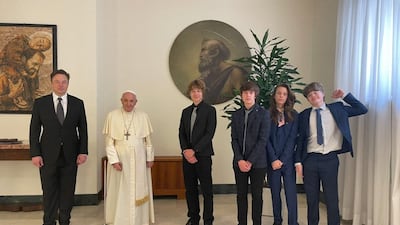
Mr Musk and his children Damian, Kai, Saxon and Griffin met Pope Francis in July at the Vatican. AFP -
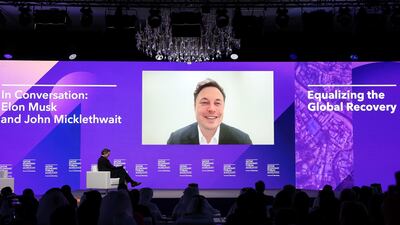
Mr Musk speaks by video in June to the Qatar Economic Forum in Doha. Bloomberg -
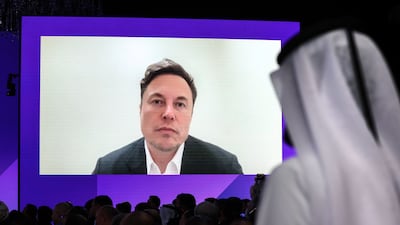
Mr Musk answers questions at the Qatar Economic Forum. Bloomberg -
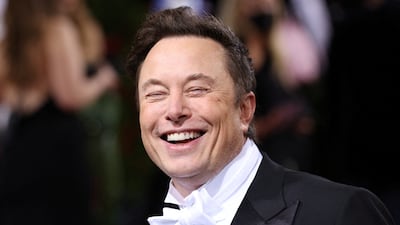
Mr Musk arrives at the Met Gala at the Metropolitan Museum of Art in New York City in May. Reuters -
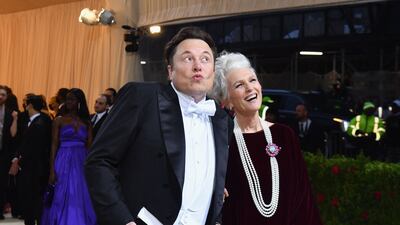
Mr Musk and his mother Maye Musk arrive at the Met Gala in May. AFP -

Mother and son pose and laugh on the Met Gala red carpet. EPA -
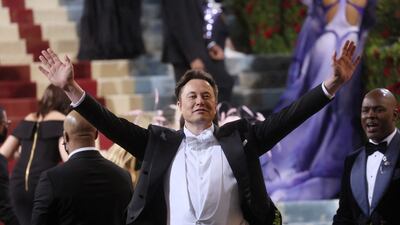
Mr Musk waves at the Met Gala. Reuters -

Mr Musk joins in online at the 'Financial Times' Future of the Car Summit in May. Financial Times -
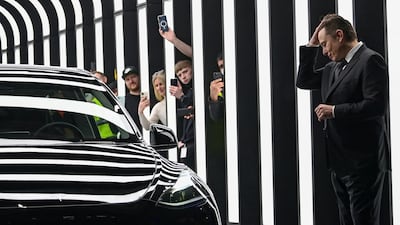
Mr Musk attends the opening ceremony of the new Tesla Gigafactory for electric cars in Gruenheide, Germany, in March. Reuters -
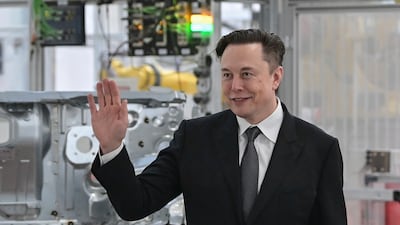
Mr Musk at the Tesla factory in Berlin, Germany, in March. AP -
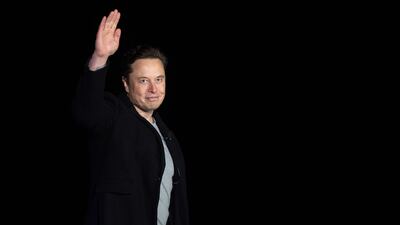
Mr Musk speaks at SpaceX's Starbase centre in South Texas in February. AFP -
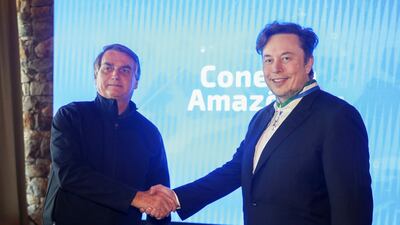
The entrepreneur shakes hands with Brazilian President Jair Bolsonaro in Porto Feliz, Brazil, in May. AP -
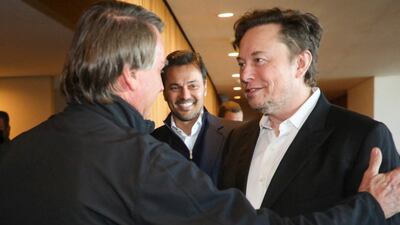
Mr Bolsonaro and Mr Musk greet each other in Sao Paulo. Reuters -
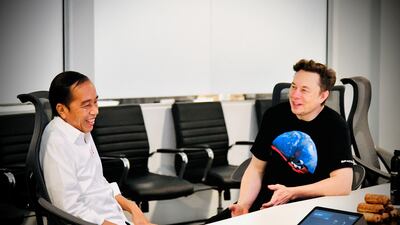
Indonesian President Joko Widodo meets Mr Musk at the SpaceX launch site in Boca Chica, Texas, in May. Reuters -
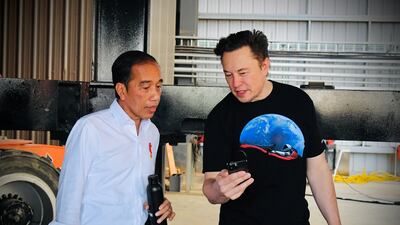
Mr Musk shows Mr Widodo his mobile phone during a tour of the SpaceX launch site in Texas. Reuters



