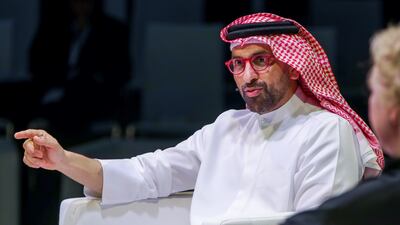
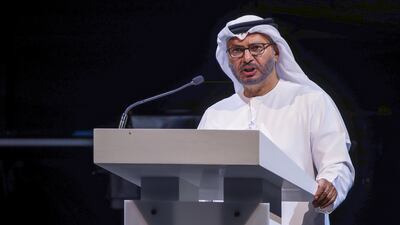
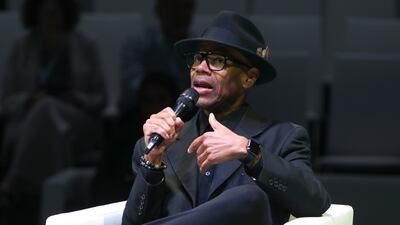
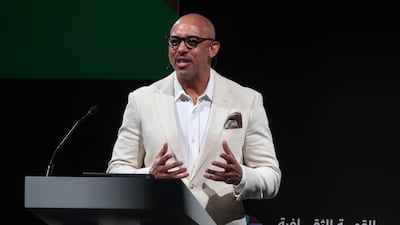
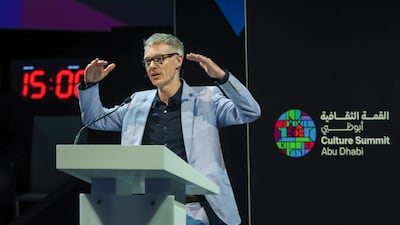
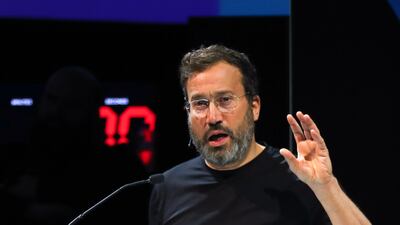
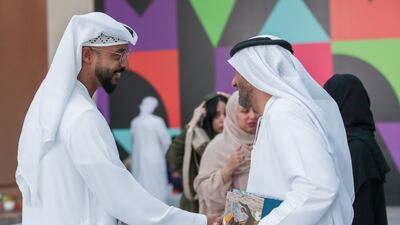
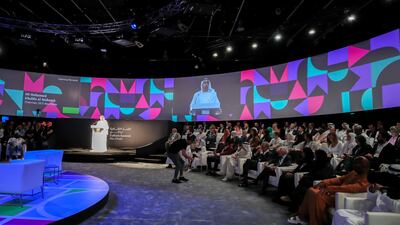
Omar Saif Ghobash, UAE Ambassador to the Vatican, delivered the opening speech of the final day of Culture Summit Abu Dhabi. Victor Besa / The National

Omar Saif Ghobash says UAE supports a broader set of cultural movements


Razmig Bedirian
  • English
  • Arabic

What constitutes Emirati culture needs to be re-examined, Omar Saif Ghobash, UAE ambassador to Vatican and Letters to a Young Muslim author, said during his speech on the final day of Culture Summit Abu Dhabi.

“I see that there are general directions for considering and determining what constitutes culture in the Emirates,” said Ghobash. “First can we have those members of our society who limit culture to ancient arts that predate the discovery of oil — songs, poetry, the culture surrounding pearling diving, desert crossing and ancient forts. It is much to be admired and enjoyed.”

However, while there is great value in bolstering the country’s traditional heritage, Ghobash said it shouldn’t come at the expense of pigeonholing what qualifies as Emirati culture. There is another tendency in local society, he says, and that is to be open to the country’s present moment.

“This is a culture that recognises that Emirati doesn't mean just the passport holder, as it once used to," he said. "This version of what our culture is includes everyone now who lives and breathes and works here. This is when our leaders begin publicly speaking about Emirati society as opposed to Emirati citizens, with the emphasis on all being included, irrespective of religion or ethnicity.

“This is an Emirati culture that says: ‘We are who we are because you are here with us’. Because we all created this society together and because we aren’t afraid of difference and change and mixing things up. It's a culture that needs to be recognised more fully. It's a culture that reflects a specific mentality, and a mentality that has its roots in the wisdom of our elders.”

This openness to change and willingness to adapt and grow dates further back than many may think, Ghobash said. The country’s founding fathers did not have the material wealth or educational resources that many today benefit from, but Ghobash said they did have “a sense of justice”.

“They brought together a strong identity and pragmatism,” he said. “When members of the tribe objected to outsiders in their presence, our founding fathers eased their fears and calmed their anger in order for all of us to benefit.

“Outsiders would certainly affect our self-understanding, and with time, our identities would begin to mix with that of the other. The founders knew it would all work out. From the early Canadian missionaries in Abu Dhabi and the Indian and Pakistani traders in the other Emirates all the way to the policies of today where all are welcome.

“We should celebrate our traditional customs and practices. A new generation of Emiratis might come to these traditions and rediscover them in a new way, maybe add to them. At the same time, we support a broader set of cultural movements. Our culture evolves beyond our control, and we should delight in its twists and turns.”

Scroll through the gallery below to see more from days one and two of the Culture Summit Abu Dhabi

  • Sultan Sooud Al Qassemi, founder of Barjeel Art Foundation, takes part in the discussion on the third and final day of Culture Summit Abu Dhabi. All photos: Victor Besa / The National
    Sultan Sooud Al Qassemi, founder of Barjeel Art Foundation, takes part in the discussion on the third and final day of Culture Summit Abu Dhabi. All photos: Victor Besa / The National
  • Manal Ataya, director general at Sharjah Museums Authority, also took part in the panel.
    Manal Ataya, director general at Sharjah Museums Authority, also took part in the panel.
  • Maya Allison, executive director and chief curator at the NYU Abu Dhabi Art Gallery, joined the discussion.
    Maya Allison, executive director and chief curator at the NYU Abu Dhabi Art Gallery, joined the discussion.
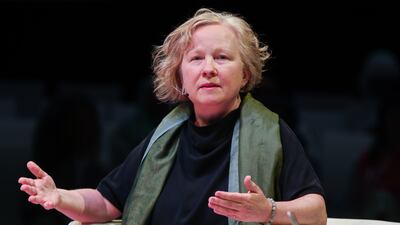
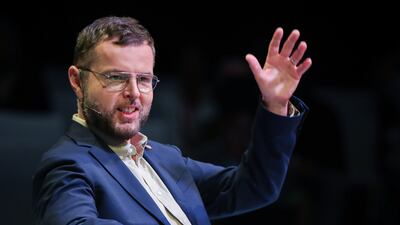
  • A panellist speaks during the event.
    A panellist speaks during the event.
  • The New Canon was one of the panels held on day three of the Culture Summit Abu Dhabi.
    The New Canon was one of the panels held on day three of the Culture Summit Abu Dhabi.
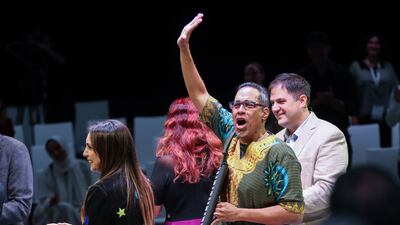
  • Famed pianist, composer and educator Danilo Perez waves to the crowd.
    Famed pianist, composer and educator Danilo Perez waves to the crowd.
  • Former minister and now diplomatic advisor Anwar Gargash. Victor Besa / The National
    Former minister and now diplomatic advisor Anwar Gargash. Victor Besa / The National
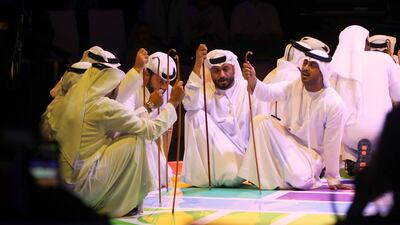
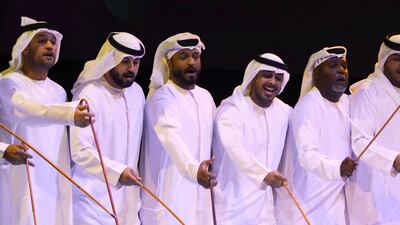
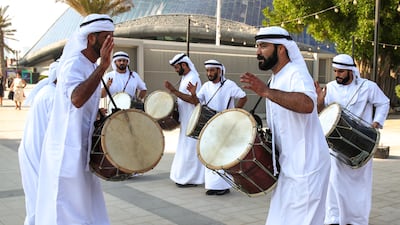
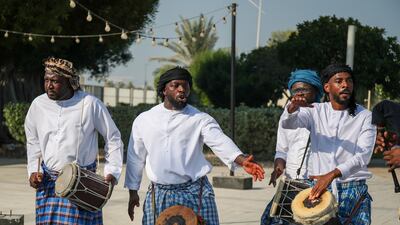
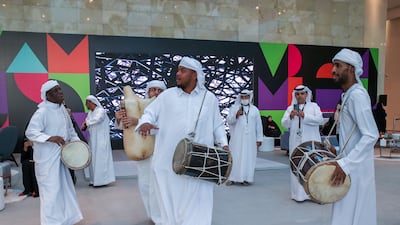
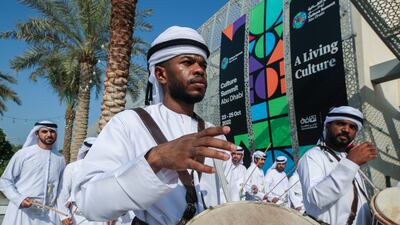
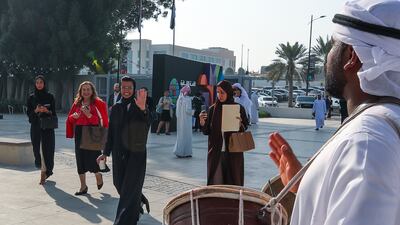
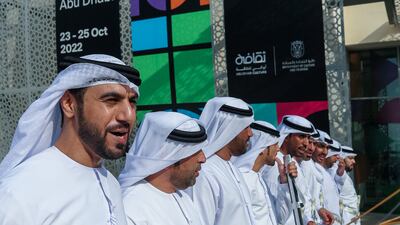
  • Visitors were treated to a traditional Al Ayala dance, where performers hold thin bamboo canes and move to steady drum rhythms.
    Visitors were treated to a traditional Al Ayala dance, where performers hold thin bamboo canes and move to steady drum rhythms.
  • Al Ayala is often performed at weddings and other celebrations.
    Al Ayala is often performed at weddings and other celebrations.
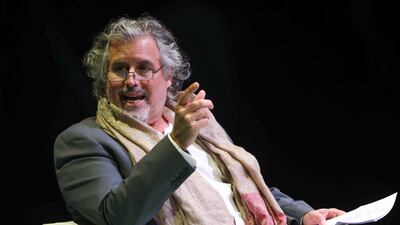
  • Chris Dercon in conversation with architect Sir David Adjaye.
    Chris Dercon in conversation with architect Sir David Adjaye.
  • A session on Taking Bollywood Global: Dynamics of Diversity, moderated by Hans Fraikin, Abu Dhabi Film Commissioner.
    A session on Taking Bollywood Global: Dynamics of Diversity, moderated by Hans Fraikin, Abu Dhabi Film Commissioner.
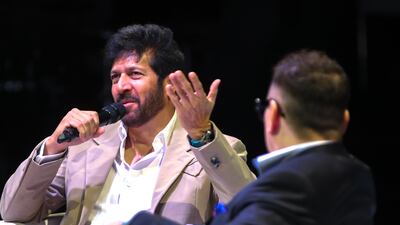
  • Kabir Khan, director of '83', in the conversation on Bollywood.
    Kabir Khan, director of '83', in the conversation on Bollywood.
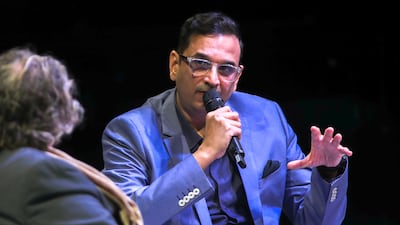
  • Taking Bollywood Global: Dynamics of Diversity - Aashish Singh, Chief Executive Officer, Lyca Productions.
    Taking Bollywood Global: Dynamics of Diversity - Aashish Singh, Chief Executive Officer, Lyca Productions.
  • Andre Timmins, founder and director of Wizcraft and IIFA, as part of the discussion on Bollywood.
    Andre Timmins, founder and director of Wizcraft and IIFA, as part of the discussion on Bollywood.
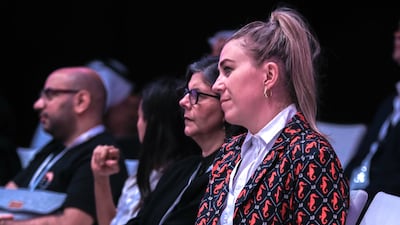
  • A member of the audience watching a panel called 'Taking Bollywood Global: Dynamics of Diversity'.
    A member of the audience watching a panel called 'Taking Bollywood Global: Dynamics of Diversity'.
  • Day three of the Culture Summit Abu Dhabi opened with a traditional performance from the mountain regions.
    Day three of the Culture Summit Abu Dhabi opened with a traditional performance from the mountain regions.
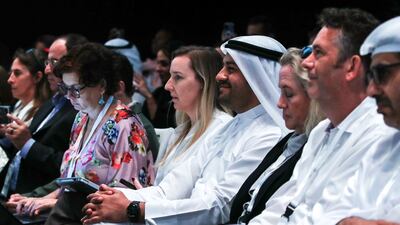
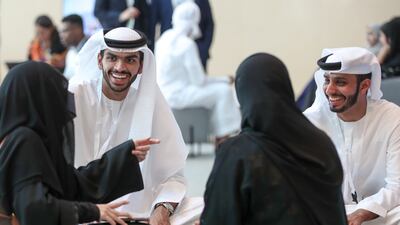
  • The event was a meeting of minds, with visitors from across various sectors sharing their thoughts on the post-Covid cultural world.
    The event was a meeting of minds, with visitors from across various sectors sharing their thoughts on the post-Covid cultural world.
  • Omar Saif Ghobash, UAE ambassador to Vatican, speaks at the event.
    Omar Saif Ghobash, UAE ambassador to Vatican, speaks at the event.
  • Grammy Award-winning producer Jimmy Jam discussed the regional music scene.
    Grammy Award-winning producer Jimmy Jam discussed the regional music scene.
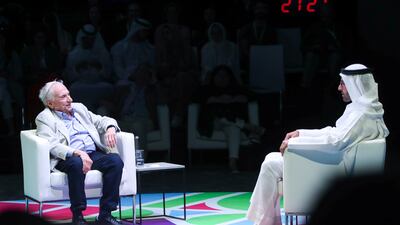
  • Mohamed Al Mubarak in conversation with Frank Gehry, Architect, Gehry Partners.
    Mohamed Al Mubarak in conversation with Frank Gehry, Architect, Gehry Partners.
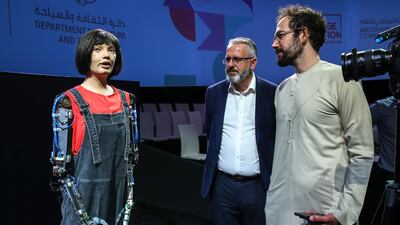
  • Robot artist Ai-Da, left, in conversation with The National's Hareth Al Bustani, far right, with her creator Aidan Meller, looking on.
    Robot artist Ai-Da, left, in conversation with The National's Hareth Al Bustani, far right, with her creator Aidan Meller, looking on.
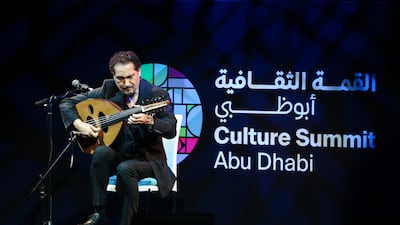
  • Performance by Iraqi oud virtuoso Naseer Shamma.
    Performance by Iraqi oud virtuoso Naseer Shamma.
  • The audience listens to Mohamed Al Mubarak in conversation with Frank Gehry, Architect, Gehry Partners.
    The audience listens to Mohamed Al Mubarak in conversation with Frank Gehry, Architect, Gehry Partners.
  • Harvey Mason Jr, chief executive of Recording Academy, lecturing on 'Music and Influence on Global Culture'.
    Harvey Mason Jr, chief executive of Recording Academy, lecturing on 'Music and Influence on Global Culture'.
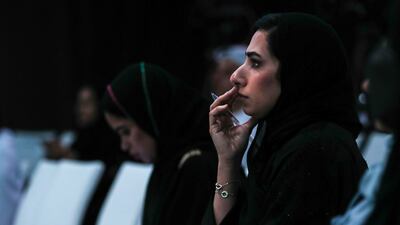
  • An attendee on day two of the Culture Summit in Abu Dhabi.
    An attendee on day two of the Culture Summit in Abu Dhabi.
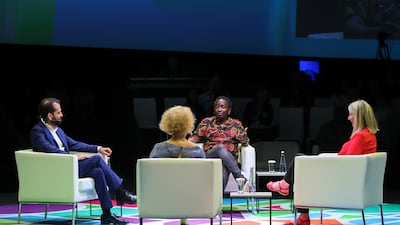
  • A discussion on 'Mentoring for Impact', with moderator Fiammetta Rocco, senior editor and culture editor of The Economist, and speakers Erica Love, director of Culture Central, Eric Wainaina, artist and founder of The Nairobi Musical Theatre Initiative, and Gael Hedding, director of Berklee Abu Dhabi.
    A discussion on 'Mentoring for Impact', with moderator Fiammetta Rocco, senior editor and culture editor of The Economist, and speakers Erica Love, director of Culture Central, Eric Wainaina, artist and founder of The Nairobi Musical Theatre Initiative, and Gael Hedding, director of Berklee Abu Dhabi.
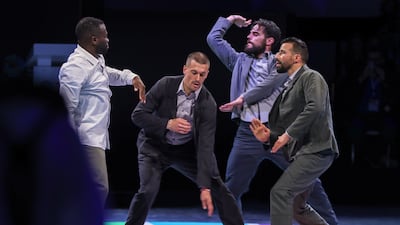
  • A peformance of 'The Roots' by French Algerian choreographer Kader Attou, a dance performance in which he returns to the origins of hip-hop with an acrobatic celebration of the genre. Eleven dancers perform different facets of the former underground culture and show how the body can bend to different beats: from breakdance to Smurf, electric boogie to popping.
    A peformance of 'The Roots' by French Algerian choreographer Kader Attou, a dance performance in which he returns to the origins of hip-hop with an acrobatic celebration of the genre. Eleven dancers perform different facets of the former underground culture and show how the body can bend to different beats: from breakdance to Smurf, electric boogie to popping.
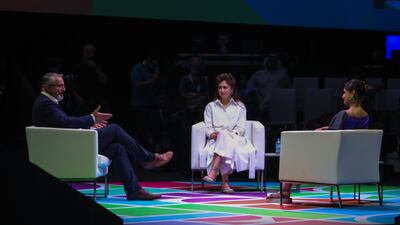
  • A discussion on 'AI and the Future of Culture', with moderator Priya Khanchandani, head of curatorial + interpretation at the Design Museum, and speakers Aidan Meller, director of Ai-Da Robot and Oxfordians, and Suhair Khan, founder and director of Open/Ended Design.
    A discussion on 'AI and the Future of Culture', with moderator Priya Khanchandani, head of curatorial + interpretation at the Design Museum, and speakers Aidan Meller, director of Ai-Da Robot and Oxfordians, and Suhair Khan, founder and director of Open/Ended Design.
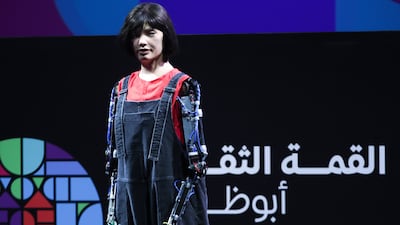
  • Artificial intelligence-powered robot artist Ai-Da at the Culture Summit in Abu Dhabi. Ai-Da's work reflects human aesthetic tastes and the conditions by which they are shaped.
    Artificial intelligence-powered robot artist Ai-Da at the Culture Summit in Abu Dhabi. Ai-Da's work reflects human aesthetic tastes and the conditions by which they are shaped.
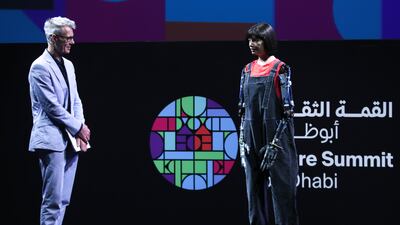
  • Ai-Da in conversation with Tim Marlow, chief executive and director of London's Design Museum, who analysed the creative philosophy of the world’s first humanoid artist.
    Ai-Da in conversation with Tim Marlow, chief executive and director of London's Design Museum, who analysed the creative philosophy of the world’s first humanoid artist.
  • Mr Marlow introduces Ai-Da at the summit.
    Mr Marlow introduces Ai-Da at the summit.
  • Eyal Weizman, director of research agency Forensic Architecture, speaks on the use of technology such as machine learning, as well as the importance of modelling and simulations.
    Eyal Weizman, director of research agency Forensic Architecture, speaks on the use of technology such as machine learning, as well as the importance of modelling and simulations.
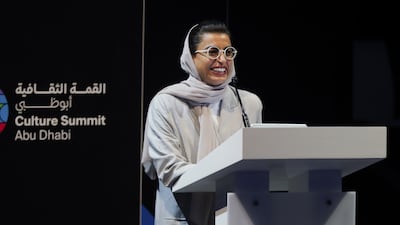
  • UAE Minister of Culture and Youth Noura Al Kaabi gives the keynote address.
    UAE Minister of Culture and Youth Noura Al Kaabi gives the keynote address.
  • This year’s Culture Summit will be attended by 1,000 people while another 5,000 will take part online.
    This year’s Culture Summit will be attended by 1,000 people while another 5,000 will take part online.
  • The summit seeks to identify ways in which culture can transform societies and communities around the globe.
    The summit seeks to identify ways in which culture can transform societies and communities around the globe.
  • The conference brings together decision makers in culture, heritage, public policy and technology, as well as artists, thinkers and performers from around the world.
    The conference brings together decision makers in culture, heritage, public policy and technology, as well as artists, thinkers and performers from around the world.
  • The summit is now in its fifth year.
    The summit is now in its fifth year.
  • It is organised by Abu Dhabi's Department of Culture and Tourism.
    It is organised by Abu Dhabi's Department of Culture and Tourism.
  • The theme of this year's event is 'A Living Culture'.
    The theme of this year's event is 'A Living Culture'.
  • The summit has returned with a more extensive programme.
    The summit has returned with a more extensive programme.
  • UAE Minister of Culture and Youth, Noura Al Kaabi at the summit.
    UAE Minister of Culture and Youth, Noura Al Kaabi at the summit.
  • In-person attendance returned to the event after it moved online for two years owing to the Covid-19 pandemic.
    In-person attendance returned to the event after it moved online for two years owing to the Covid-19 pandemic.
  • In only five years, the summit has grown from a noble idea into a staple of the international cultural calendar.
    In only five years, the summit has grown from a noble idea into a staple of the international cultural calendar.
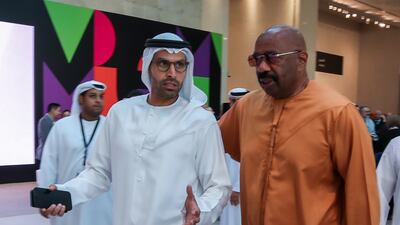
  • Mohamed Al Mubarak, chairman of DCT — Abu Dhabi, arrives with Steve Harvey.
    Mohamed Al Mubarak, chairman of DCT — Abu Dhabi, arrives with Steve Harvey.
  • Zaki Nusseibeh, cultural adviser to the President, attends the event.
    Zaki Nusseibeh, cultural adviser to the President, attends the event.
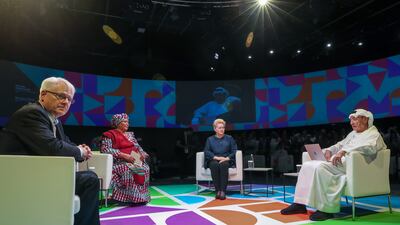
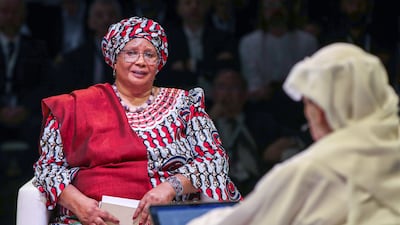
  • Mr Nusseibeh moderated a discussion on 'The role of culture in making resilient and shared societies', featuring former Lithuanian president Dalia Grybauskaite, former Malawian president Joyce Banda and former Croatian president Ivo Josipovic.
    Mr Nusseibeh moderated a discussion on 'The role of culture in making resilient and shared societies', featuring former Lithuanian president Dalia Grybauskaite, former Malawian president Joyce Banda and former Croatian president Ivo Josipovic.
  • Mr Al Mubarak makes the welcome speech and opening remarks.
    Mr Al Mubarak makes the welcome speech and opening remarks.
  • Ms Banda, former president of Malawi, takes part in the discussion moderated by Mr Nusseibeh.
    Ms Banda, former president of Malawi, takes part in the discussion moderated by Mr Nusseibeh.
The specs

Engine: four-litre V6 and 3.5-litre V6 twin-turbo

Transmission: six-speed and 10-speed

Power: 271 and 409 horsepower

Torque: 385 and 650Nm

Price: from Dh229,900 to Dh355,000

Tips for newlyweds to better manage finances

All couples are unique and have to create a financial blueprint that is most suitable for their relationship, says Vijay Valecha, chief investment officer at Century Financial. He offers his top five tips for couples to better manage their finances.

Discuss your assets and debts: When married, it’s important to understand each other’s personal financial situation. It’s necessary to know upfront what each party brings to the table, as debts and assets affect spending habits and joint loan qualifications. Discussing all aspects of their finances as a couple prevents anyone from being blindsided later.

Decide on the financial/saving goals: Spouses should independently list their top goals and share their lists with one another to shape a joint plan. Writing down clear goals will help them determine how much to save each month, how much to put aside for short-term goals, and how they will reach their long-term financial goals.

Set a budget: A budget can keep the couple be mindful of their income and expenses. With a monthly budget, couples will know exactly how much they can spend in a category each month, how much they have to work with and what spending areas need to be evaluated.

Decide who manages what: When it comes to handling finances, it’s a good idea to decide who manages what. For example, one person might take on the day-to-day bills, while the other tackles long-term investments and retirement plans.

Money date nights: Talking about money should be a healthy, ongoing conversation and couples should not wait for something to go wrong. They should set time aside every month to talk about future financial decisions and see the progress they’ve made together towards accomplishing their goals.

Company%C2%A0profile
%3Cp%3E%3Cstrong%3EDate%20started%3A%20%3C%2Fstrong%3EMay%202022%3Cbr%3E%3Cstrong%3EFounder%3A%20%3C%2Fstrong%3EHusam%20Aboul%20Hosn%3Cbr%3E%3Cstrong%3EBased%3A%20%3C%2Fstrong%3EDIFC%3Cbr%3E%3Cstrong%3ESector%3A%20%3C%2Fstrong%3EFinTech%20%E2%80%94%20Innovation%20Hub%3Cbr%3E%3Cstrong%3EEmployees%3A%20%3C%2Fstrong%3Eeight%3Cbr%3E%3Cstrong%3EStage%3A%20%3C%2Fstrong%3Epre-seed%3Cbr%3E%3Cstrong%3EInvestors%3A%20%3C%2Fstrong%3Epre-seed%20funding%20raised%20from%20family%20and%20friends%20earlier%20this%20year%3C%2Fp%3E%0A

IF YOU GO
 
The flights: FlyDubai offers direct flights to Catania Airport from Dubai International Terminal 2 daily with return fares starting from Dh1,895.
 
The details: Access to the 2,900-metre elevation point at Mount Etna by cable car and 4x4 transport vehicle cost around €57.50 (Dh248) per adult. Entry into Teatro Greco costs €10 (Dh43). For more go to www.visitsicily.info

 Where to stay: Hilton Giardini Naxos offers beachfront access and accessible to Taormina and Mount Etna. Rooms start from around €130 (Dh561) per night, including taxes.

The%20specs
%3Cp%3E%3Cstrong%3EEngine%3A%20%3C%2Fstrong%3E2.3-litre%204cyl%20turbo%0D%3Cbr%3E%3Cstrong%3EPower%3A%20%3C%2Fstrong%3E299hp%20at%205%2C500rpm%0D%3Cbr%3E%3Cstrong%3ETorque%3A%20%3C%2Fstrong%3E420Nm%20at%202%2C750rpm%0D%3Cbr%3E%3Cstrong%3ETransmission%3A%20%3C%2Fstrong%3E10-speed%20auto%0D%3Cbr%3E%3Cstrong%3EFuel%20consumption%3A%20%3C%2Fstrong%3E12.4L%2F100km%0D%3Cbr%3E%3Cstrong%3EOn%20sale%3A%20%3C%2Fstrong%3ENow%0D%3Cbr%3E%3Cstrong%3EPrice%3A%20%3C%2Fstrong%3EFrom%20Dh157%2C395%20(XLS)%3B%20Dh199%2C395%20(Limited)%3C%2Fp%3E%0A
The specs

Engine: Dual 180kW and 300kW front and rear motors

Power: 480kW

Torque: 850Nm

Transmission: Single-speed automatic

Price: From Dh359,900 ($98,000)

On sale: Now

Mercer, the investment consulting arm of US services company Marsh & McLennan, expects its wealth division to at least double its assets under management (AUM) in the Middle East as wealth in the region continues to grow despite economic headwinds, a company official said.

Mercer Wealth, which globally has $160 billion in AUM, plans to boost its AUM in the region to $2-$3bn in the next 2-3 years from the present $1bn, said Yasir AbuShaban, a Dubai-based principal with Mercer Wealth.

Within the next two to three years, we are looking at reaching $2 to $3 billion as a conservative estimate and we do see an opportunity to do so,” said Mr AbuShaban.

Mercer does not directly make investments, but allocates clients’ money they have discretion to, to professional asset managers. They also provide advice to clients.

“We have buying power. We can negotiate on their (client’s) behalf with asset managers to provide them lower fees than they otherwise would have to get on their own,” he added.

Mercer Wealth’s clients include sovereign wealth funds, family offices, and insurance companies among others.

From its office in Dubai, Mercer also looks after Africa, India and Turkey, where they also see opportunity for growth.

Wealth creation in Middle East and Africa (MEA) grew 8.5 per cent to $8.1 trillion last year from $7.5tn in 2015, higher than last year’s global average of 6 per cent and the second-highest growth in a region after Asia-Pacific which grew 9.9 per cent, according to consultancy Boston Consulting Group (BCG). In the region, where wealth grew just 1.9 per cent in 2015 compared with 2014, a pickup in oil prices has helped in wealth generation.

BCG is forecasting MEA wealth will rise to $12tn by 2021, growing at an annual average of 8 per cent.

Drivers of wealth generation in the region will be split evenly between new wealth creation and growth of performance of existing assets, according to BCG.

Another general trend in the region is clients’ looking for a comprehensive approach to investing, according to Mr AbuShaban.

“Institutional investors or some of the families are seeing a slowdown in the available capital they have to invest and in that sense they are looking at optimizing the way they manage their portfolios and making sure they are not investing haphazardly and different parts of their investment are working together,” said Mr AbuShaban.

Some clients also have a higher appetite for risk, given the low interest-rate environment that does not provide enough yield for some institutional investors. These clients are keen to invest in illiquid assets, such as private equity and infrastructure.

“What we have seen is a desire for higher returns in what has been a low-return environment specifically in various fixed income or bonds,” he said.

“In this environment, we have seen a de facto increase in the risk that clients are taking in things like illiquid investments, private equity investments, infrastructure and private debt, those kind of investments were higher illiquidity results in incrementally higher returns.”

The Abu Dhabi Investment Authority, one of the largest sovereign wealth funds, said in its 2016 report that has gradually increased its exposure in direct private equity and private credit transactions, mainly in Asian markets and especially in China and India. The authority’s private equity department focused on structured equities owing to “their defensive characteristics.”

Why your domicile status is important

Your UK residence status is assessed using the statutory residence test. While your residence status – ie where you live - is assessed every year, your domicile status is assessed over your lifetime.

Your domicile of origin generally comes from your parents and if your parents were not married, then it is decided by your father. Your domicile is generally the country your father considered his permanent home when you were born. 

UK residents who have their permanent home ("domicile") outside the UK may not have to pay UK tax on foreign income. For example, they do not pay tax on foreign income or gains if they are less than £2,000 in the tax year and do not transfer that gain to a UK bank account.

A UK-domiciled person, however, is liable for UK tax on their worldwide income and gains when they are resident in the UK.

Updated: October 25, 2022, 8:33 AM