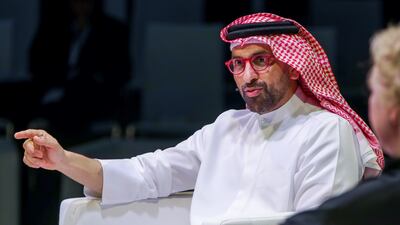
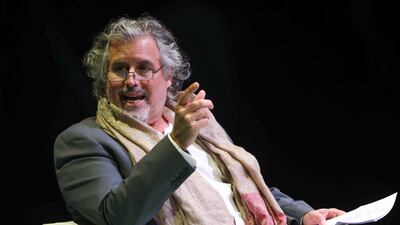
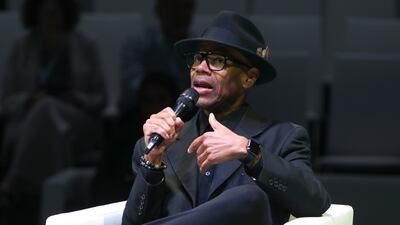
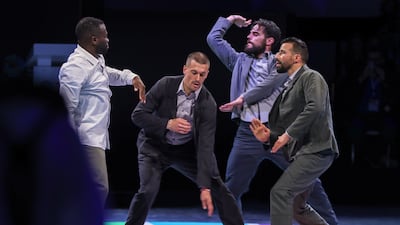
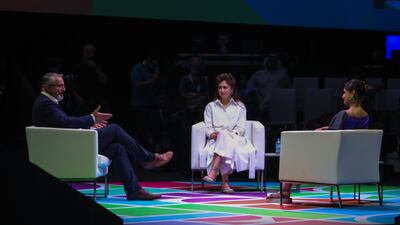
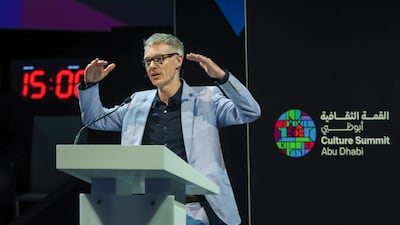
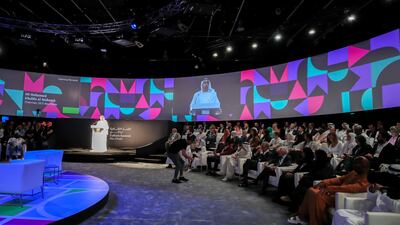
Forensic Architecture founder Eyal Weizman speaking at the Culture Summit Abu Dhabi. Victor Besa / The National

How 'forensic architecture' is being used to solve war crimes across the world


Hareth Al Bustani
  • English
  • Arabic

Technological developments in arts and culture are contributing to an increase in accountability for human rights abuses, the Culture Summit Abu Dhabi has heard.

Eyal Weizman, founder and director of Turner prize-nominated Forensic Architecture, a research agency based at Goldsmiths, University of London, spoke in a session about how the organisation uses cutting-edge techniques in spatial and architectural analysis, alongside various other tools, to investigate human rights abuses across the world.

“You would ask, ‘What has architecture got to do with politics and human rights?’” said Weizman. “I have myself started with an analysis exposing violations of human rights undertaken by Israeli architects in the occupied Palestinian territories by building settlements, that control and survey Palestinians,” he said.

“These are hilltop settlements, designed by architects almost as strategic tools, in what I call the civilian occupation.” He said these settlements enter, control and fragment Palestine.

“You see how architecture and planning can actually not only serve people, not only show the best of humanity, but also be an exercise of violence.”

Weizman said the research agency has offices in Berlin, London, Bogota, Mexico City and “very importantly”, in Ramallah, which it runs together with the human rights organisation Al-Haq.

Weizman, who is also a professor of spatial and visual cultures at Goldsmiths, University of London, said: “Forensic architecture is a way of reading architectural facts, architectural material, architectural situations, in order to see within them evidence for these violations that I'm speaking about.

“Perhaps the best way to understand it is, just like a pathologist reads a dead body — looking at the bones — forensic architecture looks for evidence of these crimes in walls, in foundations, in buildings, in plans, in bridges, in roads etc in a way that they're conceived sometimes, in order to survey and control us.”

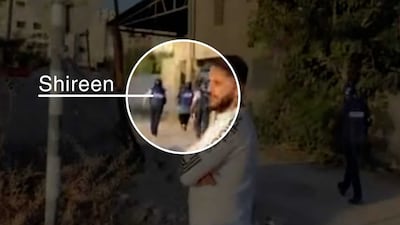
See how 'forensic architecture' was used to piece together the killing of journalist Shireen Abu Akleh below

  • A video shows the journalists, including Shireen Abu Akleh, slowly walking towards Israeli forces, following standard press protocols for self-identification. All photos: Forensic Architecture and Al-Haq
    A video shows the journalists, including Shireen Abu Akleh, slowly walking towards Israeli forces, following standard press protocols for self-identification. All photos: Forensic Architecture and Al-Haq
  • Photogrammetry model with location of armoured vehicle at time of shooting.
    Photogrammetry model with location of armoured vehicle at time of shooting.
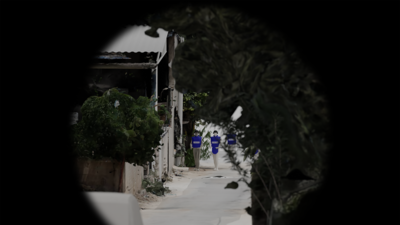
  • Digital reconstruction of the visibility of the journalists’ vests as seen from the location of the marksman, replicating the effect of the optical scope they most likely used (Trijicon COG x4), in the moment just before the first round of shots began.
    Digital reconstruction of the visibility of the journalists’ vests as seen from the location of the marksman, replicating the effect of the optical scope they most likely used (Trijicon COG x4), in the moment just before the first round of shots began.
  • Digital reconstruction of the six shots with known trajectories, revealing the tight proximity of their dispersal and positioning all at above-shoulder height.
    Digital reconstruction of the six shots with known trajectories, revealing the tight proximity of their dispersal and positioning all at above-shoulder height.
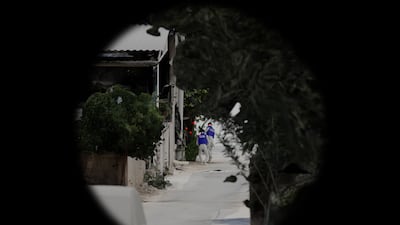
  • Optical reconstruction of the visibility of the journalist's vest in the moment he was shot, as seen from the location of the marksman.
    Optical reconstruction of the visibility of the journalist's vest in the moment he was shot, as seen from the location of the marksman.
  • The last moment Shireen is seen on camera still alive, crouching near the wall, after the first shot in the second round.
    The last moment Shireen is seen on camera still alive, crouching near the wall, after the first shot in the second round.
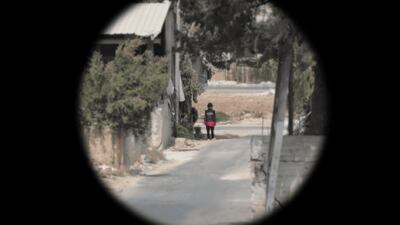
  • The visibility of Shireen’s vest at the moment she was shot.
    The visibility of Shireen’s vest at the moment she was shot.
  • Digital reconstruction of the first moment Shireen is seen lying on the ground, not far from where journalist Shatha Hanaysha is seen hiding behind a tree.
    Digital reconstruction of the first moment Shireen is seen lying on the ground, not far from where journalist Shatha Hanaysha is seen hiding behind a tree.

What makes forensic architecture so important is most civilians who die in war zones tend to die inside buildings, added Weizman. “And a majority of the people that die inside buildings die within their own homes — violence invades the most precious of public spaces.”

Weizman said forensic architecture resembles a process of archaeology — piecing together what happened through various traces of destruction. Pointing to a building hit by a drone strike in Miranshah, Pakistan, he said: “In this particular building, we're looking at every bit of shrapnel”.

By comparing architectural models with photographs and even physical models, Forensic Architecture tries to piece together events ranging from an enforced disappearance by Colombian security forces in the 1980s, to a 2006 neo-Nazi killing in Germany, and the killing of a black man, Harith Augustus, by the Chicago Police Department in 2018.

In the last case, synthesising footage from eight different body cameras, the team was able to show that the victim was reaching for his licencse when he was shot. “And that is material that goes into court and into newspapers in order to expose these forms of violence.”

The family of Palestinian-American journalist Shireen Abu Akleh, who submitted evidence compiled by Forensic Architecture and Al-Haq to the International Criminal Court investigation into her death. Willy Lowry / The National

In the West Bank, the group worked with Al-Haq to locate the exact place where Israeli forces fired the bullets that killed journalist Shireen Abu Akleh, and the ammunition that was used. He said this evidence was submitted by Abu Akleh’s family to the International Criminal Court investigation into her death.

In other examples, such as the Grenfell Tower fire in London in 2017, which killed dozens people, the models have been used as “gateways to recollection”, to help hundreds of witnesses that were too traumatised to remember exactly what happened.

“Being architects and also artists, we are participating in many exhibitions worldwide,” said Weizman. Forensic Architecture presented a model of the Miranshah building it created for the UN at Venice Biennale 2016, for example.

In one case, after being invited to exhibit at the Whitney Biennial in New York, the team used machine learning algorithms to create a project showing that the museum’s vice chairman was profiting from munitions and tear gas — which led to his resignation and divestment from the arms industry.

“Our work is presented in courts, but it's also presented in exhibitions, because we believe in the function and in the potential of art and culture, to allow places for accountability; to allow places where precise information about the most important aspects and the most important violations of human rights [can] be exposed.

“I think that this is a small example of how agency and accountability could be exercised through the creative process, through collaboration between artists, architects, lawyers and journalists, and how we can go across those disciplines in order to find a new way to exercise our art.”

Scroll through the gallery below to see more photos from days one and two of the Culture Summit Abu Dhabi

  • Sultan Sooud Al Qassemi, founder of Barjeel Art Foundation, takes part in the discussion on the third and final day of Culture Summit Abu Dhabi. All photos: Victor Besa / The National
    Sultan Sooud Al Qassemi, founder of Barjeel Art Foundation, takes part in the discussion on the third and final day of Culture Summit Abu Dhabi. All photos: Victor Besa / The National
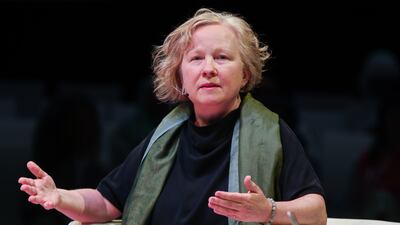
  • Manal Ataya, director general at Sharjah Museums Authority, also took part in the panel.
    Manal Ataya, director general at Sharjah Museums Authority, also took part in the panel.
  • Maya Allison, executive director and chief curator at the NYU Abu Dhabi Art Gallery, joined the discussion.
    Maya Allison, executive director and chief curator at the NYU Abu Dhabi Art Gallery, joined the discussion.
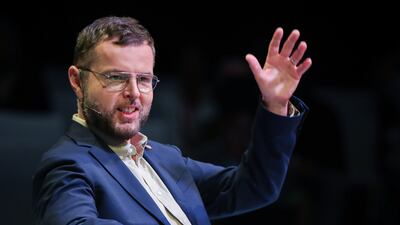
  • A panellist speaks during the event.
    A panellist speaks during the event.
  • The New Canon was one of the panels held on day three of the Culture Summit Abu Dhabi.
    The New Canon was one of the panels held on day three of the Culture Summit Abu Dhabi.
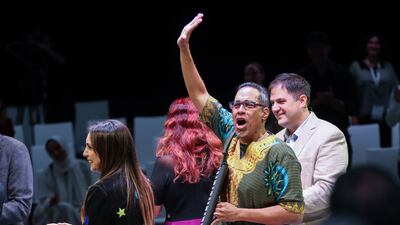
  • Famed pianist, composer and educator Danilo Perez waves to the crowd.
    Famed pianist, composer and educator Danilo Perez waves to the crowd.
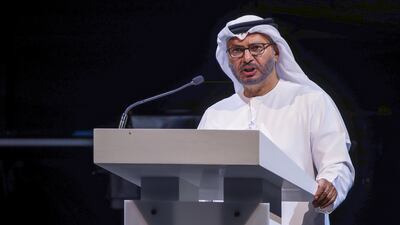
  • Former minister and now diplomatic advisor Anwar Gargash. Victor Besa / The National
    Former minister and now diplomatic advisor Anwar Gargash. Victor Besa / The National
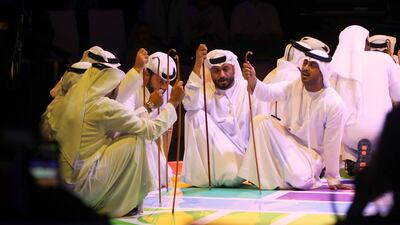
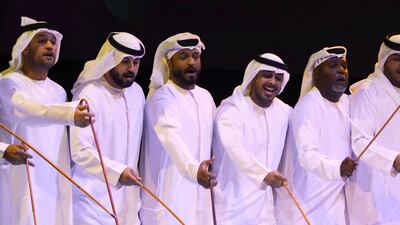
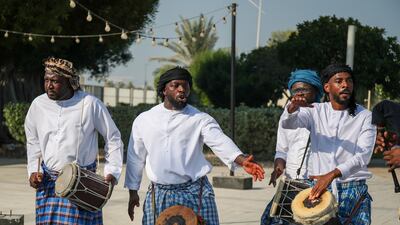
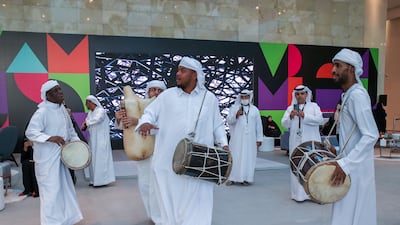
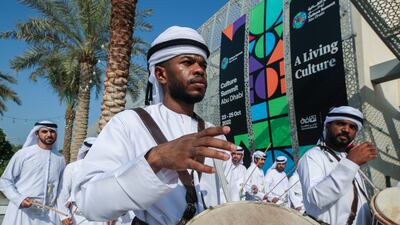
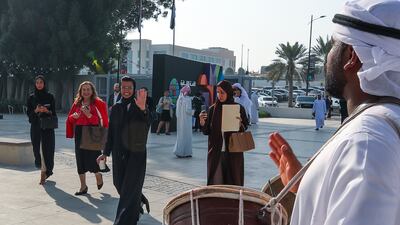
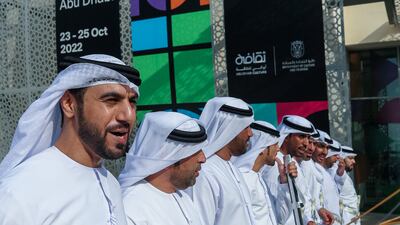
  • Visitors were treated to a traditional Al Ayala dance, where performers hold thin bamboo canes and move to steady drum rhythms.
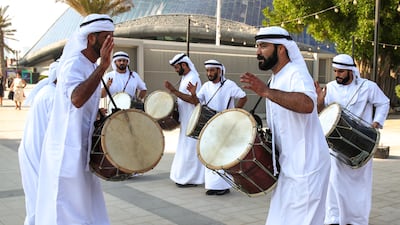
    Visitors were treated to a traditional Al Ayala dance, where performers hold thin bamboo canes and move to steady drum rhythms.
  • Al Ayala is often performed at weddings and other celebrations.
    Al Ayala is often performed at weddings and other celebrations.
  • Chris Dercon in conversation with architect Sir David Adjaye.
    Chris Dercon in conversation with architect Sir David Adjaye.
  • A session on Taking Bollywood Global: Dynamics of Diversity, moderated by Hans Fraikin, Abu Dhabi Film Commissioner.
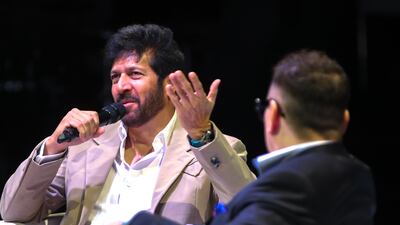
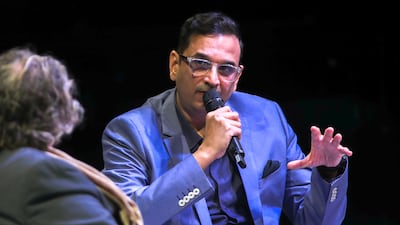
    A session on Taking Bollywood Global: Dynamics of Diversity, moderated by Hans Fraikin, Abu Dhabi Film Commissioner.
  • Kabir Khan, director of '83', in the conversation on Bollywood.
    Kabir Khan, director of '83', in the conversation on Bollywood.
  • Taking Bollywood Global: Dynamics of Diversity - Aashish Singh, Chief Executive Officer, Lyca Productions.
    Taking Bollywood Global: Dynamics of Diversity - Aashish Singh, Chief Executive Officer, Lyca Productions.
  • Andre Timmins, founder and director of Wizcraft and IIFA, as part of the discussion on Bollywood.
    Andre Timmins, founder and director of Wizcraft and IIFA, as part of the discussion on Bollywood.
  • A member of the audience watching a panel called 'Taking Bollywood Global: Dynamics of Diversity'.
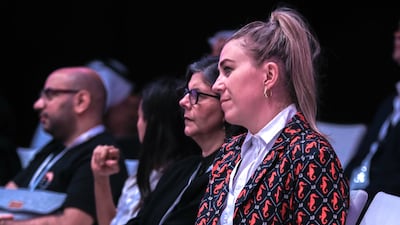
    A member of the audience watching a panel called 'Taking Bollywood Global: Dynamics of Diversity'.
  • Day three of the Culture Summit Abu Dhabi opened with a traditional performance from the mountain regions.
    Day three of the Culture Summit Abu Dhabi opened with a traditional performance from the mountain regions.
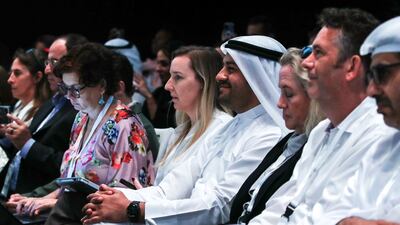
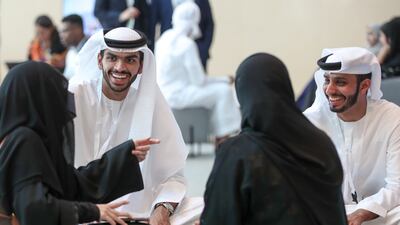
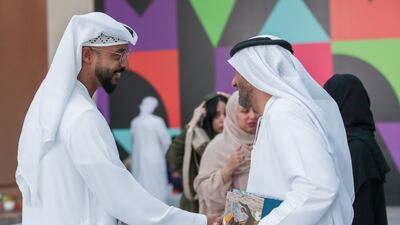
  • The event was a meeting of minds, with visitors from across various sectors sharing their thoughts on the post-Covid cultural world.
    The event was a meeting of minds, with visitors from across various sectors sharing their thoughts on the post-Covid cultural world.
  • Omar Saif Ghobash, UAE ambassador to Vatican, speaks at the event.
    Omar Saif Ghobash, UAE ambassador to Vatican, speaks at the event.
  • Grammy Award-winning producer Jimmy Jam discussed the regional music scene.
    Grammy Award-winning producer Jimmy Jam discussed the regional music scene.
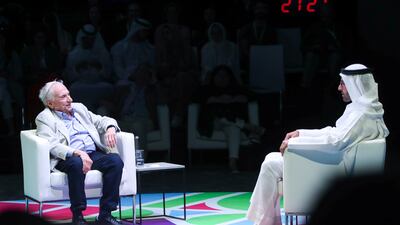
  • Mohamed Al Mubarak in conversation with Frank Gehry, Architect, Gehry Partners.
    Mohamed Al Mubarak in conversation with Frank Gehry, Architect, Gehry Partners.
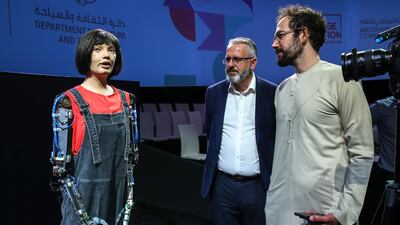
  • Robot artist Ai-Da, left, in conversation with The National's Hareth Al Bustani, far right, with her creator Aidan Meller, looking on.
    Robot artist Ai-Da, left, in conversation with The National's Hareth Al Bustani, far right, with her creator Aidan Meller, looking on.
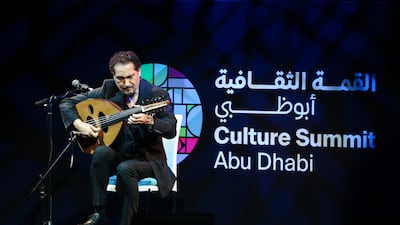
  • Performance by Iraqi oud virtuoso Naseer Shamma.
    Performance by Iraqi oud virtuoso Naseer Shamma.
  • The audience listens to Mohamed Al Mubarak in conversation with Frank Gehry, Architect, Gehry Partners.
    The audience listens to Mohamed Al Mubarak in conversation with Frank Gehry, Architect, Gehry Partners.
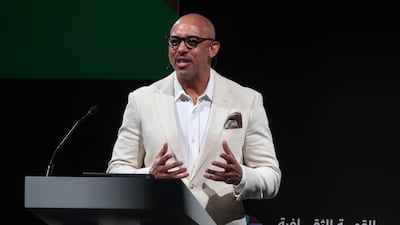
  • Harvey Mason Jr, chief executive of Recording Academy, lecturing on 'Music and Influence on Global Culture'.
    Harvey Mason Jr, chief executive of Recording Academy, lecturing on 'Music and Influence on Global Culture'.
  • An attendee on day two of the Culture Summit in Abu Dhabi.
    An attendee on day two of the Culture Summit in Abu Dhabi.
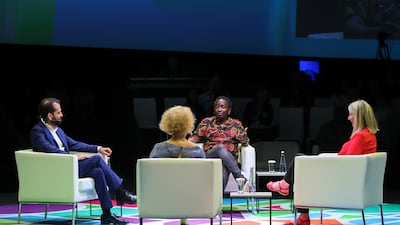
  • A discussion on 'Mentoring for Impact', with moderator Fiammetta Rocco, senior editor and culture editor of The Economist, and speakers Erica Love, director of Culture Central, Eric Wainaina, artist and founder of The Nairobi Musical Theatre Initiative, and Gael Hedding, director of Berklee Abu Dhabi.
    A discussion on 'Mentoring for Impact', with moderator Fiammetta Rocco, senior editor and culture editor of The Economist, and speakers Erica Love, director of Culture Central, Eric Wainaina, artist and founder of The Nairobi Musical Theatre Initiative, and Gael Hedding, director of Berklee Abu Dhabi.
  • A peformance of 'The Roots' by French Algerian choreographer Kader Attou, a dance performance in which he returns to the origins of hip-hop with an acrobatic celebration of the genre. Eleven dancers perform different facets of the former underground culture and show how the body can bend to different beats: from breakdance to Smurf, electric boogie to popping.
    A peformance of 'The Roots' by French Algerian choreographer Kader Attou, a dance performance in which he returns to the origins of hip-hop with an acrobatic celebration of the genre. Eleven dancers perform different facets of the former underground culture and show how the body can bend to different beats: from breakdance to Smurf, electric boogie to popping.
  • A discussion on 'AI and the Future of Culture', with moderator Priya Khanchandani, head of curatorial + interpretation at the Design Museum, and speakers Aidan Meller, director of Ai-Da Robot and Oxfordians, and Suhair Khan, founder and director of Open/Ended Design.
    A discussion on 'AI and the Future of Culture', with moderator Priya Khanchandani, head of curatorial + interpretation at the Design Museum, and speakers Aidan Meller, director of Ai-Da Robot and Oxfordians, and Suhair Khan, founder and director of Open/Ended Design.
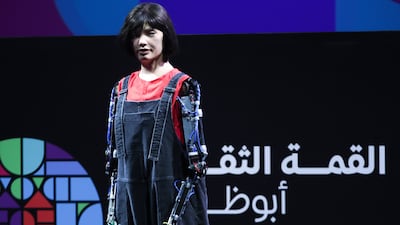
  • Artificial intelligence-powered robot artist Ai-Da at the Culture Summit in Abu Dhabi. Ai-Da's work reflects human aesthetic tastes and the conditions by which they are shaped.
    Artificial intelligence-powered robot artist Ai-Da at the Culture Summit in Abu Dhabi. Ai-Da's work reflects human aesthetic tastes and the conditions by which they are shaped.
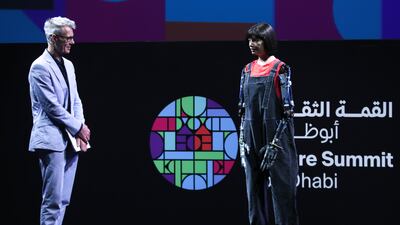
  • Ai-Da in conversation with Tim Marlow, chief executive and director of London's Design Museum, who analysed the creative philosophy of the world’s first humanoid artist.
    Ai-Da in conversation with Tim Marlow, chief executive and director of London's Design Museum, who analysed the creative philosophy of the world’s first humanoid artist.
  • Mr Marlow introduces Ai-Da at the summit.
    Mr Marlow introduces Ai-Da at the summit.
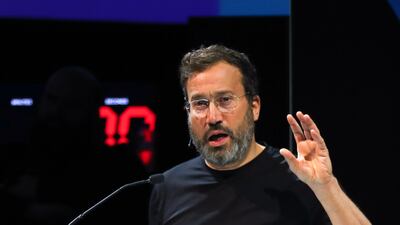
  • Eyal Weizman, director of research agency Forensic Architecture, speaks on the use of technology such as machine learning, as well as the importance of modelling and simulations.
    Eyal Weizman, director of research agency Forensic Architecture, speaks on the use of technology such as machine learning, as well as the importance of modelling and simulations.
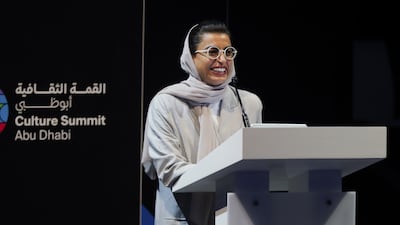
  • UAE Minister of Culture and Youth Noura Al Kaabi gives the keynote address.
    UAE Minister of Culture and Youth Noura Al Kaabi gives the keynote address.
  • This year’s Culture Summit will be attended by 1,000 people while another 5,000 will take part online.
    This year’s Culture Summit will be attended by 1,000 people while another 5,000 will take part online.
  • The summit seeks to identify ways in which culture can transform societies and communities around the globe.
    The summit seeks to identify ways in which culture can transform societies and communities around the globe.
  • The conference brings together decision makers in culture, heritage, public policy and technology, as well as artists, thinkers and performers from around the world.
    The conference brings together decision makers in culture, heritage, public policy and technology, as well as artists, thinkers and performers from around the world.
  • The summit is now in its fifth year.
    The summit is now in its fifth year.
  • It is organised by Abu Dhabi's Department of Culture and Tourism.
    It is organised by Abu Dhabi's Department of Culture and Tourism.
  • The theme of this year's event is 'A Living Culture'.
    The theme of this year's event is 'A Living Culture'.
  • The summit has returned with a more extensive programme.
    The summit has returned with a more extensive programme.
  • UAE Minister of Culture and Youth, Noura Al Kaabi at the summit.
    UAE Minister of Culture and Youth, Noura Al Kaabi at the summit.
  • In-person attendance returned to the event after it moved online for two years owing to the Covid-19 pandemic.
    In-person attendance returned to the event after it moved online for two years owing to the Covid-19 pandemic.
  • In only five years, the summit has grown from a noble idea into a staple of the international cultural calendar.
    In only five years, the summit has grown from a noble idea into a staple of the international cultural calendar.
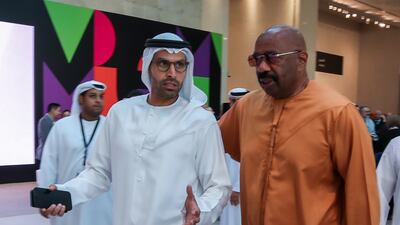
  • Mohamed Al Mubarak, chairman of DCT — Abu Dhabi, arrives with Steve Harvey.
    Mohamed Al Mubarak, chairman of DCT — Abu Dhabi, arrives with Steve Harvey.
  • Zaki Nusseibeh, cultural adviser to the President, attends the event.
    Zaki Nusseibeh, cultural adviser to the President, attends the event.
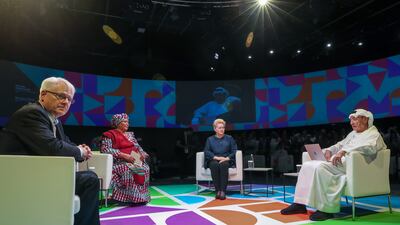
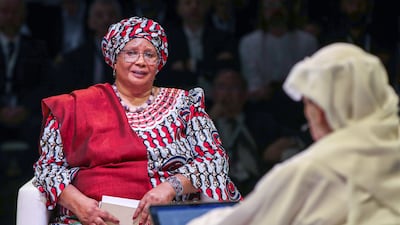
  • Mr Nusseibeh moderated a discussion on 'The role of culture in making resilient and shared societies', featuring former Lithuanian president Dalia Grybauskaite, former Malawian president Joyce Banda and former Croatian president Ivo Josipovic.
    Mr Nusseibeh moderated a discussion on 'The role of culture in making resilient and shared societies', featuring former Lithuanian president Dalia Grybauskaite, former Malawian president Joyce Banda and former Croatian president Ivo Josipovic.
  • Mr Al Mubarak makes the welcome speech and opening remarks.
    Mr Al Mubarak makes the welcome speech and opening remarks.
  • Ms Banda, former president of Malawi, takes part in the discussion moderated by Mr Nusseibeh.
    Ms Banda, former president of Malawi, takes part in the discussion moderated by Mr Nusseibeh.
How to help

Donate towards food and a flight by transferring money to this registered charity's account.

Account name: Dar Al Ber Society

Account Number: 11 530 734

IBAN: AE 9805 000 000 000 11 530 734

Bank Name: Abu Dhabi Islamic Bank

To ensure that your contribution reaches these people, please send the copy of deposit/transfer receipt to: juhi.khan@daralber.ae

Match info

Newcastle United 1
Joselu (11')

Tottenham Hotspur 2
Vertonghen (8'), Alli (18')

Scores in brief:

Day 1

New Zealand (1st innings) 153 all out (66.3 overs) - Williamson 63, Nicholls 28, Yasir 3-54, Haris 2-11, Abbas 2-13, Hasan 2-38

Pakistan (1st innings) 59-2 (23 overs)

The biog

Name: Dr Lalia Al Helaly 

Education: PhD in Sociology from Cairo

Favourite authors: Elif Shafaq and Nizar Qabbani.

Favourite music: classical Arabic music such as Um Khalthoum and Abdul Wahab,

She loves the beach and advises her clients to go for meditation.

Who was Alfred Nobel?

The Nobel Prize was created by wealthy Swedish chemist and entrepreneur Alfred Nobel.

  • In his will he dictated that the bulk of his estate should be used to fund "prizes to those who, during the preceding year, have conferred the greatest benefit to humankind".
  • Nobel is best known as the inventor of dynamite, but also wrote poetry and drama and could speak Russian, French, English and German by the age of 17. The five original prize categories reflect the interests closest to his heart.
  • Nobel died in 1896 but it took until 1901, following a legal battle over his will, before the first prizes were awarded.
In-demand jobs and monthly salaries
  • Technology expert in robotics and automation: Dh20,000 to Dh40,000 
  • Energy engineer: Dh25,000 to Dh30,000 
  • Production engineer: Dh30,000 to Dh40,000 
  • Data-driven supply chain management professional: Dh30,000 to Dh50,000 
  • HR leader: Dh40,000 to Dh60,000 
  • Engineering leader: Dh30,000 to Dh55,000 
  • Project manager: Dh55,000 to Dh65,000 
  • Senior reservoir engineer: Dh40,000 to Dh55,000 
  • Senior drilling engineer: Dh38,000 to Dh46,000 
  • Senior process engineer: Dh28,000 to Dh38,000 
  • Senior maintenance engineer: Dh22,000 to Dh34,000 
  • Field engineer: Dh6,500 to Dh7,500
  • Field supervisor: Dh9,000 to Dh12,000
  • Field operator: Dh5,000 to Dh7,000
Match info

Uefa Champions League Group F

Manchester City v Hoffenheim, midnight (Wednesday, UAE)

Avatar: Fire and Ash

Director: James Cameron

Starring: Sam Worthington, Sigourney Weaver, Zoe Saldana

Rating: 4.5/5

Brave CF 27 fight card

Welterweight:
Abdoul Abdouraguimov (champion, FRA) v Jarrah Al Selawe (JOR)

Lightweight:
Anas Siraj Mounir (TUN) v Alex Martinez (CAN)

Welterweight:
Mzwandile Hlongwa (RSA) v Khamzat Chimaev (SWE)

Middleweight:
Tarek Suleiman (SYR) v Rustam Chsiev (RUS)
Mohammad Fakhreddine (LEB) v Christofer Silva (BRA)

Super lightweight:
Alex Nacfur (BRA) v Dwight Brooks (USA)

Bantamweight:
Jalal Al Daaja (JOR) v Tariq Ismail (CAN)
Chris Corton (PHI) v Zia Mashwani (PAK)

Featherweight:
Sulaiman (KUW) v Abdullatip (RUS)

Super lightweight:
Flavio Serafin (BRA) v Mohammad Al Katib (JOR)

Ten10 Cricket League

Venue and schedule Sharjah Cricket Stadium, December 14 to 17

Teams

Maratha Arabians Leading player: Virender Sehwag; Top picks: Mohammed Amir, Imad Wasim; UAE players: Shaiman Anwar, Zahoor Khan

Bengal Lions Leading player: Sarfraz Ahmed; Top picks: Sunil Narine, Mustafizur Rahman; UAE players: Mohammed Naveed, Rameez Shahzad

Kerala Kings Leading player: Eoin Morgan; Top picks: Kieron Pollard, Sohail Tanvir; UAE players: Rohan Mustafa, Imran Haider

Pakhtoons Leading player: Shahid Afridi; Top picks: Fakhar Zaman, Tamim Iqbal; UAE players: Amjad Javed, Saqlain Haider

Punjabi Legends Leading player: Shoaib Malik; Top picks: Hasan Ali, Chris Jordan; UAE players: Ghulam Shabber, Shareef Asadullah

Team Sri Lanka Cricket Will be made up of Colombo players who won island’s domestic limited-overs competition

if you go

The flights

Fly to Rome with Etihad (www.etihad.ae) or Emirates (www.emirates.com) from Dh2,480 return including taxes. The flight takes six hours. Fly from Rome to Trapani with Ryanair (www.ryanair.com) from Dh420 return including taxes. The flight takes one hour 10 minutes. 

The hotels 

The author recommends the following hotels for this itinerary. In Trapani, Ai Lumi (www.ailumi.it); in Marsala, Viacolvento (www.viacolventomarsala.it); and in Marsala Del Vallo, the Meliaresort Dimore Storiche (www.meliaresort.it).

Updated: October 27, 2022, 11:13 AM