

Despite its edgy headliners performing clean versions of their greatest hits, Sunday night's Super Bowl half-time show did not go down without a bit of controversy.
Already referred to by some as one of the greatest half-time shows, the high-wattage performance, featuring hip-hop greats Dr Dre, Snoop Dogg, 50 Cent, Mary J Blige and Eminem, along with Kendrick Lamar and Anderson .Paak, proved that rap music can work as well in the family-friendly spectacle, one of the most-watched sporting events in the world.
But it is Eminem, music's most prominent white rapper, who is set to dominate post-show conversations and debates. As his rendition of the massive 2002 hit Lose Yourself ended at the 70,000-capacity SoFi Stadium, Eminem, dressed in a black hoodie, took a knee and held his head in his hand in an apparent tribute to Colin Kaepernick.
Scroll through the gallery for more pictures from the Super Bowl 2022 half-time show:
-
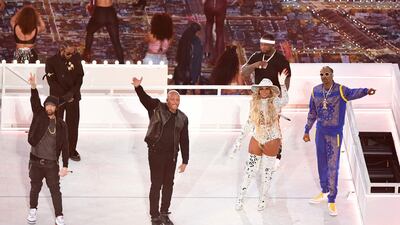
Eminem, Dr Dre, Kendrick Lamar, 50 Cent, Mary J Blige and Snoop Dogg perform during the half-time show of Super Bowl LVI between the Los Angeles Rams and the Cincinnati Bengals at SoFi Stadium in California. AFP -
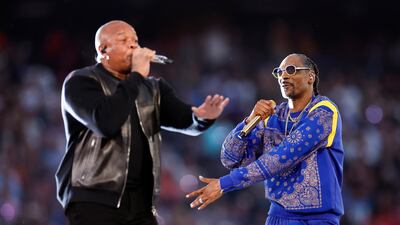
Dr Dre and Snoop Dogg open the show. EPA -
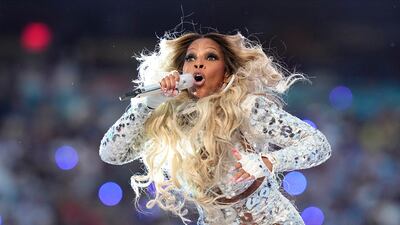
The star-packed line-up also featured R&B star Mary J Blige. AP -

Blige performing 'Family Affair', dressed in a sequinned white outfit with thigh-high boots, accompanied by a sparkling group of backup dancers. AP -
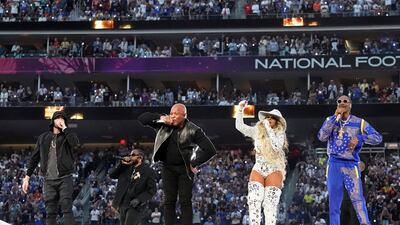
Eminem on stage with Kendrick Lamar, Dr Dre, Mary J Blige and Snoop Dogg. AP -

Eminem performed a few of his hits, including 'Forgot About Dre' with Anderson .Paak playing the drums. AP -
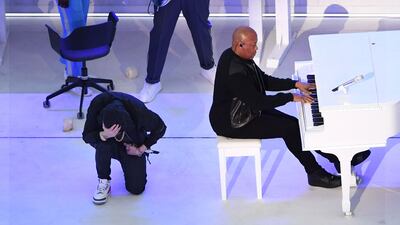
Eminem ends his set with his record-breaking 2002 song 'Lose Yourself' and by kneeling and placing his head in his hand, a gesture that former quarterback Colin Kaepernick made during the US national anthem at NFL games as a call for racial justice. AFP -
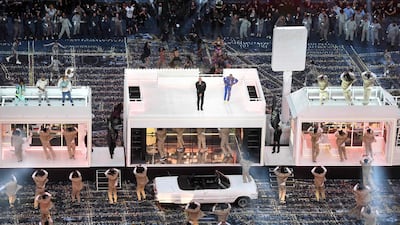
Dr Dre kicks off the performances at SoFi Stadium, standing behind a sound table on top of a makeshift white house. AFP -
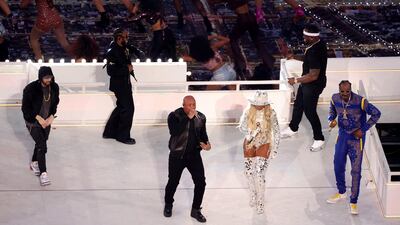
The hip-hop stars perform clean versions of their biggest hits. Reuters -
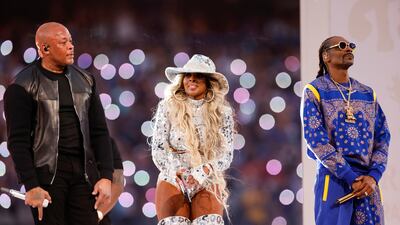
Dr Dre, Mary J Blige and Snoop Dogg on stage. EPA -
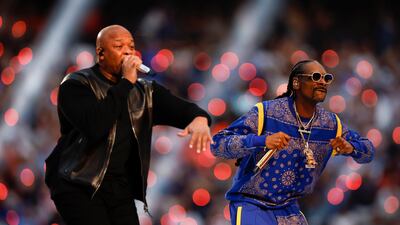
Dr Dre and Snoop Dogg during the half-time show. EPA -
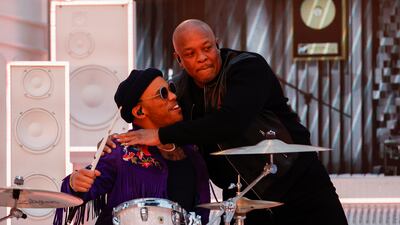
Dr Dre hugs rapper Anderson .Paak who played the drums. EPA -
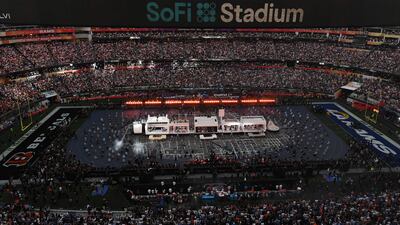
An aerial shot of the Super Bowl LVI half-time show. AFP -
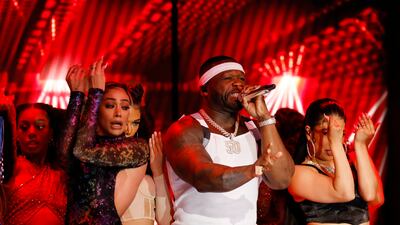
Surprise guest 50 Cent at the half-time show. EPA -
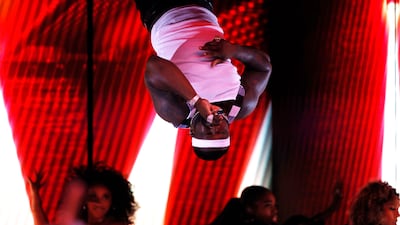
50 Cent performs his 2003 hit 'In da Club' while hanging upside down and dressed in a white tank top, like in the song's music video. EPA -
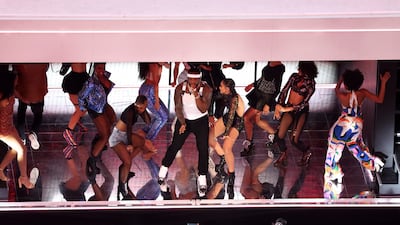
50 Cent performs during the half-time show. Reuters -
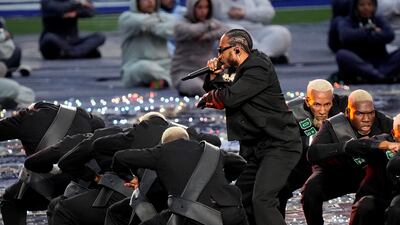
A black suit-wearing Kendrick Lamar performs alongside other men sporting the same outfit as him. AP -
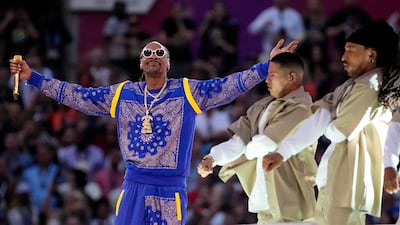
Before the show, Snoop Dogg said the NFL should have embraced rap years ago and that he hoped this would open doors for more hip-hop artists. AP -
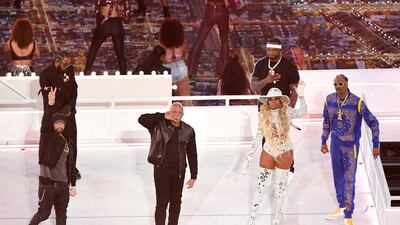
The six artists acknowledge fans after their performance. Reuters -
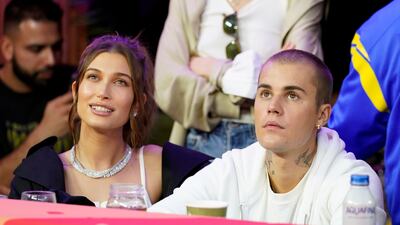
Justin Bieber and his wife, Hailey, watching the half-time show. AP -
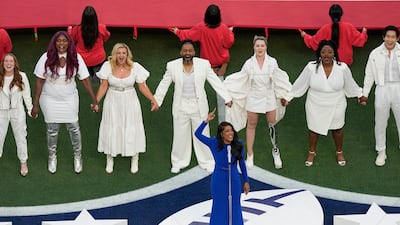
Country music artist Mickey Guyton performs the US national anthem before Super Bowl match. AP -
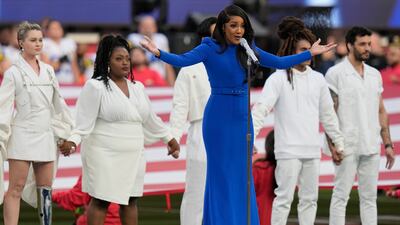
Guyton, who made history in 2020 as the first Black woman to earn a Grammy nomination in a country category, performed 'The Star Spangled Banner'. AP -

Guyton delivers a soaring, emotive version of the anthem, which she largely sang a cappella. Reuters -
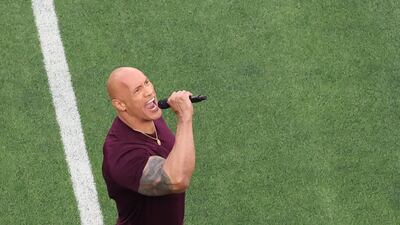
Dwayne 'The Rock' Johnson introduces the teams just before kick-off, putting on his old wrestling persona. Reuters -
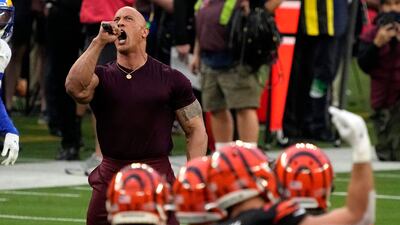
Johnson was a WWE champion before he became a movie star. AP -
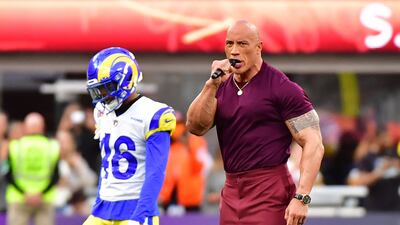
Dwayne Johnson delivering his pre-game speech. AFP


Kaepernick, a former NFL quarterback for the San Francisco 49ers, received worldwide attention in 2016 for kneeling during the US national anthem to protest against police brutality and racial injustice.
At Sunday's show, Eminem went down on one knee for a moment while Dr Dre sat in front of a piano and played the opening notes of his hit Still Dre, before all of the performers joined together to close the rap spectacular as fireworks lit up the sky.
While earlier reports suggested that the NFL, which owns the Super Bowl, had told Eminem not to kneel during the performance, a representative denied it soon after.
“We watched all elements of the show during multiple rehearsals this week and were aware that Eminem was going to do that,” league spokesman Brian McCarthy said.
Why did Colin Kaepernick 'take a knee' while he was a player in the NFL?

Before the American football season began in 2016, Kaepernick had been actively voicing his opinions on social media, decrying police violence against black Americans. Then, during the preseason games, reporters began to notice the quarterback was refusing to stand whenever the US national anthem was played.
"I am not going to stand up to show pride in a flag for a country that oppresses black people and people of colour," Kaepernick told NFL media after a game in August. "To me, this is bigger than football and it would be selfish on my part to look the other way. There are bodies in the street and people getting paid leave and getting away with murder."
As Kaepernick's activism received widespread coverage, more NFL players and professional athletes participated in various acts of silent protest, from sitting or kneeling to raising a fist, every time the US national anthem was played, soon sparking a nationwide debate. The support only strengthened Kaepernick's resolve, who soon stepped up his activism, donating millions to community groups and social justice causes throughout the country.
By March 2017, however, after leaving the San Francisco 49ers and becoming a free agent, Kaepernick was not signed by a single NFL team.
Then US president Donald Trump saw an opportunity in the raging debate: "Wouldn't you love to see one of these NFL owners, when somebody disrespects our flag, get that [expletive] off the field right now," he said at a rally.
What happened to Kaepernick after he left football?
In October 2017, Kaepernick filed a grievance against the NFL, accusing owners of colluding by not signing him and keeping him out of the league. The next year, an arbitrator denied the NFL's request to dismiss the complaint and allowed Kaepernick's lawsuit against the league to move forward. In February 2019, Kaepernick reached a settlement with the NFL and withdrew the grievance.
Since leaving the league, Kaepernick has continued his activism. He has been praised for his bravery, winning a number of honours including the American Civil Liberties Union's Courageous Advocate Award and Amnesty International's Ambassador of Conscience Award. GQ magazine also called him the Citizen of the Year in 2017.
In 2018, Nike released advertisements featuring Kaepernick, with the line: "Believe in something, even if it means sacrificing everything."
In 2019, Rihanna confirmed she had turned down an offer to perform for the Super Bowl half-time show, citing Kaepernick.
"I couldn't dare do that," she told Vogue. "For what? Who gains from that? Not my people. I just couldn't be a sell-out. I couldn't be an enabler. There's things within that organisation that I do not agree with at all, and I was not about to go and be of service to them in any way."
Last year, Netflix released a six-episode limited fictionalised drama series based on Kaepernick's life called Colin in Black & White.
Opening doors for hip-hop artists

Speaking ahead of their performance at the half-time show last week, Dr Dre said the show would create more opportunities for hip-hop.
“We’re going to open more doors for hip-hop artists in the future and making sure that the NFL understands that this is what it should have been a long time ago,” the rapper said at a media event also attended by Snoop Dogg and Mary J Blige.
“It’s crazy that it took all of this time for us to be recognised,” Dre said. “I think we’re going to do a fantastic job. We’re going to do it so big that they can’t deny us any more in the future.”
Snoop Dogg called it a “great moment” that combined “the biggest sporting event in the world” with hip-hop, “the biggest form of music in the world.”
“We appreciate the NFL for even entertaining hip-hop because we know a lot of people that don’t want hip-hop onstage,” he said. “But we’re here now and there’s nothing you can do about it.”
Social media responds to Eminem's gesture at the Super Bowl half-time show
Meanwhile, social media was abuzz with Eminem taking the knee.
"Eminem took the knee despite NFL [telling] him not to. Legend behaviour," one user wrote on Twitter.
"If you tell Eminem not to do something, Slim Shady will do it instead. A legend!" another wrote, referring to Eminem's alter ego.
"Eminem is the man. Great to see him take the knee after his performance," posted another fan.
Another fan called it a "beautiful" gesture.

