

What do the co-founder of Woodstock and the man who signed Led Zeppelin have to do with Turkey's biggest pop star?
At the turn of the millennium, American concert promoter Michael Lang and Atlantic Records co-founder Ahmet Ertegun were involved in Tarkan's bid to break into the American mainstream, the former as his manager and the latter, arguably Turkey's most influential figure in the international recording industry, as a supporter of his English-language ambitions.
By then, Tarkan's songs were already in vogue in Parisian nightclubs, while receiving airplay on Spanish-language radio stations in Latin America.

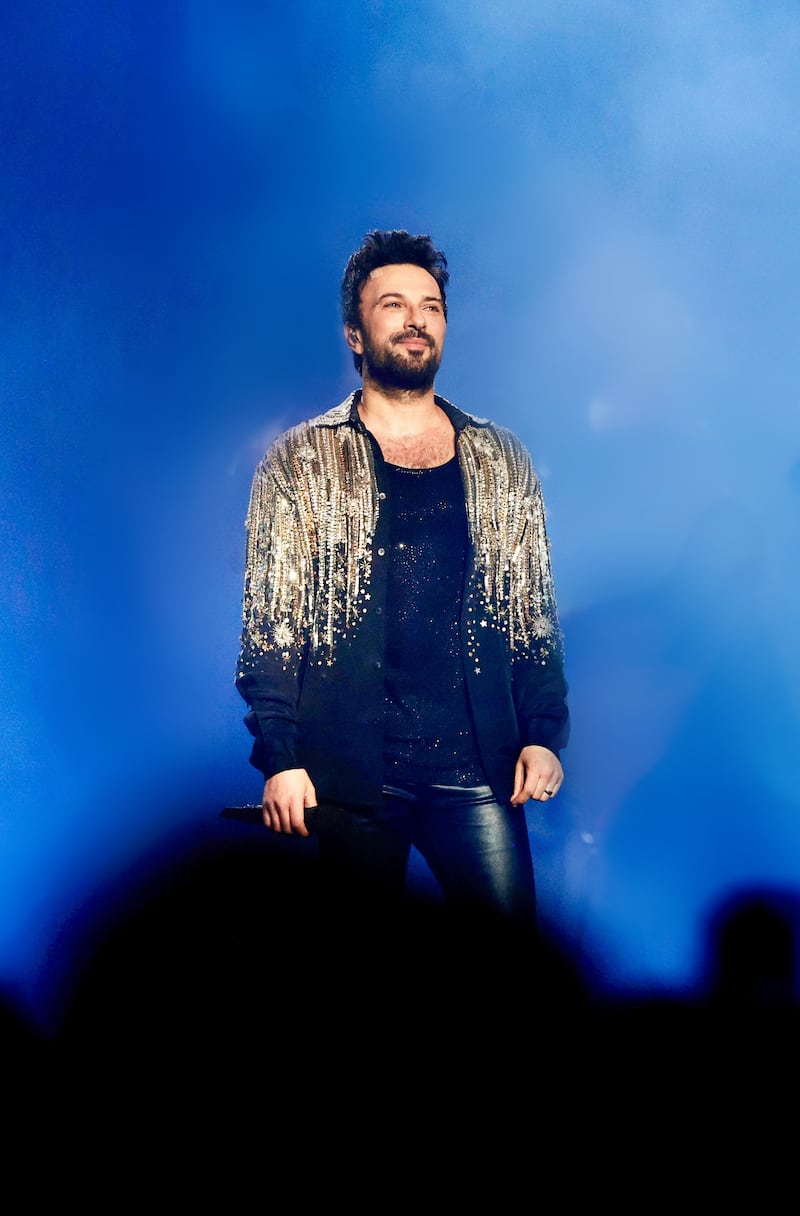
The 54-year-old, who will perform at Abu Dhabi's Etihad Arena on Friday, has sold more than 15 million records worldwide, according to his official biography, and has performed at major venues from London to Moscow.

Much of Tarkan's international appeal stems from what endeared him to audiences at home: the glamour and physicality of a modern pop star and a repertoire rooted in the melodic sensibilities of Turkish classical music.
The fusion of Turkish and western music was hardly new. The aranjman movement, which gained prominence in the 1960s, involved setting Turkish lyrics to European and American pop compositions, with singers such as Ajda Pekkan becoming household names. By the early 1990s, artists such as Sezen Aksu had helped establish a contemporary Turkish pop repertoire drawing extensively on the country's musical traditions.
Tarkan's musical education, however, was in the classical tradition. Born Tarkan Tevetoglu in Germany to Turkish parents, he moved to Turkey as a teenager, studying at a music association in Karamursel before continuing his education at Istanbul's Uskudar Music Society.

His debut album, Yine Sensiz, arrived in 1992 as commercial radio and television were transforming Turkey's entertainment industry. The proliferation of music videos gave Tarkan ample scope to develop his image as a pop heartthrob.
By incorporating belly-dance movements into his performances, Tarkan brought a brash male sensuality to Turkish dance-pop. While the flamboyant classical singer Zeki Muren had challenged conventions of masculine performance decades earlier, Tarkan did so for a generation growing up with MTV.
“I think people felt the emotion for the first time. They thought that, aside from being this cheeky young boy who sang (older hit) Kil Oldum, perhaps there was also an emotional young man there, someone who sang from the heart,” he told Turkish broadcaster Mehmet Ali Birand on the television programme 32 Gun in 2001.
The 1997 ballad Inci Tanem, which he wrote, deals with the pain of separation and the reassurance that love will endure it. Even one of his biggest dance hits, 2001's Kuzu Kuzu, is essentially a plea for forgiveness from a man acknowledging his romantic failings.
His versatility was already apparent on his second album, 1994's Aacayipsin, which reportedly sold more than two million copies and cemented his status as the Megastar, a title bestowed on him by the Turkish press.
Tarkan drew inspiration as readily from Turkish folk music as from American funk, with Seytan Azapta opening with a traditional march before developing into a funk number, while Gul Doktum Yollarina, for which he wrote the Turkish lyrics, features the oud and kanun alongside bass guitar and strings.
His exuberance and quirkiness are particularly evident on Simarik, from his 1997 album Olurum Sana. Featuring percolating percussion and a refrain punctuated by kissing sounds, the song is a playful account of a man exasperated by the behaviour of a woman he finds attractive.
Overseas audiences could sing along to its most memorable hook without understanding a word of Turkish.
Among those who spotted Tarkan's international potential was French record executive Alain Veille, who discovered his music through a friend returning from a holiday in Turkey, according to a 1998 report in industry publication Music & Media.
PolyGram France subsequently licensed his recordings, with Simarik reaching the top three in France and Switzerland and No 6 in Germany.
His popularity extended beyond Europe's sizeable Turkish diaspora, with research by German ethnomusicologist Martin Greve documenting significant numbers of non-Turkish concertgoers attending his European tour in the spring of 1999.
More surprising was his reception on the other side of the Atlantic. In July 2000, the Los Angeles Times reported that a radio station in San Juan, Puerto Rico, was playing Simarik an average of 55 times a week. Tarkan's self-titled international compilation also went platinum in Mexico, according to his official biography.
Simarik also spawned at least 34 cover versions in 24 languages, according to a 2019 study by University of Edinburgh academic Sebnem Susam-Saraeva. The most famous was Australian singer Holly Valance's Kiss Kiss, which topped the British singles chart in 2002.
It was a milestone for the Turkish pop industry that had spent much of its formative years adapting foreign compositions. Now international performers were looking to Turkey for their next hit.
Tarkan saw his international success as carrying a cultural responsibility.
“Simarik represented us, our country and our music. We have to continue that.
“All of these things are also laying the foundations for the English-language project, because I will be singing Turkish songs on stages in Europe,” he told 32 Gun.
It was a responsibility he took seriously, releasing Bir Oluruz Yolunda, an anthem supporting Turkey's national football team during its historic third-place finish at the 2002 World Cup, jointly hosted by South Korea and Japan.
Which brings us back to Ertegun. The record executive, whose father had served as Turkey's ambassador to the US, spent years searching for a Turkish artist with international potential. He recalled that search in a 2001 interview with The Washington Post, five years before his death.
“I saw him perform in Turkey and I thought he was one of the best live performers I had ever seen,” he said. “He's a great dancer, he moves beautifully, and he has the magic that all big hit artists share, which is the ability to get an emotion across through a recording.”
Tarkan also sensed the potential for an American breakthrough. Despite collaborations with Shakira's collaborator Lester Mendez and rapper Wyclef Jean, 2006's Come Closer, his only English-language album to date, made a modest commercial impact.

Tarkan subsequently doubled down on his Turkish repertoire, returning to his musical roots with 2016's Ahde Vefa, a collection of Turkish classical songs.
The ebullient Turkish pop of his latest album, 2024's Kuantum 51, keeps him a mainstay on the international arena circuit.
What Lang and Ertegun recognised in Tarkan nearly three decades ago was his potential to transcend language barriers.
As it turned out, he achieved just that by singing in his mother tongue and keeping his cultural roots intact.
Tarkan performs at Etihad Arena, Abu Dhabi, on Friday at 8.30pm; tickets start at Dh295

