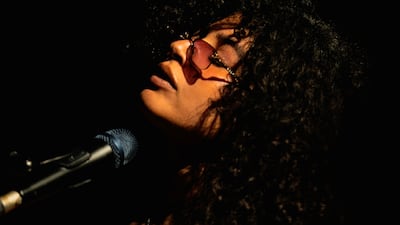

When Fafa performed the first of two planned shows at Abu Dhabi’s Hidden Bar in April, she faced the usual questions asked of a local musician: was there enough space, enough time and, most importantly, would people show up?
The gig, featuring Fafa and her band playing original material spanning neo-soul, jazz and R&B, left her with more welcome problems. The buzz around the show led to a follow-up a month later, which sold out, with people gathering outside the venue to listen to snatches of the performance.
The show was also recorded and released as The Veiled Essence Experience: Live at The Hidden Bar, a new live album capturing the Emirati-Honduran singer in a setting she had long wanted to see more of in the UAE.

The performances were part of the Music in the City initiative by Department of Culture and Tourism Abu Dhabi, in part to display some of the the breadth of the city’s music venues.
The turnout also suggested there was public appetite to hear original material from the local music scene.
“It just serves as a reminder that we have we have creativity and we have purpose,” Fafa, whose real name is Fatima bin Safwan, tells The National.
“We are so used to importing talent from abroad that it became normal. And so I want to normalise the idea that creativity already exists here.”
It is a conversation likely to become more prominent across the local music industry, from venues and promoters to singers and songwriters, when new royalty rules come into effect on December 1.
Premises including restaurants, cafes, hotels, malls and fitness centres will be required to obtain licences for copyrighted music. Under the system announced by the Ministry of Economy, fees will vary according to the size of the business and how the music is used, with live music and DJ performances attracting higher rates.
The system is designed to create a more formal route for songwriters and rights holders to receive royalties when their music is used commercially.
“It’s 100 per cent a game changer because now when I perform, I’m not only going to get paid for the performance, I’m also getting paid to perform my songs because of copyright,” Fafa says. “So now I’m getting two sources of income.”
But she says the commercial initiative should not be the reason an artist turns to original material.
“If your drive is to make money, then you need to get out of the game. If your driving factor is, ‘I’m going to do my originals now because I’m going to make money,’ you’re in it for the wrong reasons,” she says.
“The change can still encourage artists by giving original music another source of income, but what it really does is show that the wider system is beginning to recognise the value of artists creating and performing their own work.”
Fafa has been performing in the UAE for nearly a decade, with a sound that draws on R&B, soul, blues and jazz. She has performed at events including Bred Abu Dhabi and Sikka Art Festival in Dubai, as well as supporting Bruno Mars in Abu Dhabi.
Fafa is now recording studio versions of songs featured on the live album and plans to release physical editions incorporating art and poetry.
Once that material is released, she plans to return to UAE stages and hopes the conversation around those performances has evolved between venue and promoters and performers. Fafa adds that artists also need to be more assertive about playing their own work.
“Venues will tell you to play Top 40. It’s up to you whether you want to listen to that venue or not, because last time I checked, the venue is not an entertainment manager. Last time I checked, they’re not a musical director. Last time I checked, they hired you to do the entertainment,” she says.
“You as the entertainer should know better. And it gets to a point where they start hiring you because of that. But you have a proof of concept and you can bring in your own fan base. And if they don’t hire you back, well, it gives you a chance to learn and rework it.”
Before the Hidden Bar shows, Fafa had also begun to question why she should leave the UAE to chase opportunities when musicians from abroad were coming here to find them.
Her time studying songwriting and production in New York and Los Angeles had shown her what repeated access to open mics and small stages could do for an artist.
“Our experiences here as artists in the UAE and really the region are much different than in the States because we’re building the infrastructure ourselves,” Fafa says.
She talks of Abu Dhabi’s designation as a Unesco Creative City of Music and the incoming royalty system among signs of change.
“The government and the policymakers are already giving the tools and the resources to create that structure,” she says. “If there’s something happening that they’re unaware of, they are more than receptive to that information.”
Fafa is equally clear that those structures do not remove responsibility from artists.
“We are the ones who create the art. They give us the tools and enable the platform for us to be on there. If there’s something missing, then that is a conversation to be had,” she says.
“It is a relationship between the policymakers, government and the artists. We all need to be in the room. However, sometimes we do have to take it into our own hands, in a way that is still respectful and within the tools that are available.”

