

It's 5.30am and in the middle of the desert in Bahrain, hundreds of men, women and children of varying nationalities gather, filling up on tea and coffee as they wait patiently for the competition to begin.
A group of men confidently ride out on horseback. Some are dressed like cowboys, others like Native Americans. They're here to practise their reining skills – circles, spins and stops, loping and galloping – and it's something they do every weekend throughout the cooler months.
A civil engineer by day...
Hussain Fateel is one of the men dressed like a cowboy; his preferred get-up includes a western saddle for his steed and a Clint Eastwood-inspired costume. The Bahraini civil engineer grew up in a family of animal-lovers, and his horse-mad uncle, in particular, taught Fateel and his siblings the basics of riding while they were still young.
Look through the below photo gallery to see more of the cowboys in action:
-
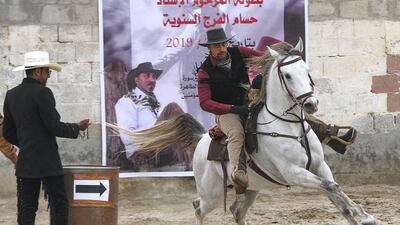
The cowboys of Bahrain meet up nearly every week throughout the cooler months to practise their reining skills. Phil Weymouth for The National -
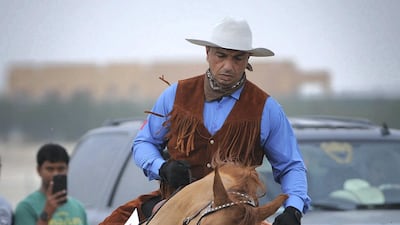
This particular event took place in Saar, Bahrain. Phil Weymouth for The National -

The Bahraini horse-riders enjoy dressing up like cowboys and Native Americans. Phil Weymouth for The National -
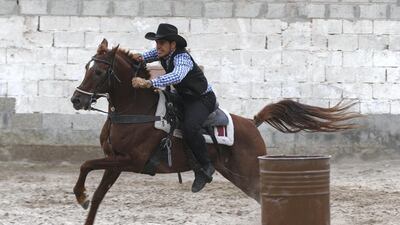
The events take place on private land or in the country's stables. Phil Weymouth for The National -

It's a subculture that's said to date back to the 1970s-80s, but its origins are tough to trace. Phil Weymouth for The National -
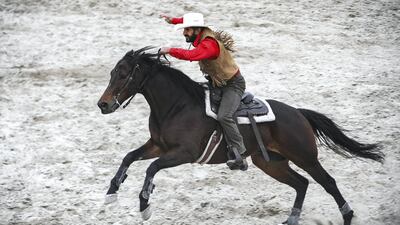
Reining - or western dressage - is a style of horse-racing practised by the cowboys. Phil Weymouth for The National -
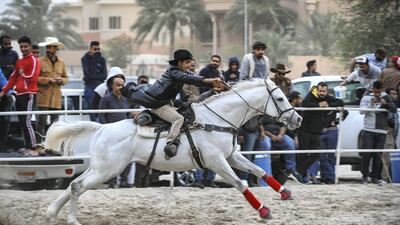
Hundreds of spectators show up to cheer the cowboys on each week. Phil Weymouth for The National -
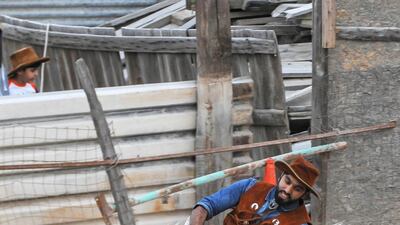
They practise circles, spins and stops, loping and galloping. Phil Weymouth for The National -
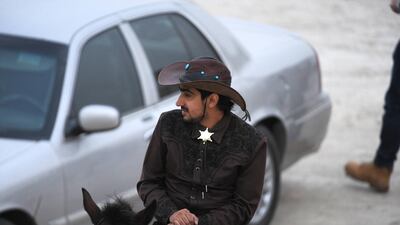
The men make their outfits themselves or buy them from Hussain Fateel, who imports the equipment and wardrobe essentials from America. Phil Weymouth for The National -
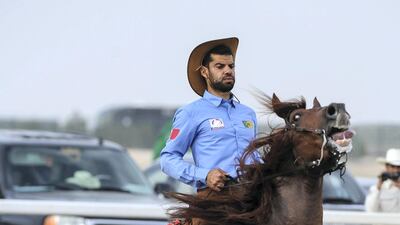
Hussain Fateel is keen to run more basic skills workshops in the future for the horse-riders. Phil Weymouth for The National -

The men are the subject of a new documentary by I Heart Film Productions. Phil Weymouth for The National


It's the memory of these lessons and of watching Western movies – The Good, The Bad and The Ugly was his favourite – on television as a child that inspired Fateel to explore the subculture. He even opened a dedicated cowboy shop in 2015 in the Bahraini town of Budaiya, and began importing all the necessary equipment and wardrobe essentials directly from the US.
There were about 20 to 30 cowboys in Bahrain at that time, he says (the subculture is said to date back to the 1970s-80s, although its origins are tough to trace). "When I opened the shop I faced a lot of resistance," Fateel tells The National. "People said, 'You're crazy for bringing American culture to Bahrain, nobody will buy from you'. But I managed to change the culture slowly, socialising with people, giving them gifts and hats."
Over the past four years, the perception has changed. Increases in rent have forced Fateel to move his shop – he has merged with a local veterinary shop to make ends meet – but a close-knit community has formed, with about 300 like-minded riders now meeting up for the friendly contests. "In the beginning they were too shy to wear the costumes and go to the events, but slowly, kids and people of all ages, and both genders, have started wearing the outfits and attending the events," he says.

A new documentary
It's not just riders and cheerleaders who turn up at the crack of dawn on Fridays, as the Bahraini cowboys have also captured the attention of local photographers and filmmakers, who join the growing group of spectators regularly. "One day I was having a walk by Qal'at Al Bahrain [the Bahrain Fort], and I saw the cowboys and was fascinated," says British-Egyptian filmmaker Shereen Shaltout, co-founder of local production house, I Heart Film Productions.
Shaltout and her Irish business partner, Helen McKee, got in touch with the gang immediately, keen to see if they could collaborate on a documentary about the subject. "I was amazed by their costumes and how much thought they clearly put into it," Shaltout says.
It is now about 18 months since they started filming and the project is in the production stage. The film follows three main characters, including Fateel, who act as the documentary's protagonists and drive the narrative forward. "The subculture is perhaps larger than we initially thought," McKee adds. "The following that the cowboys have is huge, not only on social media but also in terms of spectators and fans who come down to the events to watch and cheer on their friends or fellow riders from individual stables."
Throughout their time shooting, Shaltout has been inspired by the riders' passion, and their determination to practise their hobby. "Our recent trips have been exciting and informative," she says. "At each one, there are different riders and horses, and the costumes are unreal. There are such a broad variety of styles and even how they dress and prepare their horses is so individualistic.
The more time we spend with them, the more we notice different riders participating in different competitions, as well as the regulars. There seems to be a lot of camaraderie among the cowboys from different stables.”
A matter of funding
While the I Heart Film team is committed to making this observational documentary – their first feature film – Shaltout and McKee are looking for funding in order to finish the project, which is a labour of love for the pair, who were both raised in Bahrain and studied film in the UK. Usually, you'd find them filming weddings, corporate videos or TV commercials.
“We just felt that, having grown up here, we want to show real stories from real people in this part of the world,” Shaltout explains. “All we want to do is observe this group, tell their story as honestly as possible, and let whoever comes across this film – if it ever gets made – to make up their own mind.”
But creating this kind of documentary with no commercial backing is difficult, as Bahrain's film industry is fairly small in comparison to other countries, Shaltout adds. The idea of ultimately getting it distributed and screened still seems far-fetched. "There are many talented Bahraini filmmakers, but there isn't a big enough infrastructure set-up, government or privately supported, that specifically helps fund and promote films produced in Bahrain to enter into international film festivals," says McKee.
And yet, Bahrain is a rich canvas, with a culture that is ideal for creating observational documentaries, adds Shaltout. "There are so many stories in this part of the world, especially Bahrain, and we just think the people are really unique," she says. "The people are extremely kind and inclusive. No matter what your background or culture, Bahrain is extremely open and welcoming to all."
'Everybody is really inspired'
In many ways, that's the spirit this cowboy community embodies, and perhaps that's why it's becoming so popular. "Everybody is really inspired by this," Fateel says. "Almost every week you'll see a competition, if it's the season."
He says the community has also seen an inkling of government support, through the Bahrain Royal Equestrian and Endurance Federation (Breef), while the Bahrain Reining Committee was even asked to organise a cowboy event. Fateel wrote his own manual on how competitions should be judged and scored for the occasion.
Now, they want to see more reining competitions – often referred to as "western dressage" – that are officially approved by the International Federation for Equestrian Sports (FEI). These kinds of sports, after all, are important to this island nation, as horses are believed to have been part of Bahrain's culture for about 4,000 years. King Hamad bin Isa Al Khalifa also continues to support activities that aim to preserve this strand of the country's past. "The horse riders like it so much and the competition is so high, they think we need to do this," Fateel adds.
While FEI-approved reining is slightly different to the style of riding the Bahraini cowboys are used to, they're willing to adapt, says Fateel. The riders are looking to perfect their skills in order to prepare for and enter international events. But they're only at the beginning of their journey into cowboy territory, he adds. "The horse riders [internationally] have special skills and they train their horses for years and years before they become perfect in the reining competition," Fateel says.
He feels that his cowboy collective is not ready to compete with them quite yet, as a number of fellow riders have still to learn how to saddle up or brake without hurting their horses, for example. "It will take years before we change the people," Fateel says, explaining that he has run some basic skills workshops already and hopes to hold more in the future. "The [government] support is our big goal."
But he won't stop trying. It's in his blood, after all. "When you're into horse riding you might want to quit, but you won't be able to," he says with a laugh, explaining that he tried to take a break while at university to focus on his studies. "After graduation, when I got engaged to my wife, the first gift I gave her was a horse."
He hasn't looked back since and, as one of the stars of this new "Western" film, he may soon share that unbridled passion with the world.

