Denis Villeneuve in the Liwa desert while filming 'Dune'. Photo: Chiabella James

Why 'Dune' director Denis Villeneuve chose 'mesmerising' Abu Dhabi as his Arrakis


Evelyn Lau
  • English
  • Arabic

It’s one of the most anticipated films of the year, and Abu Dhabi has a starring role in Denis Villeneuve’s Dune, which will hit UAE cinemas on Thursday.

The sci-fi epic was partly filmed in the Liwa desert and uses the vast open landscape as the setting for the planet Arrakis.

In the film, which is adapted from the book series of the same name by Frank Herbert, the dangerous planet is known for its exclusive supply of Spice, the most essential and valuable commodity in the universe.

Described as a desert planet with no surface water bodies, Liwa seemed to be the perfect location. However, producers were initially looking for something a little different.

“When the producers were looking to the UAE, the brief wasn’t about a big desert landscape,” says Robbie McAree of Epic Films, which provided production services for Dune.

“We were looking for locations that had big, rocky mountains with desert around, which sounds achievable but it’s not particularly easy to find in the UAE, especially when they’re also looking at other countries like Jordan where you have places like Wadi Rum.

“Eventually it changed. They fell in love with the UAE and the desert landscape so much that they decided to choose the UAE for the vast desert landscapes.”

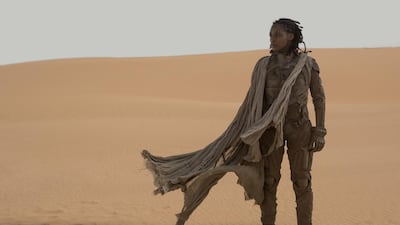
  • Sharon Duncan-Brewster as Liet Kynes, an Imperial Planetologist who was originally written as a man in Frank Herbert's novel. All photos: Chiabella James / Warner Bros Pictures
    Sharon Duncan-Brewster as Liet Kynes, an Imperial Planetologist who was originally written as a man in Frank Herbert's novel. All photos: Chiabella James / Warner Bros Pictures
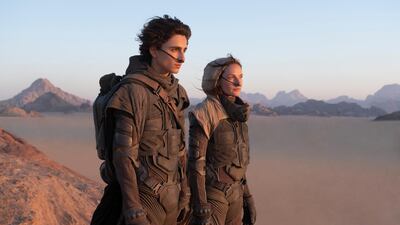
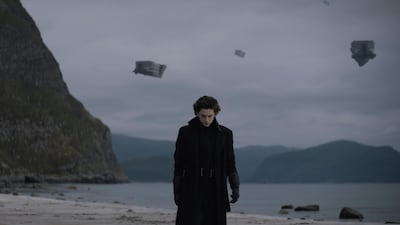
  • Timothee Chalamet as Paul Atreides and Rebecca Ferguson as Lady Jessica Atreides in 'Dune'.
    Timothee Chalamet as Paul Atreides and Rebecca Ferguson as Lady Jessica Atreides in 'Dune'.
  • Ferguson plays Chalamet's mother in the sci-fi film.
    Ferguson plays Chalamet's mother in the sci-fi film.
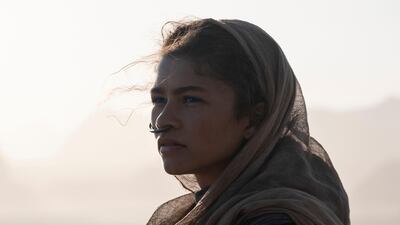
  • Zendaya stars as Chani, one of the native Fremen inhabitants of the planet Arrakis.
    Zendaya stars as Chani, one of the native Fremen inhabitants of the planet Arrakis.
  • Oscas Isaac plays Duke Leto Atreides, Chalamet's father.
    Oscas Isaac plays Duke Leto Atreides, Chalamet's father.
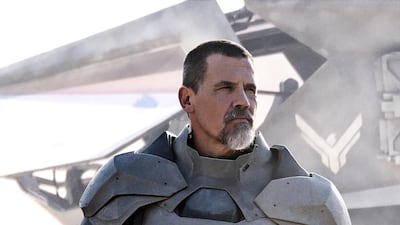
  • Josh Brolin as elite warrior Gurney Halleck.
    Josh Brolin as elite warrior Gurney Halleck.
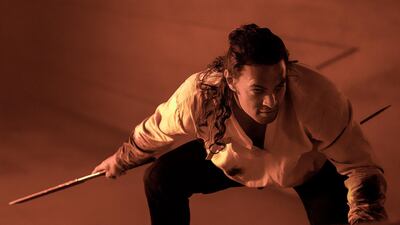
  • Jason Momoa as Duncan Idaho, a warrior who helps train Chalamet's character.
    Jason Momoa as Duncan Idaho, a warrior who helps train Chalamet's character.
  • A sequel to the film has now been confirmed.
    A sequel to the film has now been confirmed.
  • Scenes were filmed in Jordan and the UAE, as well as Budapest.
    Scenes were filmed in Jordan and the UAE, as well as Budapest.

Even though producers found their Arrakis, the next challenge was to decide when and how to film, in order to achieve the environment they were looking for. McAree says a creative choice was taken to film during July and August, typically the hottest months in the UAE.

“Logistically it was challenging, however, we did come up with an approach that was safe for everyone. We would film for a few hours in the morning, we’d have a break during the hot hours in midday and then we’d go back out again in the late hours of the afternoon,” he says.

It wasn’t only the actors and crew that had to deal with rising temperatures, but also the equipment used. McAree says special tents with air conditioning and temporary shades had to be created to help keep things cool.

Despite the heat, there was also a specific reason why Villeneuve wanted to film during those months.

“Summer in the UAE has greyer skies and a lot more haze. For Denis’s vision of Dune, it was absolutely perfect. We all knew that it was going to be harsh but he wanted that for a reason," says McAree.

In a behind-the-scenes video released by the Abu Dhabi Film Commission, Villeneuve revealed what drew him to Liwa as a central location for the film.

"What I found in Abu Dhabi is unmatchable. There’s a scale to the dunes and the desert in a variety of shapes that we thought was absolutely mesmerising," he says.

"There’s also some climatic conditions there that were perfect for us because of the proximity to the city, it's like a strange kind of haze in that air that I was looking for that matched totally with the look of the film.”

Although Dune won't be released in the US for another month, reviews have been promising. The cast and crew received an eight-minute standing ovation after the film's debut at the Venice Film Festival earlier in September.

On the back of the blockbuster, Abu Dhabi now has a stronger position to promote itself as a major filming locale, in the hopes that future productions will also consider coming to the capital.

Sharon Duncan-Brewster as Liet Kynes in a scene from 'Dune'.

Dune is yet another example of how Abu Dhabi continues to attract major international productions. By doing so, the large and diverse pool of crew that we have here gain invaluable experience working with major players such as Netflix, Legendary Pictures and Paramount on projects such as Dune, Mission Impossible and 6 Underground,” says Hans Fraikin, head of the Abu Dhabi Film Commission.

“The success of such projects in turn attracts more productions from across the globe – Hollywood, Bollywood and the Arab world – because they can see that Abu Dhabi offers everything they need to realise their creative vision, smoothly and seamlessly.”


Mobile phone packages comparison

Mercer, the investment consulting arm of US services company Marsh & McLennan, expects its wealth division to at least double its assets under management (AUM) in the Middle East as wealth in the region continues to grow despite economic headwinds, a company official said.

Mercer Wealth, which globally has $160 billion in AUM, plans to boost its AUM in the region to $2-$3bn in the next 2-3 years from the present $1bn, said Yasir AbuShaban, a Dubai-based principal with Mercer Wealth.

Within the next two to three years, we are looking at reaching $2 to $3 billion as a conservative estimate and we do see an opportunity to do so,” said Mr AbuShaban.

Mercer does not directly make investments, but allocates clients’ money they have discretion to, to professional asset managers. They also provide advice to clients.

“We have buying power. We can negotiate on their (client’s) behalf with asset managers to provide them lower fees than they otherwise would have to get on their own,” he added.

Mercer Wealth’s clients include sovereign wealth funds, family offices, and insurance companies among others.

From its office in Dubai, Mercer also looks after Africa, India and Turkey, where they also see opportunity for growth.

Wealth creation in Middle East and Africa (MEA) grew 8.5 per cent to $8.1 trillion last year from $7.5tn in 2015, higher than last year’s global average of 6 per cent and the second-highest growth in a region after Asia-Pacific which grew 9.9 per cent, according to consultancy Boston Consulting Group (BCG). In the region, where wealth grew just 1.9 per cent in 2015 compared with 2014, a pickup in oil prices has helped in wealth generation.

BCG is forecasting MEA wealth will rise to $12tn by 2021, growing at an annual average of 8 per cent.

Drivers of wealth generation in the region will be split evenly between new wealth creation and growth of performance of existing assets, according to BCG.

Another general trend in the region is clients’ looking for a comprehensive approach to investing, according to Mr AbuShaban.

“Institutional investors or some of the families are seeing a slowdown in the available capital they have to invest and in that sense they are looking at optimizing the way they manage their portfolios and making sure they are not investing haphazardly and different parts of their investment are working together,” said Mr AbuShaban.

Some clients also have a higher appetite for risk, given the low interest-rate environment that does not provide enough yield for some institutional investors. These clients are keen to invest in illiquid assets, such as private equity and infrastructure.

“What we have seen is a desire for higher returns in what has been a low-return environment specifically in various fixed income or bonds,” he said.

“In this environment, we have seen a de facto increase in the risk that clients are taking in things like illiquid investments, private equity investments, infrastructure and private debt, those kind of investments were higher illiquidity results in incrementally higher returns.”

The Abu Dhabi Investment Authority, one of the largest sovereign wealth funds, said in its 2016 report that has gradually increased its exposure in direct private equity and private credit transactions, mainly in Asian markets and especially in China and India. The authority’s private equity department focused on structured equities owing to “their defensive characteristics.”

Updated: September 22, 2021, 2:19 PM