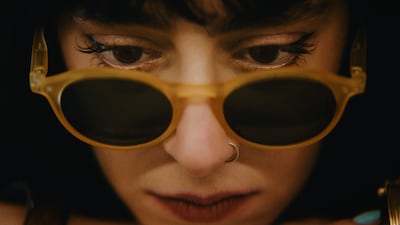
It’s not often a first-time feature filmmaker gets the backing of a Hollywood heavyweight such as George Clooney. But that’s exactly what has happened to Lebanese director Rami Kodeih, 43, and his co-writer and wife, Nora Mariana, with their debut feature Furies.
Clooney’s Smokehouse Pictures, which he runs with producing partner Grant Heslov, came on board for the film, which was unveiled at this year’s Venice Film Festival on September 4.
Clooney and Heslov were both in Venice for the screening, adding further star power to the film’s debut. For Kodeih and Mariana, though, Smokehouse’s appeal goes beyond the names attached to it. The production company’s credits include the Oscar-winning Argo, as well as Clooney-directed films such as The Monuments Men and The Tender Bar.


“Something we love about his filmography and Smokehouse’s filmography is they really make films intended for anyone in the world to enjoy, but they have something to say,” says Mariana, sitting alongside Kodeih in a private room at the festival’s HQ. “That’s something that we hope for our film.”
While Kodeih spent three decades in Lebanon, cultivating a career in documentary films, Mariana – who has Lebanese roots – hails from Los Angeles. The couple have lived in the US for the past decade, but Lebanon’s recent turbulent history has affected them greatly – and inspired the plot for Furies.
When Lebanon’s banking crisis took hold in 2019, Mariana needed surgery and was planning to pay for it with savings she had banked in Lebanon.
“One day, we were not able to access our money and that was extremely traumatic,” says Kodeih. “A couple of days after, Nora sends a message to one of her close friends in Lebanon, saying: ‘Do I have to write a movie about us heisting our own money back?’”
And that's what happened. During the Covid-19 pandemic, Mariana began writing Furies scene by scene, “out of catharsis and out of fantasy”, she says.

That fantasy has now made it to the big screen. The film tells the story of sisters Maro (Rym Mroue) and Dalia (Maria Nakouzi) embroiled in the banking crisis of 2019 that affected so many in Lebanon.
As bleak as the backdrop is, the film plays out like a tense crime thriller as the resourceful siblings hit upon the idea to break into a local bank and steal back the money owed to them – partly to pay for life-saving surgery needed for Dalia, echoing Mariana's own experience.
“We both love and have a huge passion for the heist genre,” says Kodeih. His favourite is Stanley Kubrick’s racetrack classic The Killing, while Mariana lists Rififi, the French masterpiece depicting a robbery that plays out in near-silence.
Certainly, the contrast between Rififi and Furies is striking. “In Beirut, it’s extremely loud,” says Mariana, who points out how crucial it was for them to film in Lebanon.
“It felt important to have it in the streets of Lebanon because there is an essence, there is a soul to places that you cannot replicate. Even with the best talents in the world, you cannot replicate the soul of a city.”

Another thing that sets Furies apart from most other heist movies is that its two female protagonists instigate the crime. Mariana notes that one of her favourites as a child was Ridley Scott’s feminist thriller Thelma & Louise, while Kodeih loved James Cameron’s sci-fi sequel Aliens. “They both have very strong women in the lead, and we talked a lot about this. Like, what’s this attraction?”
The answer was personal. “I think part of it is our mums are incredible. They’re strong women who went through separately very challenging socio-economic, socio-political crises in their lifetimes, but they were the anchors of their family. They have a sense of humour in the face of difficult circumstances.”
The question of just how far you’d go for a relative is at the core of the film, and it’s not hard to sense that the couple’s hearts ache while they are so far from their families.
“It breaks your heart in a very different way than when you're actually living in Lebanon because you’re just living off speculation,” says Kodeih. “Every day I’m talking to my parents and my family and friends, but you wake up in a way that’s not settled.”
He points to the traumatic port explosion in Beirut in 2020, another horrifying moment that caused so much grief and pain. “We were depressed for a long time after that. It becomes psychological and psychologically damaging, and then you try to get out of that trauma yourself. It’s very different.”
Only one question remains: did Mariana ever get her money back from the Lebanese banks?
“No,” she says with a sigh. “They sold my grandfather’s house to pay for my surgery. At the time, that was the way my family handled it. But, yeah, I prefer how the characters handled it.”