


Camel racing, grass-mowing, saunas and the art of glass bead-making might not sound like they have much in common, but there's one thread now tying these activities together.
They have all been added to the United Nations Educational, Scientific and Cultural Organisation’s prestigious list of Intangible Cultural Heritage this week.
The organisation annually announces a list of cultural artefacts that capture the spirit and heritage of various countries around the world, in a bid to ensure their protection.
This year, 35 new entries have been added to the list, including sauna culture in Finland, sourdough making in Malta and Budima dancing in Zambia.
Two entries have ties to the UAE
The time-honoured tradition of camel racing made the cut after it was submitted jointly by the UAE and Oman.
Camel racing forms a bedrock of Emirati culture, with tens of thousands of camels from across the Gulf competing for prize money at landmark calendar events such the Sheikh Hamdan bin Mohammed Festival, usually held in February.
-
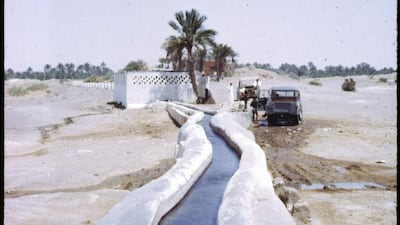
An aflaj in the Al Ain area taken at some point between 1962 and 1964. Courtesy: David Riley One time use - permission must be sought from desk or David - -
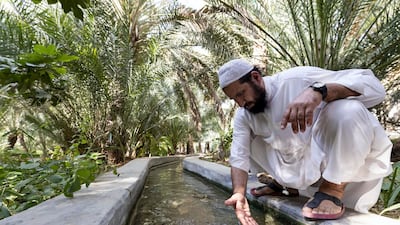
A farmer dips his hands into the aflaj at Al Ain Oasis. A aflaj is an ancient irrigation channel. Chris Whiteoak / The National -
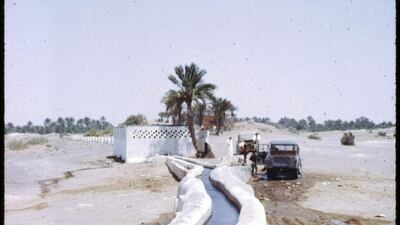
An aflaj in the Al Ain area taken at some point between 1962 and 1964. The development of the falaj system allowed settlements to expand. Courtesy David Riley -
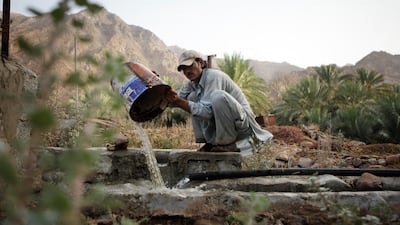
A worker pours water into an aflaj in the town of Nahwa. Galen Clarke / The National -
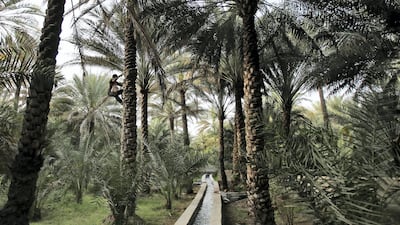
Shahid Iqbal, a date farm worker from Pakistan, climbs up a palm tree over a fresh water canal based on the aflaj at the Al Qattara Oasis in Al Ain. Kamran Jebreili / AP Photo


Aflaj – the system of Iron Age water channels used for farm irrigation in Al Ain – also made it to Unesco's list, after being submitted by the Emirates.
The irrigation system, created by digging water tunnels by hand, is thought to be one of the oldest in the region.
Entries from the Middle East
Also new to the list of intangible cultural heritage in need of urgent safeguarding is Sa’eed, the art of handmade weaving found in upper Egypt.
“(Sa’eed) is a complex process requiring intricate craftsmanship. Many steps and techniques are involved in preparing the looms, threading and weaving to achieve the final product," Unesco said.
"Although the practice is a source of identity and pride for the communities concerned, it faces many threats, which have led to its neglect and weakened transmission to the young."

The traditional weaving practice of Al Sadu in Saudi Arabia and Kuwait was also highlighted by the organisation and added to the list.
The technique comprises weaving in a horizontal style, with threads forming a tightly woven, durable textile with patterns that reflect the desert environment. According to Unesco, Al Sadu is typically practised by the Bedouin community, although it has become less of a functional product and more a signifier of tradition and culture.
A combined entry from Azerbaijan, Iran, Turkey and Uzbekistan was the “art of the miniature”, artwork involving small paintings in books, rugs and textiles, using materials such as gold, silver and organic dyes.
From sourdough to couscous: the foods that made the cut
Several dishes have been showcased in the intangible cultural heritage list.
Among them is couscous, with the entry submitted jointly by Algeria, Mauritania, Morocco and Tunisia. The Berber dish, made up of small steamed balls of crushed durum wheat, has risen in popularity over the past few years, and is widely hailed as a superfood.
The preparation of couscous, seen as a “ceremonial process" according to Unesco, is what led to its inclusion on the list.

Paraguay’s terere drink was also awarded Unesco status. The traditional drink mixes cold water with poha nana medicinal herbs crushed in a mortar.
In Singapore, "hawker" culture was awarded recognition.
The city-state is full of open-air food courts where vendors serve delectable and cheap dishes in “community dining rooms”, where people of diverse backgrounds come together. Dishes are usually refined through the years, with each "hawker" specialising in one dish and passing on the knowledge to their next of kin.
Finally, flattened sourdough bread found in Malta also made its way to the list. Il-ftira has a thick crust, light texture within, and is usually filled with ingredients such as olive oil, capers, tomatoes and olives. As Unesco noted: “Eating ftira as a filled snack or appetiser fosters a shared identity in Malta, and skilled bakers are required to shape it by hand.”
Sauna culture, lantern lighting and grass mowing also recognised
In Korea, the lantern-lighting festival of Yeondeunghoe made its way to the list. The annual event, also known as the Lotus Lantern Festival, is celebrated throughout Korea, with colourful lanterns decorating streets and crowds parading with handmade lanterns.
The art of glass bead-making was jointly recognised in Italy and France, with the spheres made using traditional tools and processes. “Gifts made with glass beads are used to mark certain events and social occasions,” noted Unesco.
Sauna culture was inscribed in the list for playing an integral part in the lives of the Finnish population. As noted by Unesco: “It is not only used to wash one’s body, but also to cleanse the mind and enjoy a sense of inner peace.”
The fine art of mechanical watchmaking in Switzerland and France was included for "shaping the architecture, urban landscape and everyday social reality of the regions concerned, where craftsmanship remains particularly dynamic”.
In Kupres, a town located in Bosnia and Herzegovina, grass mowing is seen as much more than just a chore, and was also recognised in this year's list.
The town even has an annual mowing competition in July called Strljanica, which involves the manual mowing of grass using a scythe.

