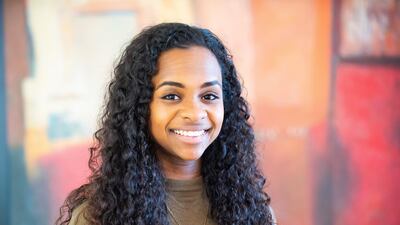
It was 2019, and Hafsa Zayyan was enjoying all the trappings of a fledgling professional career; a first-class education at both Cambridge and Oxford, training in Singapore and finally a great job working as a dispute resolution lawyer in the City of London. But, she admits, there was a part of her brain that was “dusty and completely unattended to”. On a night off, she went to the launch of Stormzy’s new publishing imprint, Merky Books, and, it’s fair to say, it was life-changing.
The British grime artist was also asking for submissions from unpublished and unrepresented 16 to 31-year-old writers, looking for “stories that are not being heard, and the stories that deserve to be read”. Zayyan immediately remembered the experience of her husband’s family, expelled from Uganda by Idi Amin in 1972, simply because they were of South Asian heritage.
“There were almost 30,000 people who had to come to the UK,” says Zayyan of a forced migration that is estimated to have affected 55,000 people in total. “Incredible, and yet it felt to me that I didn’t know anything about it; it seemed to have been erased from history. I started thinking about what it was like to lose everything, how the trajectory of people’s lives could be completely changed.”
So Zayyan set about piecing together her 2,500-word entry for the competition, which initially comprised a poetic, reflective letter written by a successful Indian-Ugandan business owner, Hasan, to his late wife. The Merky Books New Writers' Prize judges saw it and immediately asked for the rest of her manuscript, in the next seven days. The problem was, Zayyan hadn't written any of it.
It was at this point that Sameer, a young, high-flying lawyer living in present-day London, was woven into text, his coming-of-age tale and family story dovetailing intricately with the historical elements of Hasan’s experiences in Uganda. “Like me, he’s a product of his culture,” says Zayyan, “and I know exactly where he came from and how he came to be.”
This combination of contemporary and historical cultural insight from a hitherto unknown writer was almost too good to be true for Merky. Zayyan won the prize in June 2019, and then was asked for a full finished version of her novel to be delivered that same year. “I spent many a night after work in the British Library researching refugee camps in multicultural Britain,” she says.
The result – We Are All Birds of Uganda – was finally published last week, although it could have seen the light of day earlier if Covid-19 hadn't got in the way. The pace and urgency with which it was written is evident in the story itself, which races through decades of racial tension, immigration and generational ties in Kampala, Leicester and London.
The Ugandan experience is certainly enjoying something of a moment in literary fiction. Last year, Jennifer Nansubuga Makumbi's The First Woman explored the aftermath of Amin's reign of terror, and next month, Neema Shah's Kololo Hill will explore similar territory to We Are All Birds of Uganda.

What's interesting is that among these three, Zayyan is the only writer without Ugandan heritage. When we talk it's the day after the presidential election in the country, and she won't really be drawn on the current situation, but the shared experience and effects of mass migration on future generations (Zayyan's parents are Pakistani and Nigerian and spent some time in Saudi Arabia) means the story takes on an allegorical feel, too.
"It's interesting, a lot of the time my generation don't know about the experience of our parents and grandparents because they don't like to talk about the trauma of it," she says. "I didn't grow up listening to my grandparents discuss the Partition, or my parents tell me stories of the prejudice they suffered. Maybe that's natural given we were children; these were painful episodes in their lives. But as you get older as an immigrant child, that journey of discovering more about where you come from comes at the same time as you start to question what you're doing with your life."
Which is a neat way of surmising Sameer. He starts out as something of a wide boy, living life to the full in London. It's only when he realises something is missing, that he is searching for his own identity, that he starts to look again at Uganda, setting himself on course for conflict with his own family and finding succour in a contemporary reading of Islam.
“When you’re young, and living that fast life, it can feel quite empty,” Zayyan says. “Sameer’s faith journey is part of the way he discovers elements of himself he’d not considered before. More generally, it was also important to me to write a book that had a positive depiction of Islam because you don’t really see that in literature.”
Zayyan is a practising Muslim and is really keen to emphasise that the book is not meant to preach, rather reflect how Islam has been positive for her. It does so sensitively, highlighting all the doubts, fears and worries of any young person on a faith journey. "It is meant to be a subtle portrayal," she says. "To be honest, I just wanted to counter the thousands of stories that get published about Islamic terrorism. Something positive."
Whether the book ends on a positive note, though, is intriguingly unclear. Its cliffhanger conclusion is possibly the most literary device in an otherwise relatively straightforward expository novel.
It'll certainly make for interesting book club discussions – which Zayyan is happy to encourage; she actually wrote the "reading group questions" herself.
“I just wanted to make sure that people who finished the book, who were probably feeling all these emotions, really got some direction about the parallels across the decades, the way that the issues facing migrants back then can still affect migrants today. We all have that intergenerational trauma I think, and we all try and let it go,” she says.
Stories across the generations continue to intrigue Zayyan. As the Merky Books Prize underlines, there are still so many that remain untold. "I feel I have to say something about my next book," she says with a nervous laugh.
After all, she's still intending to continue her day job. "But it'll be something written from the perspective of someone who's a bit older. I just find they have so much to tell, and they never get to tell it because nobody cares. We really should. Because once they've died, the stories are gone."

