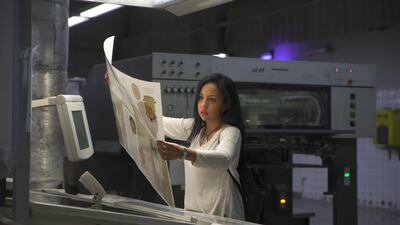
Yasmine El Dorghamy says that keeping 'Rawi' going has been challenging in these harsh economic times. Yasmine El Dorghamy

How 'Rawi' magazine continues to tell stories of Egyptian heritage against all odds


Hamza Hendawi
  • English
  • Arabic

Almost a decade ago, Yasmine El Dorghamy took on a task that was borderline impossible in her native Egypt.

The daughter of an Egyptian diplomat, who spent her time criss-crossing the globe, attending schools in places as far apart as Greece, Mexico, Japan and Mauritius, El Dorghamy, 40, acted upon a lofty idea, but one that would keep her grounded: publishing a cultural periodical, Rawi (Storyteller), in Egypt that offers material inviting to ordinary folk yet nuanced and sophisticated enough for experts and academics.

El Dorghamy will publish an 11th edition next year, which will be her 10th anniversary issue, focused on the history of healing medical practices in Egypt. But it hasn’t been easy.

'Rawi' is an cultural publication focused on Egyptian heritage. Yasmine El Dorghamy

Egypt, now a nation of almost 100 million people, has traditionally been labelled the cultural centre of the Arab world, with its once-prolific film industry, theatre, book publishing and classical art forms, such as ballet and opera, setting it apart from the rest of the region. And while that’s no longer the case, at least not entirely – a condition brought about by economic woes, the rapid spread of religious conservatism and the emergence or growth of rival cultural centres – it still provides plenty of rich material for El Dorghamy’s magazine.

The challenge has been to keep the title financially afloat, not least in the current harsh economic climate. After years of political and economic turmoil in Egypt, it has been the devastating financial fallout from the coronavirus pandemic that has taken its toll this year. "We were slammed hard against a wall from day one," El Dorghamy tells The National.

People's concentration span is a problem. If you don't engage readers right away, they will leave you right away

Similar titles to Rawi have not been so lucky. The list of publications that have had to close because they're no longer commercially viable has grown. "Many superficially say that you cannot find enough readers for a publication like Rawi, but I have found out this was not true. They do exist and they are many. The problem is that publishing a good cultural product is prohibitively costly."

El Dorghamy says the magazine is sold on the news stand at a third of its production cost to make it accessible to more people, but that securing funds to publish it is difficult. “It’s nearly impossible in Egypt to finance anything that is not commercial,” she says.

That’s why she is tirelessly searching for funders to secure the magazine’s future. “I started learning every trick in the game,” the editor-in-chief wrote to a potential sponsor in a delicately penned letter that seamlessly mixed pragmatism and hope.

"How to cut costs, how to stay relevant (we produced some iconic covers), and how to keep enough people interested in order to stay afloat. I knew Rawi would not grow into the publishing company I had dreamt of any time soon, but if I could just keep it alive until we ride out the storm, there would be hope."

It all began for El Dorghamy when the inaugural edition of Rawi was published only two months before the 2011 uprising that toppled long-time president Hosni Mubarak – a particularly unstable time for a fledgling title. Nevertheless, El Dorghamy pressed on and the content of Rawi's initial editions was a "deliberate bouquet of diverse articles showing the many facets of Egyptian heritage".

Yasmine El Dorghamy is the editor-in-chief of 'Rawi'. Yasmine El Dorghamy

But the magazine later made a shift that has taken it where it is today. Every edition is now devoted to a single topic, from Coptic heritage to the jewellery industry.

The eighth publication was the first released in this “encyclopedic” style. Dedicated to the history of Egyptian modern art, it covered the main aspects of the topic offering a comprehensive timeline. Issue nine was on Egyptian cinema, while the 10th, and the latest edition, focuses on Egypt’s culinary history.

El Dorghamy recalls that the eighth issue was exceptionally difficult to put together. Given little had been written on the topic, she had to reconcile the contradictions in the literature she found and identify experts or academics reliable enough to write the articles. "We delayed publication for six months and in the end, it took us a total of 18 months to prepare, but it constituted a landmark in the history of Rawi," she says. "That edition, which has 200 pages, earned Rawi recognition and fame. Now, they teach from that edition in arts colleges in Egypt."

For El Dorghamy, 10 years in, she can see the impact the magazine has on its readers. “I tried to bridge the gap between the academic or the specialised and what is accessible, but now I feel I don’t need to do that any more. I don’t want to patronise my audience.”

She plans to engage with her readers through expansion into multimedia and special editions that can run at a shorter length. This will help the brand to stay relevant in a country where, as the case is in many others, the internet and streaming services have grown more popular than traditional media.

Rawi, like books, is up against tough competition from a host of forums for information and entertainment available on the internet and subscription-based streaming services. "People's concentration span is a problem. If you don't engage readers right away, they will leave you right away. You're competing with well-made series and documentaries on streaming services. Anyone who tells you that he or she is not reading less because of them is a liar."

It's against this backdrop that Rawi shines as evidence of an Egypt that continues to give in the face of formidable odds. It offers readers – in Arabic and English – a rich range of in-depth articles written by experts in their respective fields, as well as a generous dose of attractive visuals and fine printing.

More information is available at rawi-magazine.com

The%20Letter%20Writer
%3Cp%3E%3Cstrong%3EDirector%3A%3C%2Fstrong%3E%20Layla%20Kaylif%3C%2Fp%3E%0A%3Cp%3E%3Cstrong%3EStars%3A%3C%2Fstrong%3E%20Eslam%20Al%20Kawarit%2C%20Rosy%20McEwen%2C%20Muhammad%20Amir%20Nawaz%3C%2Fp%3E%0A%3Cp%3E%3Cstrong%3ERating%3A%3C%2Fstrong%3E%202%2F5%3C%2Fp%3E%0A
ABU%20DHABI%20CARD
%3Cp%3E%0D%3Cstrong%3E5pm%3A%3C%2Fstrong%3E%20Al%20Rabi%20Tower%20%E2%80%93%20Maiden%20(PA)%20Dh80%2C000%20(Turf)%201%2C400%0D%3Cbr%3E%3Cstrong%3E5.30pm%3A%3C%2Fstrong%3E%20Wathba%20Stallions%20Cup%20%E2%80%93%20Handicap%20(PA)%20Dh70%2C000%20(T)%201%2C600m%0D%3Cbr%3E%3Cstrong%3E6pm%3A%3C%2Fstrong%3E%20Abu%20Dhabi%20Championship%20%E2%80%93%20Listed%20(PA)%20Dh180%2C000%20(T)%201%2C600m%0D%3Cbr%3E%3Cstrong%3E6.30pm%3A%3C%2Fstrong%3E%20Hili%20Tower%20%E2%80%93%20Handicap%20(PA)%20Dh80%2C000%20(T)%202%2C200m%0D%3Cbr%3E%3Cstrong%3E7pm%3A%20%3C%2Fstrong%3EUAE%20Arabian%20Derby%20%E2%80%93%20Prestige%20(PA)%20Dh150%2C000%20(T)%202%2C200m%0D%3Cbr%3E%3Cstrong%3E7.30pm%3A%3C%2Fstrong%3E%20Abu%20Dhabi%20Championship%20%E2%80%93%20Listed%20(TB)%20Dh380%2C000%20(T)%202%2C200m%3C%2Fp%3E%0A
What to watch out for:

Algae, waste coffee grounds and orange peels will be used in the pavilion's walls and gangways

The hulls of three ships will be used for the roof

The hulls will painted to make the largest Italian tricolour in the country’s history

Several pillars more than 20 metres high will support the structure

Roughly 15 tonnes of steel will be used

Results

6pm: Dubai Trophy – Conditions (TB) $100,000 (Turf) 1,200m 

Winner: Silent Speech, William Buick (jockey), Charlie Appleby
(trainer) 

6.35pm: Jumeirah Derby Trial – Conditions (TB) $60,000 (T)
1,800m 

Winner: Island Falcon, Frankie Dettori, Saeed bin Suroor 

7.10pm: UAE 2000 Guineas Trial – Conditions (TB) $60,000 (Dirt)
1,400m 

Winner: Rawy, Mickael Barzalona, Salem bin Ghadayer 

7.45pm: Al Rashidiya – Group 2 (TB) $180,000 (T) 1,800m 

Winner: Desert Fire, Hector Crouch, Saeed bin Suroor 

8.20pm: Al Fahidi Fort – Group 2 (TB) $180,000 (T) 1,400m 

Winner: Naval Crown, William Buick, Charlie Appleby 

8.55pm: Dubawi Stakes – Group 3 (TB) $150,000 (D) 1,200m 

Winner: Al Tariq, Pat Dobbs, Doug Watsons 

9.30pm: Aliyah – Rated Conditions (TB) $80,000 (D) 2,000m 

Winner: Dubai Icon, Patrick Cosgrave, Saeed bin Suroor  

THE%20STRANGERS'%20CASE
%3Cp%3E%3Cstrong%3EDirector%3C%2Fstrong%3E%3A%20Brandt%20Andersen%3Cbr%3E%3Cstrong%3EStarring%3A%20%3C%2Fstrong%3EOmar%20Sy%2C%20Jason%20Beghe%2C%20Angeliki%20Papoulia%3Cbr%3E%3Cstrong%3ERating%3A%3C%2Fstrong%3E%204%2F5%3C%2Fp%3E%0A
Napoleon
%3Cp%3E%3Cstrong%3EDirector%3C%2Fstrong%3E%3A%20Ridley%20Scott%3Cbr%3E%3Cstrong%3EStars%3C%2Fstrong%3E%3A%20Joaquin%20Phoenix%2C%20Vanessa%20Kirby%2C%20Tahar%20Rahim%3Cbr%3E%3Cstrong%3ERating%3C%2Fstrong%3E%3A%202%2F5%3Cbr%3E%3Cbr%3E%3C%2Fp%3E%0A
THE BIO

Age: 33

Favourite quote: “If you’re going through hell, keep going” Winston Churchill

Favourite breed of dog: All of them. I can’t possibly pick a favourite.

Favourite place in the UAE: The Stray Dogs Centre in Umm Al Quwain. It sounds predictable, but it honestly is my favourite place to spend time. Surrounded by hundreds of dogs that love you - what could possibly be better than that?

Favourite colour: All the colours that dogs come in

Specs

Engine: Dual-motor all-wheel-drive electric

Range: Up to 610km

Power: 905hp

Torque: 985Nm

Price: From Dh439,000

Available: Now

Dolittle

Director: Stephen Gaghan

Stars: Robert Downey Jr, Michael Sheen

One-and-a-half out of five stars

COMPANY%20PROFILE
%3Cp%3E%3Cstrong%3EName%3A%3C%2Fstrong%3E%20SupplyVan%3Cbr%3E%3Cstrong%3EBased%3A%3C%2Fstrong%3E%20Dubai%2C%20UAE%3Cbr%3E%3Cstrong%3ELaunch%20year%3A%3C%2Fstrong%3E%202017%3Cbr%3E%3Cstrong%3ENumber%20of%20employees%3A%3C%2Fstrong%3E%2029%3Cbr%3E%3Cstrong%3ESector%3A%3C%2Fstrong%3E%20MRO%20and%20e-commerce%3Cbr%3E%3Cstrong%3EFunding%3A%3C%2Fstrong%3E%20Seed%3C%2Fp%3E%0A

SPECS

Toyota land Cruiser 2020 5.7L VXR

Engine: 5.7-litre V8

Transmission: eight-speed automatic

Power: 362hp

Torque: 530Nm

Price: Dh329,000 (base model 4.0L EXR Dh215,900)

Who's who in Yemen conflict

Houthis: Iran-backed rebels who occupy Sanaa and run unrecognised government

Yemeni government: Exiled government in Aden led by eight-member Presidential Leadership Council

Southern Transitional Council: Faction in Yemeni government that seeks autonomy for the south

Habrish 'rebels': Tribal-backed forces feuding with STC over control of oil in government territory

Queen

Nicki Minaj

(Young Money/Cash Money)

Mercer, the investment consulting arm of US services company Marsh & McLennan, expects its wealth division to at least double its assets under management (AUM) in the Middle East as wealth in the region continues to grow despite economic headwinds, a company official said.

Mercer Wealth, which globally has $160 billion in AUM, plans to boost its AUM in the region to $2-$3bn in the next 2-3 years from the present $1bn, said Yasir AbuShaban, a Dubai-based principal with Mercer Wealth.

Within the next two to three years, we are looking at reaching $2 to $3 billion as a conservative estimate and we do see an opportunity to do so,” said Mr AbuShaban.

Mercer does not directly make investments, but allocates clients’ money they have discretion to, to professional asset managers. They also provide advice to clients.

“We have buying power. We can negotiate on their (client’s) behalf with asset managers to provide them lower fees than they otherwise would have to get on their own,” he added.

Mercer Wealth’s clients include sovereign wealth funds, family offices, and insurance companies among others.

From its office in Dubai, Mercer also looks after Africa, India and Turkey, where they also see opportunity for growth.

Wealth creation in Middle East and Africa (MEA) grew 8.5 per cent to $8.1 trillion last year from $7.5tn in 2015, higher than last year’s global average of 6 per cent and the second-highest growth in a region after Asia-Pacific which grew 9.9 per cent, according to consultancy Boston Consulting Group (BCG). In the region, where wealth grew just 1.9 per cent in 2015 compared with 2014, a pickup in oil prices has helped in wealth generation.

BCG is forecasting MEA wealth will rise to $12tn by 2021, growing at an annual average of 8 per cent.

Drivers of wealth generation in the region will be split evenly between new wealth creation and growth of performance of existing assets, according to BCG.

Another general trend in the region is clients’ looking for a comprehensive approach to investing, according to Mr AbuShaban.

“Institutional investors or some of the families are seeing a slowdown in the available capital they have to invest and in that sense they are looking at optimizing the way they manage their portfolios and making sure they are not investing haphazardly and different parts of their investment are working together,” said Mr AbuShaban.

Some clients also have a higher appetite for risk, given the low interest-rate environment that does not provide enough yield for some institutional investors. These clients are keen to invest in illiquid assets, such as private equity and infrastructure.

“What we have seen is a desire for higher returns in what has been a low-return environment specifically in various fixed income or bonds,” he said.

“In this environment, we have seen a de facto increase in the risk that clients are taking in things like illiquid investments, private equity investments, infrastructure and private debt, those kind of investments were higher illiquidity results in incrementally higher returns.”

The Abu Dhabi Investment Authority, one of the largest sovereign wealth funds, said in its 2016 report that has gradually increased its exposure in direct private equity and private credit transactions, mainly in Asian markets and especially in China and India. The authority’s private equity department focused on structured equities owing to “their defensive characteristics.”

Frankenstein in Baghdad
Ahmed Saadawi
​​​​​​​Penguin Press

MATCH INFO

What: 2006 World Cup quarter-final
When: July 1
Where: Gelsenkirchen Stadium, Gelsenkirchen, Germany

Result:
England 0 Portugal 0
(Portugal win 3-1 on penalties)

Ten tax points to be aware of in 2026

1. Domestic VAT refund amendments: request your refund within five years

If a business does not apply for the refund on time, they lose their credit.

2. E-invoicing in the UAE

Businesses should continue preparing for the implementation of e-invoicing in the UAE, with 2026 a preparation and transition period ahead of phased mandatory adoption. 

3. More tax audits

Tax authorities are increasingly using data already available across multiple filings to identify audit risks. 

4. More beneficial VAT and excise tax penalty regime

Tax disputes are expected to become more frequent and more structured, with clearer administrative objection and appeal processes. The UAE has adopted a new penalty regime for VAT and excise disputes, which now mirrors the penalty regime for corporate tax.

5. Greater emphasis on statutory audit

There is a greater need for the accuracy of financial statements. The International Financial Reporting Standards standards need to be strictly adhered to and, as a result, the quality of the audits will need to increase.

6. Further transfer pricing enforcement

Transfer pricing enforcement, which refers to the practice of establishing prices for internal transactions between related entities, is expected to broaden in scope. The UAE will shortly open the possibility to negotiate advance pricing agreements, or essentially rulings for transfer pricing purposes. 

7. Limited time periods for audits

Recent amendments also introduce a default five-year limitation period for tax audits and assessments, subject to specific statutory exceptions. While the standard audit and assessment period is five years, this may be extended to up to 15 years in cases involving fraud or tax evasion. 

8. Pillar 2 implementation 

Many multinational groups will begin to feel the practical effect of the Domestic Minimum Top-Up Tax (DMTT), the UAE's implementation of the OECD’s global minimum tax under Pillar 2. While the rules apply for financial years starting on or after January 1, 2025, it is 2026 that marks the transition to an operational phase.

9. Reduced compliance obligations for imported goods and services

Businesses that apply the reverse-charge mechanism for VAT purposes in the UAE may benefit from reduced compliance obligations. 

10. Substance and CbC reporting focus

Tax authorities are expected to continue strengthening the enforcement of economic substance and Country-by-Country (CbC) reporting frameworks. In the UAE, these regimes are increasingly being used as risk-assessment tools, providing tax authorities with a comprehensive view of multinational groups’ global footprints and enabling them to assess whether profits are aligned with real economic activity. 

Contributed by Thomas Vanhee and Hend Rashwan, Aurifer

Lexus LX700h specs

Engine: 3.4-litre twin-turbo V6 plus supplementary electric motor

Power: 464hp at 5,200rpm

Torque: 790Nm from 2,000-3,600rpm

Transmission: 10-speed auto

Fuel consumption: 11.7L/100km

On sale: Now

Price: From Dh590,000

The specs

Common to all models unless otherwise stated

Engine: 4-cylinder 2-litre T-GDi

0-100kph: 5.3 seconds (Elantra); 5.5 seconds (Kona); 6.1 seconds (Veloster)

Power: 276hp

Torque: 392Nm

Transmission: 6-Speed Manual/ 8-Speed Dual Clutch FWD

Price: TBC
