



The impressionists were the rebels of the 19th-century art world, and a new exhibition at Louvre Abu Dhabi highlights just how revolutionary they were.
Impressionism began in France in the 1860s, when a group of painters including Claude Monet, Alfred Sisley and Pierre-Auguste Renoir ventured out of the studio to paint outdoors. With their feverish dabs and brushstrokes, they tried to capture the transient subtleties of light and colour. However, not all were immediately hooked as art critic Louis Leroy coined the term "the impressionists" after accusing Monet's Impression, Sunrise of being a "sketch" and not a complete painting.
The artists impressed themselves upon their work. They weren’t interested so much in realistic, or objective depictions as they were in trying to capture what they saw, as they saw it. The movement was a stride for modernity and subjectivity, as well as a model for freedom in art.
Impressionism: Pathways to Modernity, which opens on Wednesday and runs until February, brings together masterpieces from the Musee d'Orsay in Paris alongside etchings, costumes, films and photographs.
The exhibition is curated by Sylvie Patry, chief curator and deputy director for Collections and Curatorial Affairs at Musee d’Orsay, and Stephane Guegan, scientific advisor to the president at Musee d’Orsay and Musee de l’Orangerie, with the support of Dr Souraya Noujaim, director of Scientific, Curatorial and Collections Management at Louvre Abu Dhabi.
Curated in roughly chronological order, the exhibition guides visitors through the preceding years of the impressionists, to show what made them so shocking in the 19th century before expanding on how their legacy still endures.
“The impact of the impressionists was huge,” Patry tells The National.
“They changed the way artists embraced modernity and the contemporary world. They broke the rules of traditions with their technique. They also had a significant longevity, starting with the late 1860s up to the beginning of the 20th century.”
The exhibition begins by setting the social and cultural context that led to the rise of the impressionists. It features older works by Monet and Edouard Manet, a luminary in the transition from realism to impressionism.
“We try to highlight how Impressionism was full of different perspectives and destinies,” Guegan says. “Each painter had their own agenda and reacted to the context differently.”

The impressionists were not always seen in high regard.
Their work was, in fact, rejected by the Salon de Paris, the official exhibition of Academie des Beaux-Arts and gatekeeper of the art world. The dismissal, if anything, helped consolidate the movement as artists organised an exhibition of their own featuring the rejected works, offering an alternative platform for the snubbed talent.
This 1874 exhibition, which took place in a gallery on Rue du Capucines in Paris, marked the official debut of the impressionists.
It was organised by Monet, Pissarro, Renoir, Sisley, Edgar Degas and Berthe Morisot, and displayed some 165 works by 30 artists. Among the highlights of the work was Monet’s aforementioned Impression Sunrise.
More than 3,500 people came to the exhibition but it was considered a failure, as most who attended were critical of the works and their "unfinished" style.
Guegan says the Louvre Abu Dhabi exhibition aims to evoke that first impressionist viewing. The centrepiece of the exhibition is a space that is split in two. While one half is devoted to the works that were featured in the 1874 exhibition, including Degas’s Ballet Rehearsal on Stage and Morisot’s The Cradle, the other displays works that were presented at the Salon at the time. There are paintings with Hellenic influences and realistic depictions of landscapes.
“We confronted with the official salon, which was the place where the more conservative painters were on view to let the visitors know what the real aesthetic states of the moments were," Guegan says.

Through Cezanne’s Apples and Oranges, Monet’s The Ice Floes and Rouen Cathedral paintings, as well as his London, Houses of Parliament and The Sun Shining Through the Fog, we see how the impressionists developed their techniques, experimenting with different primers and expertly laying out dabs of colours to mix vibrantly in the viewer’s eye.
Decades after they were painted, American abstract expressionist Jackson Pollock would cite Monet’s Water Lilies as a major inspiration for his own uninhibited style. Water lilies were a lifelong preoccupation of Monet. The artist produced some 250 paintings of water lilies and arguably the most famous of these are the eight murals exhibited at Musee de l'Orangerie. It isn’t difficult to see how the frenzied currents of colour, painted as Monet’s vision was impaired by cataracts, inspired Pollock’s own mad drips and dashes.
Similar energy can be seen in Monet’s Weeping Willow, which is on display at the Louvre Abu Dhabi exhibition. The work was also painted in the artist’s later years and in his flower garden at his home in Giverny. Though the artist never deemed it for public viewing and the signature it bears is actually a stamp, the painting is an augur of the concerns and styles that would grip the art world in the future.

Monet’s Water Lilies is also an inspiration for the final artwork in Impressionism: Pathways to Modernity. After Monet is a 36-minute video arrangement by artist Ange Leccia that was created in response to the paintings.
“The artist wanted to convey the melancholy of the Water Lilies,” Patry says. “Initially when we asked him to pay tribute to Monet, he said he would film different places but that he wouldn’t shoot in Giverny. Because it was very touristic and obvious. Then, he happened to stay in Giverny one night, and he was completely charmed. He immersed himself and made this film. In fact, next week he is even going to open a solo show in Giverny."
With more than 150 masterpieces, displayed alongside films, photographs, and costumes, the exhibition might sound dizzying.
However, the pace of its curation, as well as a pivoting point around the landmark 1874 exhibition makes Impressionism: Pathways to Modernity one of the most insightful shows on the transformative movement outside of France.
It comes as part of four major international exhibitions held each year at Abu Dhabi's universal museum that explore themes common to all humanity.
“Impressionism saw some of history’s bravest and most visionary painters embrace and extoll new ways of seeing, making art, and living. They celebrated this thrilling new reality, representing truthful observations of nature and modern life" reads Louvre Abu Dhabi's description of the exhibition.
"The result was a fundamentally new and different kind of art, unburdened by artistic and academic convention or tradition, whose radicalism, honesty, and bravery continues to inspire artists to this day."
Scroll through more images from Impressionism: Pathways to Modernity below
-
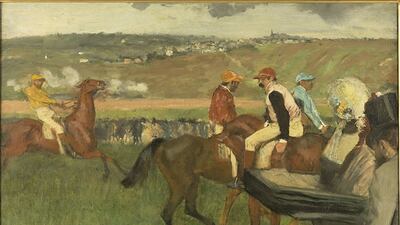
Louvre Abu Dhabi is hosting a significant exhibition of Impressionist works, with more than 150 masterpieces, including 'The Racecourse, amateur jockeys near a car', 1876-1887, by Edgar Degas. All photos: Louvre Abu Dhabi, Musee d'Orsay -
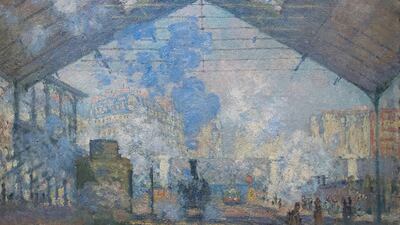
'Saint Lazare Station', 1877, by Claude Monet. -
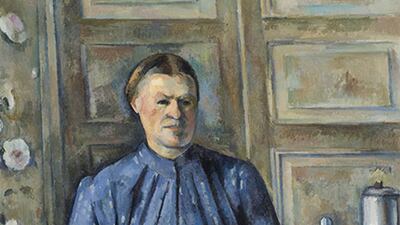
'Woman with a Coffee Pot' by Paul Cezanne. -
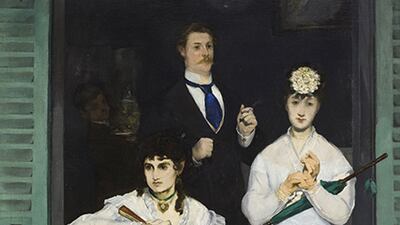
'The Balcony', 1868-1869, by Edouard Manet. -
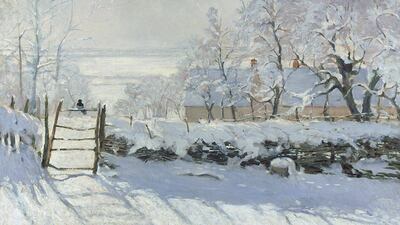
'The Magpie Winter', 1868-1869, Claude Monet. -
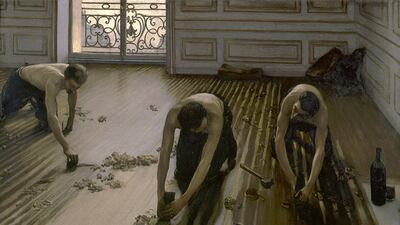
'Floor Scrapers', 1875, by Gustave Caillebotte. -
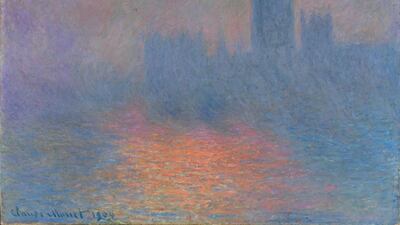
'London, Parliament, Sunshine in the Fog', 1904, by Claude Monet. -
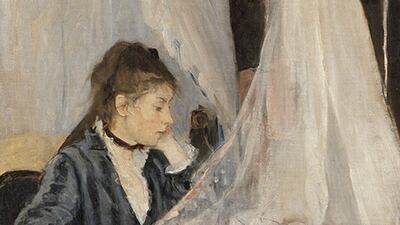
'The Cradle', 1872, by Berthe Morisot. -
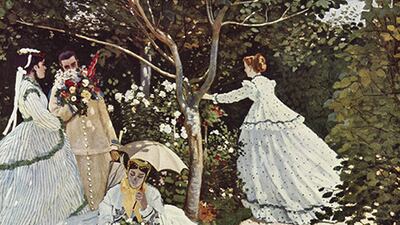
'Women in the Garden', circa 1866, by Claude Monet.



