• Najat Makki held a series of workshops in collaboration with Guggenheim Abu Dhabi, introducing students to her 'Daily Diaries' concept. All Photos: Khushnum Bhandari / The National
    Najat Makki held a series of workshops in collaboration with Guggenheim Abu Dhabi, introducing students to her 'Daily Diaries' concept. All Photos: Khushnum Bhandari / The National
  • Makki, centre, with students and staff from Sorbonne University Abu Dhabi.
    Makki, centre, with students and staff from Sorbonne University Abu Dhabi.
  • Students created their own 'Daily Diaries', taking the concept in their own unique directions.
    Students created their own 'Daily Diaries', taking the concept in their own unique directions.
  • Makki shares her creative process with young students.
    Makki shares her creative process with young students.
  • Students can experiment with new mediums and ideas; capturing moments, feelings and thoughts as they arise.
    Students can experiment with new mediums and ideas; capturing moments, feelings and thoughts as they arise.
  • Makki takes inspiration not just from folklore, but people, landscapes and nature too.
    Makki takes inspiration not just from folklore, but people, landscapes and nature too.
  • Makki, left, says: 'If someone starts out thinking: ‘I’m going to be famous’, that’s not the right way, and they won’t achieve anything.'
    Makki, left, says: 'If someone starts out thinking: ‘I’m going to be famous’, that’s not the right way, and they won’t achieve anything.'
  • Makki's work demonstrates a varied range of techniques and influences, Emirati landscapes and Emirati culture through realism and abstract expressionism.
    Makki's work demonstrates a varied range of techniques and influences, Emirati landscapes and Emirati culture through realism and abstract expressionism.
  • 'Words are spoken, and then they disappear. But once you look at a painting, if it resonates with you, then it will stay with you forever — it will always keep you thinking,' says Makki.
    'Words are spoken, and then they disappear. But once you look at a painting, if it resonates with you, then it will stay with you forever — it will always keep you thinking,' says Makki.

Emirati artist Najat Makki partners with Guggenheim Abu Dhabi to inspire a new generation


Hareth Al Bustani
  • English
  • Arabic

The Study Room at Abu Dhabi’s Cultural Foundation is filled with art, wonder and laughter.

Across the room, tables are adorned with a colourful array of artworks, each carefully crafted over small square canvases. Between them, palettes and plates alike are covered in vast gradients of paint, interspersed with torn-up tissues of all colours, patterned paper, paint brushes and pens.

At one end, Sorbonne University Abu Dhabi students gather around a table, studying a series of masterpieces by Najat Makki. At the other, the pioneering Emirati artist herself talks them through her process.

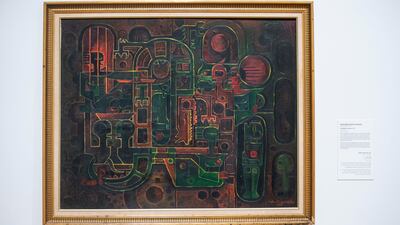
They include selections from her Daily Diaries series — part of the Guggenheim Abu Dhabi collection — capturing snapshots of her inner and outer worlds every day; moods, visions, experiences and environments are all funneled into beautiful abstract creations.

“The Daily Diaries series is a framework that embraces every human being; it’s about capturing a moment in time — whether it’s good, or bad,” Makki tells The National.

Najat Makki, right, held workshops with students, in collaboration with Guggenheim Abu Dhabi. Khushnum Bhandari / The National

“Your day is a journey and even the simplest things like waking up and having breakfast, or washing your face, every one of those steps can evoke certain ideas. Any change or shift in oneself can create something new.”

Makki explains Daily Diaries takes inspiration from everything around her, from people and places to nature itself. “The birds, the wind, a change of weather, they’re all very important, they can all lead to new ideas,” she says.

The first Emirati woman to receive a PhD in art, Makki was part of a pioneering generation of Emirati artists. She studied in Cairo and trained in sculpture, before turning her focus to painting. Her work was recently included in NYUAD Art Gallery's Khaleej Modern exhibition, documenting the rise of contemporary art in the Arabian Peninsula.

She expresses herself through a wide array of aesthetics; changes of colour, textures and collages. Images shift dramatically from dark to light, and vast waves of emotions overlap through rich layers of paint; with leftover material gathered and reused later.

Makki's work not only displays a varied range of techniques, as bursts of inspiration flash through from moment to moment, but a dynamic blend of styles exploring landscapes, folklore and Emirati culture through realism and abstract expressionism.

Makki's 'Daily Diaries' series takes inspiration not just from folklore, but people, landscapes and nature too. Khushnum Bhandari / The National

After exploring her work, the students disperse to produce their own creations, with Makki following closely behind, observing their work and answering questions. One student creates an abstraction of her grandmother through a combination of paper and fabric; another draws a wave reminiscent of Japanese artist Hokusai.

Fatma Almheiri, an Emirati history of arts student in her first year, holds her own piece, which is a recreation of a dream she had the night before, produced using coloured tissue with splashes of paint.

“I had this dream last night; there was this with fireworks going off overhead,” she says. “I find it so interesting how Najat has interpreted other mediums into her art pieces, and that inspired my own. I usually work with oil paint or acrylic.

“With the workshop, I love how everything is abstract, I love that everyone has a chance to do whatever they want. There’s no right or wrong way to do it — you just need to express yourself."

Meanwhile, Kahl Halabi, a Lebanese master’s student and freelance graphic designer, displays an original process, creating intricate patterns using characters of the alphabet in ink.

“You’re not supposed to know what the words are,” he says. “For this piece, I actually took a piece of paper with printed words on it and cut up some letters from the alphabet, assembled all the pieces and tried to come up with words that are unreadable.”

The main lesson he takes away from Makki’s workshop is simple. “Art has no rules. And, I believe that everyone is an artist,” he says.

The workshop is a rare treat for the students; many of whom have never had the opportunity to experience a hands-on class like this — owing to the disruption caused by the Covid-19 pandemic — let alone one with an artist of Makki’s calibre.

Organised by Guggenheim Abu Dhabi, the workshops continue for another two days, with another held for Zayed University students and a final session with 10 people of determination, who are students at a Ministry of Education institution. Makki works closely with the Emirates Down Syndrome Association and Sharjah's Al Falaj centre, hosting regular workshops with people of determination.

Maisa Al Qassimi, Guggenheim Abu Dhabi’s acting project director, says the museum has been developing educational engagements like the Makki collaboration since its inception. The Daily Diaries workshop series, she adds, gives students a unique opportunity to enrich their knowledge of and interest in Guggenheim Abu Dhabi, by working with one of its Emirati artists.

Makki, left, says: 'Our generation had to go out and do this on the ground because there was nothing really here. So the new generation should work especially hard.' Khushnum Bhandari / The National

Al Qassimi says: “The workshop series crystallised Guggenheim Abu Dhabi’s ambition to build bridges with its future visitors and establish more dialogue on the region’s modern and contemporary art by offering a deep dive into Najat Makki’s Daily Diaries, part of the Guggenheim Abu Dhabi collection.

“Following a long period where students couldn’t physically participate in the classroom, the outreach element of this programme was essential in spearheading a return to collective learning for our youth and I was incredibly excited to welcome the next generation in what was such an engaging and hands-on experience.”

Reflecting Abu Dhabi’s unique nature as a place of inclusivity, she says: “Guggenheim Abu Dhabi seeks to continue engaging and connecting with all of its educational institutions through its civic role and mission, sparking wider interest and awareness of global modern and contemporary art in the community.”

The construction of Guggenheim Abu Dhabi, a collaboration between the Department of Culture and Tourism — Abu Dhabi and the Solomon R Guggenheim Foundation, is due to be completed by 2025.

Kahl Halabi, a master’s student and freelance graphic designer, says his main takeaway from the workshop is: 'Art has no rules. And I believe that everyone is an artist.' Khushnum Bhandari / The National

Rose Demir, associate director of education and community engagement for the Guggenheim Museum in New York, says Makki's workshop ties in with the museum’s mission to educate people, engage the community and “build connections”.

“There’s this real interest in understanding her process," she says.

“We’ve often brought artists here from our collection to talk about their work and their process, but to have the real engagement, and the real hands-on interaction, takes it to the next level,” she adds.

Although most of the Sorbonne students taking part are studying art history and archaeology, Claude Habib, who has been an art tutor at the university for 12 years, says every art historian should have some knowledge of practical art.

“I believe they should go together," says Habib. "I always tell my students not to judge an artwork — if you don't understand it, look into the artist themselves; you have to understand the philosophy behind it, you can’t just judge it from how it looks.”

She says Makki’s Diaries is a perfect study for students. “Dr Najat explained how she works on her diaries; they contain lots of memories and emotions. The workshop is about how you can implement this using acrylic or simple materials that you have at home; how to create art from our daily lives. I’m so happy they’ve been able to experience this.”

Makki, left, shares pearls of wisdom with the students. Khushnum Bhandari / The National

However, equally gracious and inquisitive, Makki says she gains as much from the process as her students: “My practice also benefits from their ideas; it’s a two-way process, an exchange of ideas, feelings and emotions from many different cultures."

The artist recently completed similar workshops in Albania and Tunisia, and is set to host another soon in Morocco. “Art is so important,” she says. “It can shift a perspective of an entire community.”

She adds: “Words are spoken, and then they disappear. But once you look at a painting, if it resonates with you, then it will stay with you forever — it will always keep you thinking.

“Picasso’s Guernica was so powerful, it resonated for decades and generations. So much so that it had the red carpet rolled out for its entrance,” she adds, with a touch of humour.

Yet contemporary art can bring those conversations into people’s homes, in a more subdued way, she says.

It is this subtlety that is central to her work. Female forms are presented in a variety of unexpected, and beautifully profound, ways.

“The working woman, the mother, she is a deep ocean, a representation of a woman that gives without borders," she says. "In my paintings, when I paint a tree that has a shadow, it represents a woman, because women are always giving, protecting others beneath their shade.”

Makki says she and her students both benefit from the workshops. Khushnum Bhandari / The National

Makki encourages young artists to produce work that explores equally serious themes, in subtle, yet contemporary, ways. “Young Emirati artists are having a real moment; where everything is accessible and space is no limit,” she says.

“Thirty or 40 years ago, if we wanted to see a famous artwork, we had to travel.” However, even then, she says the UAE offered emerging artists unique opportunities through scholarships and group exhibitions abroad.

“Now, with this generation, everything is available at their doorstep; whether it’s through publications, exhibitions or museums, the knowledge, the history, the schools are there," she says.

“If you want to do a deep dive on any artist throughout history, it’s accessible. Our generation had to go out and do this on the ground because there was nothing really here. So the new generation should work especially hard. They have to be serious.

“If someone starts out thinking: ‘I’m going to be famous’, that’s not the right way, and they won’t achieve anything. It’s about honesty, commitment, setting milestones and achieving small goals to reach a bigger goal.”

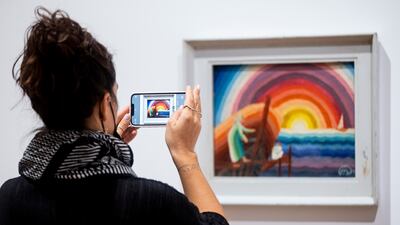
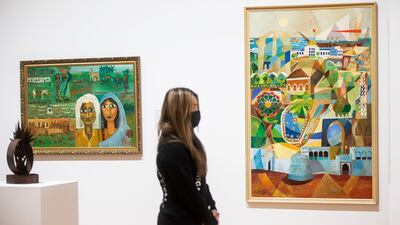
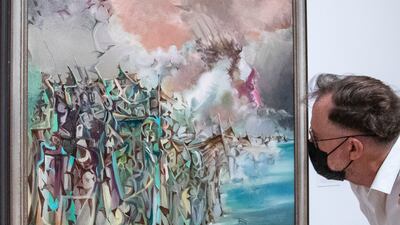
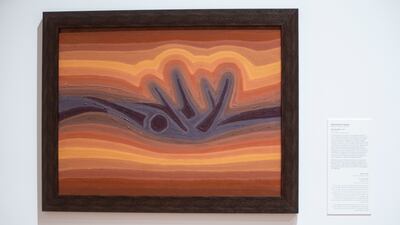
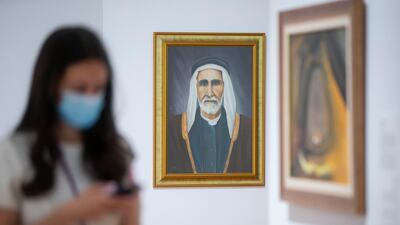
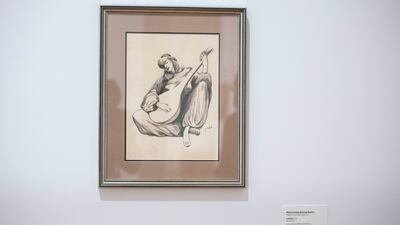
Scroll through images of NYUAD Art Gallery's Khaleej Modern exhibition, which includes Makki's work, below

  • 'Building of Ships' by Ibrahim Ismail on display at Khaleej Modern. All Photos: Ruel Pableo for The National
    'Building of Ships' by Ibrahim Ismail on display at Khaleej Modern. All Photos: Ruel Pableo for The National
  • Khaleej Modern will be running until December 11.
    Khaleej Modern will be running until December 11.
  • 'Al Zaboun' by Safeya Binzagr.
    'Al Zaboun' by Safeya Binzagr.
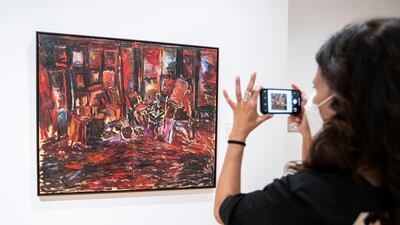
  • 'Studio' by Mohammed Kazem.
    'Studio' by Mohammed Kazem.
  • 'Old Architecture of Manama' by Ahmed Qassim Al Sunni.
    'Old Architecture of Manama' by Ahmed Qassim Al Sunni.
  • 'Memories of Pearl Fishing Days' by Abdul Karim Al Bosta.
    'Memories of Pearl Fishing Days' by Abdul Karim Al Bosta.
  • 'No to the Invasion' by Thuraya Al-Baqsami.
    'No to the Invasion' by Thuraya Al-Baqsami.
  • 'Abstract Figure' by Mohammed Al Saleem.
    'Abstract Figure' by Mohammed Al Saleem.
  • (left) 'A Portrait of Taqfiq Ahmed Al-Jarrah' by Mojib Al Dosari.
    (left) 'A Portrait of Taqfiq Ahmed Al-Jarrah' by Mojib Al Dosari.
  • Untitled painting by Mohammed Ahmed Rasim.
    Untitled painting by Mohammed Ahmed Rasim.
  • 'The Darkness of Love' by Rashid Abdul Rahman Al Balushi.
    'The Darkness of Love' by Rashid Abdul Rahman Al Balushi.
  • 'Return from the Village' by Thuraya Al-Baqsami.
    'Return from the Village' by Thuraya Al-Baqsami.
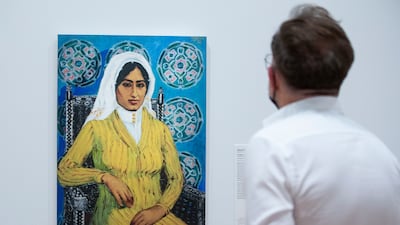
  • 'Fatma' by Anwar Sonya.
    'Fatma' by Anwar Sonya.
  • 'Under the Water' by Hassan Meer.
    'Under the Water' by Hassan Meer.
The President's Cake

Director: Hasan Hadi

Starring: Baneen Ahmad Nayyef, Waheed Thabet Khreibat, Sajad Mohamad Qasem 

Rating: 4/5

THE DETAILS

Kaala

Dir: Pa. Ranjith

Starring: Rajinikanth, Huma Qureshi, Easwari Rao, Nana Patekar  

Rating: 1.5/5 

The Comeback: Elvis And The Story Of The 68 Special
Simon Goddard
Omnibus  Press

Avatar: Fire and Ash

Director: James Cameron

Starring: Sam Worthington, Sigourney Weaver, Zoe Saldana

Rating: 4.5/5

EMERGENCY PHONE NUMBERS

Estijaba – 8001717 –  number to call to request coronavirus testing

Ministry of Health and Prevention – 80011111

Dubai Health Authority – 800342 – The number to book a free video or voice consultation with a doctor or connect to a local health centre

Emirates airline – 600555555

Etihad Airways – 600555666

Ambulance – 998

Knowledge and Human Development Authority – 8005432 ext. 4 for Covid-19 queries

Who was Alfred Nobel?

The Nobel Prize was created by wealthy Swedish chemist and entrepreneur Alfred Nobel.

  • In his will he dictated that the bulk of his estate should be used to fund "prizes to those who, during the preceding year, have conferred the greatest benefit to humankind".
  • Nobel is best known as the inventor of dynamite, but also wrote poetry and drama and could speak Russian, French, English and German by the age of 17. The five original prize categories reflect the interests closest to his heart.
  • Nobel died in 1896 but it took until 1901, following a legal battle over his will, before the first prizes were awarded.
A cryptocurrency primer for beginners

Cryptocurrency Investing  for Dummies – by Kiana Danial 

There are several primers for investing in cryptocurrencies available online, including e-books written by people whose credentials fall apart on the second page of your preferred search engine. 

Ms Danial is a finance coach and former currency analyst who writes for Nasdaq. Her broad-strokes primer (2019) breaks down investing in cryptocurrency into baby steps, while explaining the terms and technologies involved.

Although cryptocurrencies are a fast evolving world, this  book offers a good insight into the game as well as providing some basic tips, strategies and warning signs.

Begin your cryptocurrency journey here. 

Available at Magrudy’s , Dh104 

Ten tax points to be aware of in 2026

1. Domestic VAT refund amendments: request your refund within five years

If a business does not apply for the refund on time, they lose their credit.

2. E-invoicing in the UAE

Businesses should continue preparing for the implementation of e-invoicing in the UAE, with 2026 a preparation and transition period ahead of phased mandatory adoption. 

3. More tax audits

Tax authorities are increasingly using data already available across multiple filings to identify audit risks. 

4. More beneficial VAT and excise tax penalty regime

Tax disputes are expected to become more frequent and more structured, with clearer administrative objection and appeal processes. The UAE has adopted a new penalty regime for VAT and excise disputes, which now mirrors the penalty regime for corporate tax.

5. Greater emphasis on statutory audit

There is a greater need for the accuracy of financial statements. The International Financial Reporting Standards standards need to be strictly adhered to and, as a result, the quality of the audits will need to increase.

6. Further transfer pricing enforcement

Transfer pricing enforcement, which refers to the practice of establishing prices for internal transactions between related entities, is expected to broaden in scope. The UAE will shortly open the possibility to negotiate advance pricing agreements, or essentially rulings for transfer pricing purposes. 

7. Limited time periods for audits

Recent amendments also introduce a default five-year limitation period for tax audits and assessments, subject to specific statutory exceptions. While the standard audit and assessment period is five years, this may be extended to up to 15 years in cases involving fraud or tax evasion. 

8. Pillar 2 implementation 

Many multinational groups will begin to feel the practical effect of the Domestic Minimum Top-Up Tax (DMTT), the UAE's implementation of the OECD’s global minimum tax under Pillar 2. While the rules apply for financial years starting on or after January 1, 2025, it is 2026 that marks the transition to an operational phase.

9. Reduced compliance obligations for imported goods and services

Businesses that apply the reverse-charge mechanism for VAT purposes in the UAE may benefit from reduced compliance obligations. 

10. Substance and CbC reporting focus

Tax authorities are expected to continue strengthening the enforcement of economic substance and Country-by-Country (CbC) reporting frameworks. In the UAE, these regimes are increasingly being used as risk-assessment tools, providing tax authorities with a comprehensive view of multinational groups’ global footprints and enabling them to assess whether profits are aligned with real economic activity. 

Contributed by Thomas Vanhee and Hend Rashwan, Aurifer

The Orwell Prize for Political Writing

Twelve books were longlisted for The Orwell Prize for Political Writing. The non-fiction works cover various themes from education, gender bias, and the environment to surveillance and political power. Some of the books that made it to the non-fiction longlist include: 

  • Appeasing Hitler: Chamberlain, Churchill and the Road to War by Tim Bouverie
  • Some Kids I Taught and What They Taught Me by Kate Clanchy
  • Invisible Women: Exposing Data Bias in a World Designed for Men by Caroline Criado Perez
  • Follow Me, Akhi: The Online World of British Muslims by Hussein Kesvani
  • Guest House for Young Widows: Among the Women of ISIS by Azadeh Moaveni
Labour dispute

The insured employee may still file an ILOE claim even if a labour dispute is ongoing post termination, but the insurer may suspend or reject payment, until the courts resolve the dispute, especially if the reason for termination is contested. The outcome of the labour court proceedings can directly affect eligibility.


- Abdullah Ishnaneh, Partner, BSA Law 

Who's who in Yemen conflict

Houthis: Iran-backed rebels who occupy Sanaa and run unrecognised government

Yemeni government: Exiled government in Aden led by eight-member Presidential Leadership Council

Southern Transitional Council: Faction in Yemeni government that seeks autonomy for the south

Habrish 'rebels': Tribal-backed forces feuding with STC over control of oil in government territory

MORE FROM CON COUGHLIN
The%20specs
%3Cp%3E%3Cstrong%3EEngine%3A%3C%2Fstrong%3E%204.4-litre%20twin-turbo%20V8%20with%2048V%20mild%20hybrid%20system%3Cbr%3E%3Cstrong%3EPower%3A%20%3C%2Fstrong%3E544hp%20at%205%2C500rpm%3Cbr%3E%3Cstrong%3ETorque%3A%20%3C%2Fstrong%3E750Nm%20at%201%2C800-5%2C000rpm%3Cbr%3E%3Cstrong%3ETransmission%3A%20%3C%2Fstrong%3E8-speed%20auto%3Cbr%3E%3Cstrong%3EPrice%3A%20%3C%2Fstrong%3Efrom%20Dh700%2C000%20(estimate)%3Cbr%3E%3Cstrong%3EOn%20sale%3A%20%3C%2Fstrong%3Elate%20November%3C%2Fp%3E%0A


Key facilities
  • Olympic-size swimming pool with a split bulkhead for multi-use configurations, including water polo and 50m/25m training lanes
  • Premier League-standard football pitch
  • 400m Olympic running track
  • NBA-spec basketball court with auditorium
  • 600-seat auditorium
  • Spaces for historical and cultural exploration
  • An elevated football field that doubles as a helipad
  • Specialist robotics and science laboratories
  • AR and VR-enabled learning centres
  • Disruption Lab and Research Centre for developing entrepreneurial skills
War and the virus
Who has been sanctioned?

Daniella Weiss and Nachala
Described as 'the grandmother of the settler movement', she has encouraged the expansion of settlements for decades. The 79 year old leads radical settler movement Nachala, whose aim is for Israel to annex Gaza and the occupied West Bank, where it helps settlers built outposts.

Harel Libi & Libi Construction and Infrastructure
Libi has been involved in threatening and perpetuating acts of aggression and violence against Palestinians. His firm has provided logistical and financial support for the establishment of illegal outposts.

Zohar Sabah
Runs a settler outpost named Zohar’s Farm and has previously faced charges of violence against Palestinians. He was indicted by Israel’s State Attorney’s Office in September for allegedly participating in a violent attack against Palestinians and activists in the West Bank village of Muarrajat.

Coco’s Farm and Neria’s Farm
These are illegal outposts in the West Bank, which are at the vanguard of the settler movement. According to the UK, they are associated with people who have been involved in enabling, inciting, promoting or providing support for activities that amount to “serious abuse”.

Updated: September 24, 2022, 12:42 PM