


Abu Dhabi Art has announced multidisciplinary artist Abed Al Kadiri as guest curator for its annual Beyond: Emerging Artists programme.
Over the past year, Al Kadiri has selected and mentored three artists living in the UAE, who have produced a series of works that will be exhibited at Abu Dhabi Art in November.
Dyala Nusseibeh, director of Abu Dhabi Art, said the annual Beyond: Emerging Artists programme aims to propel artists who live in the UAE to an international level, "enabling them to create ambitious new work”. Nusseibeh added: “Having Abed Al Kadiri curate this year’s programme is extremely exciting, and we are all looking forward to seeing what emerges from this wonderful collaboration.”
Al Kadiri expressed excitement to be curating this year’s Abu Dhabi Art’s Beyond: Emerging Artists. He said: “In this edition, I hope to spark deep conversation that weaves the works of the three artists together while approaching the exhibition with a new perspective by focusing on the practice of artist’s book making.”
Speaking to The National, he said the artists' books were a unique addition to this year’s Beyond: Emerging Artists programme. “From the start of our conversations, we were discussing how each one of these projects could be conceived in the form of a book. Through this experience, I want them to develop works that show strong research, as well as a sensibility to aesthetics.
“I am very happy to be working with the passionate young artists I have selected for this edition, who are embracing this challenge head on.”
Al Kadiri said each artist had a strong individual voice, rooted in contemporary concerns around negotiating land and borders, and the notion of home. “I am looking forward to the conversations we are going to generate,” he added.
“From the moment I started my conversations with the artists, my primary concern was always to try and find them a project or a direction that they are interested in and, more importantly, which touches their sensibilities.
“So, we were really delving into how much an artist's voice can be amplified in his or her body of work. We also wanted to see how they can best take advantage of this opportunity to reach the audience.”
Although the artists hail from a diverse backgrounds, and draw upon different artistic practices, Al Kadiri said they are all inspired by their own experiences to explore themes of identity.

Emirati artist Sarah Al Mehairi’s art investigates her presence within the elements of environments in flux, deconstructing and rebuilding them through a prism of fact and fiction, while crafting a language to explore these interrelationships.
Discussing the programme, she said: “The support we have received so far from the Abu Dhabi Art team and our curator, Abed Al Kadiri, has helped us develop our practice even further, truly looking beyond.
“Being on this journey with fellow artists and friends is special and gives us a unique space in which to be challenged and to grow together, both as a group and individually. I’m particularly excited to work with the scale and new forms in my practice and, through the process, have it translated into an artist’s book.”
Syrian artist Majd Alloush’s art challenges of borders “as a concept, content and medium”, by exploring geopolitics and social and environmental issues, such as the ramifications of war and displacement. “I am honoured to be selected for Abu Dhabi Art’s Beyond: Emerging Artists programme this year,” said Alloush.

“I am also excited to work with Abed Al Kadiri — we have had very fruitful conversations in our brainstorming sessions together and came up with great ideas to develop.
“I find myself rethinking the term ‘digital cartography’ and the meaning behind cartography in general. I hope to produce works that investigate the idea of borders in depth, dismantling and questioning the idea of these lines that divides us.”
Mohamed Khalid meanwhile, looks at the materiality of everyday objects, and draws out their metaphorical potential.
Khalid said the programme was an opportunity not just to display his work locally, but beyond. “New perspectives and insights from the international curators brought on board by Abu Dhabi Art are extremely helpful,” he added.

“Abed and I have been having interesting conversations about the individual and how feelings are translated into work and vice versa. My practice looks into the individual, using mundane materials and trying to coax out their metaphorical potential.”
Aside from the Beyond: Emerging Artists programme, Al Kadiri will also bring his pandemic project, Cities Under Quarantine: The Mailbox Project, to Al Ain; where it will be exhibited at Qasr Al Muwaiji from November 16.
The Mailbox project features works from more than 50 Arab artists — including Dia Al-Azzawi, Mona Saudi, Mohammad Omar Khalil and Mohammad Kazem. Participants drew on their own experiences of isolation during Covid-19, creating their own artist’s books, which Nusseibeh said celebrate “the importance of the tangible and the tactile in an era of rapid digital innovations and metaverse compulsions”.
Al Kadiri’s work looks at the idea of translating violence, and investigates repressed personal and collective traumatic experiences, while highlighting the destruction of cultural heritage, migration and belonging.
As director of the Lebanese publisher, Dongola Limited Editions, he collaborates with artists, authors and designers to create books, offering unconventional perspectives on art and contemporary topics in the Middle East, North Africa and South Asia.
He said that Abu Dhabi Art gives young artists an "immense platform", adding: "On top of the exposure that these young artists will be getting, the programme pushes their works and presents them to an audience eager to listen to new talent."
Abu Dhabi Art will run at Manarat Al Saadiyat from November 16 to 20 November. More information is at abudhabiart.ae
Beyond: Emerging Artists 2022 will be on show at Manarat Al Saadiyat and Cities Under Quarantine will be exhibited at Qasr Al Muwaiji in Al Ain from November 16 to January 22
Scroll through images of last year's Beyond: Emerging Artists exhibition at Abu Dhabi Art
-
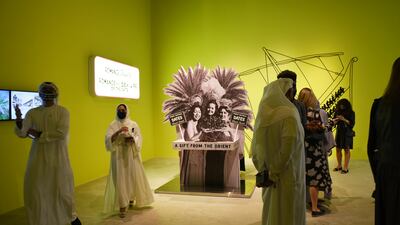
Visitors to Abu Dhabi Art view Christopher Benton's 'The World Was My Garden'. Vidhyaa Chandramohan / The National -
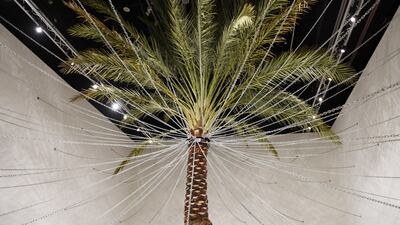
Part of Benton's work is a shackled date palm, evoking the Arab slave trade of the 19th century. Vidhyaa Chandramohan / The National -
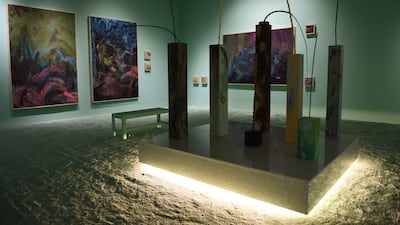
Hashel Al Lamki's 'Neptune' includes sculptures and landscape paintings. Vidhyaa Chandramohan / The National -

In his work, Al Lamki draws from the landscape of Al Ain. Vidhyaa Chandramohan / The National -

Maitha Abdalla's work 'Too Close to the Sun' explores Emirati folklore. Photo: Abu Dhabi Art -
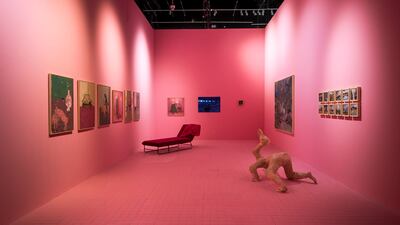
Abdalla's immersive room includes sculptures and video documentation of performances by the artist. Photo: Abu Dhabi Art



