• Text is an important part of the new 21,39 show. This neon work by Abdullah AlOthman greets visitors with the well-known saying 'In Al Balad, I encountered the Bride of the Red Sea'. The work refers to Jeddah, where 21,39 began. Now the exhibition is in Ithra for the first time.
    Text is an important part of the new 21,39 show. This neon work by Abdullah AlOthman greets visitors with the well-known saying 'In Al Balad, I encountered the Bride of the Red Sea'. The work refers to Jeddah, where 21,39 began. Now the exhibition is in Ithra for the first time.
  • Works on paper, a specialisation of the curator Venetia Porter, are an important subtheme of the show. Here, the poignant work by exiled Iraqi artist Sadik Kwaish Alfraji, of 'The Tree I Love at Abu Nuwas Street'.
    Works on paper, a specialisation of the curator Venetia Porter, are an important subtheme of the show. Here, the poignant work by exiled Iraqi artist Sadik Kwaish Alfraji, of 'The Tree I Love at Abu Nuwas Street'.
  • Bader Awwad AlBalawi has been chronicling the different people of North Khobar and the changes in the city, in interviews and photographs for his project The City's Alive.
    Bader Awwad AlBalawi has been chronicling the different people of North Khobar and the changes in the city, in interviews and photographs for his project The City's Alive.
  • Porter's research yields work that has been seen publicly before, such as this watercolour by the Saudi modernist Abdulhalim Radwi. Photo: Estate of Abdulhalim Radwi
    Porter's research yields work that has been seen publicly before, such as this watercolour by the Saudi modernist Abdulhalim Radwi. Photo: Estate of Abdulhalim Radwi
  • Emy Kat grew up in Jeddah but lives in France. He returned to Al Balad for a residency in 2012 and this group of local children introduced him, he says, to places in the Old Town even he didn't know about. He memorialises them in group and individual photos.
    Emy Kat grew up in Jeddah but lives in France. He returned to Al Balad for a residency in 2012 and this group of local children introduced him, he says, to places in the Old Town even he didn't know about. He memorialises them in group and individual photos.
  • Bashaer Hawsawi's family looked after pilgrims in Makkah. She made these collages of African fabric, bought in the Jeddah souq, and plastic brooms in reference to them.
    Bashaer Hawsawi's family looked after pilgrims in Makkah. She made these collages of African fabric, bought in the Jeddah souq, and plastic brooms in reference to them.
  • Inspired by the question of her 'makan', or significant place, Asma Bahmim makes a wall out of the crumbling coral foundations of Al Balad in Jeddah, tucking wishes into its cracks.
    Inspired by the question of her 'makan', or significant place, Asma Bahmim makes a wall out of the crumbling coral foundations of Al Balad in Jeddah, tucking wishes into its cracks.
  • Emy Kat says that when he was a child, he would take his bike and cycle through Al Balad. Later, he would hurry to get home so that his parents would not know he was lost in the labyrinth of the Old Town. This photo installation nods to that memory.
    Emy Kat says that when he was a child, he would take his bike and cycle through Al Balad. Later, he would hurry to get home so that his parents would not know he was lost in the labyrinth of the Old Town. This photo installation nods to that memory.
  • A beautiful presentation of dafatir and artists' books show the artistic variety in the form. Here, Dia al-Azzawi's 'For the Rail and Hamad and Other Poems by Muzaffar al-Nawab'.
    A beautiful presentation of dafatir and artists' books show the artistic variety in the form. Here, Dia al-Azzawi's 'For the Rail and Hamad and Other Poems by Muzaffar al-Nawab'.
  • In places, Porter's exhibition lays bare the artistic process, as in this drawing by Safeya Binzagr that is accompanied by the etching that preceded it. Photo: Darat Safeya Binzagr
    In places, Porter's exhibition lays bare the artistic process, as in this drawing by Safeya Binzagr that is accompanied by the etching that preceded it. Photo: Darat Safeya Binzagr
  • Mohammed Hammad creates an allegorical story in the short film 'Yallah, Yallah Beenah!' of a young boy on the verge of manhood, full of references to witchcraft as well as anime.
    Mohammed Hammad creates an allegorical story in the short film 'Yallah, Yallah Beenah!' of a young boy on the verge of manhood, full of references to witchcraft as well as anime.
  • Obadah Aljefri says this giant Moleskine notebook with its fantastical drawings also refers to his youth, when he grew up drawing. He pictures himself on the left-hand of the diptych. Porter's show is full of personal touches.
    Obadah Aljefri says this giant Moleskine notebook with its fantastical drawings also refers to his youth, when he grew up drawing. He pictures himself on the left-hand of the diptych. Porter's show is full of personal touches.
  • Imran Qureshi's large-scale painting 'Do You Remember Still, How It Was Once', is inspired by a disaster in his studio: termites had eaten away at one of his folded paintings, in a perfectly symmetrical pattern.
    Imran Qureshi's large-scale painting 'Do You Remember Still, How It Was Once', is inspired by a disaster in his studio: termites had eaten away at one of his folded paintings, in a perfectly symmetrical pattern.
  • Manal AlDowayan makes porcelain scrolls out of an Abbasid-era text of jurisprudence that her father had in his library, frustrating the viewer's desire for total knowledge of the work.
    Manal AlDowayan makes porcelain scrolls out of an Abbasid-era text of jurisprudence that her father had in his library, frustrating the viewer's desire for total knowledge of the work.

Ithra opens 21,39 show in Dhahran exploring local artists in a new light


Melissa Gronlund
  • English
  • Arabic

“What is your place — your makan?” curator Venetia Porter asked the artists for the latest 21,39 exhibition, The Saudi Art Council's annual initiative. “Can you take me to it?”

Porter’s show, Amakin, opened in March in Jeddah. It has now travelled for the first time in the programme's history, launching on Thursday at the King Abdulaziz Centre for World Culture — Ithra, the Saudi Aramco-funded art centre in the Eastern Province.

Porter's question yielded an intimate, personal and cross-generational exhibition, as visions of home — a changing home, a home one cannot go back to, a home being destroyed by climate change — emerge among the works by 28 artists.

Scroll through the gallery above to see some of the works on show at Ithra

“It was the era of endless Zoom conversations,” she recalls about her preparations for the exhibition, saying her initial plan had been to organise a group field trip across Saudi Arabia. The Covid-19 pandemic gave her video meetings instead, and an extra year to organise it, which she put to use researching young artists or lesser-known parts of historical practices, showing these alongside established Saudi and international names.

21,39 curator Venetia Porter in front of Bashaer Hawsawi's 'Cleansing' (2019)

Places emerge through stories, with many of the works gesturing towards recalled or imaginary narratives, or personal and family memories. In a lovely pairing, Emy Kat captures Al Balad in Jeddah without a single image of a mashrabiya or carved woodwork. Instead, he exhibits close-ups of the bright cerulean blue found in the Old Town, in a choppy, stop-and-start grid — a throwback, he says, to when he used to wander through Al Balad as a boy and get lost in its labyrinth. The memory from his childhood sits alongside portraits of the small children who accompanied him when he went to shoot the photographs on a residency in 2012, on a visit from France.

Placed next to this is a wall made of the crumbling coral material of Al Balad, by Asma Bahmim, in which she has incorporated folded up bits of paper featuring her wishes, with snippets of their hoped-for outcomes barely visible.

Bashaer Hawsawi shows wall-based textile works in Cleansing (2019), for which she places the bristles of a red plastic broom on to African fabrics in neat, gridded patterns. Here, the materials tell of Hawsawi’s family history: some of her family were mutawifun, who take care of the pilgrims to Makkah, and who came from Nigeria generations ago.

One of the exhibition's highlights is the video Yallah, Yallah Beenah! (2022) by Mohammed Hammad, a surrealist take on the entrance into adulthood, complete with talking feet and laser-eyed witches. This note of surrealism and visual spectacle resonates throughout several works by young creators in the show, co-existing with Porter’s predilection towards artists’ books and works on paper.

A coven of young witches in Mohammed Hammad's fantastic film, 'Yallah, Yallah Beenah!' (2022), shown at 21,39. Photo: Saudi Art Council

At times, the tempo shift from spectacle towards the intimacy of artists' book is abrupt, but it is interesting to watch how the younger cohort of creators sought after both scale and the private reflection usually associated with drawing or notebooks. Obadah Aljefri, for example, created a giant lavender Moleskine notebook, adorned with kitsch, fantastical drawings that he describes as a collaboration between himself in the present and the child he used to be. Ending the show is Sara Abdu's sublime presentation of The Infinite Now, 15 hanging scrolls of paper in which she attempted to write a straight line in henna ink — a perforative act that attempted to site her “place” as out of body, out of mind.

Porter is the longtime curator of Islamic and contemporary Middle East art at the British Museum, where she has built up for the museum an important collection of works on paper. Her specialism in this area also grounds the 21,39 exhibition in a classicism, of the skills of draughtsmanship and calligraphy, which are on the wane in contemporary art. In some cases, that means showing the work of artists who still come up through classical training, such as Pakistani creators Imran Qureshi or Aisha Khalid, both in Lahore. Khalid’s green-textured patterns, minutely drawn, are overlaid with gold-leaf shapes in an evocation of the Kaaba.

Porter also reaches back into the past to show substantial presentations of senior names, such as Dia al-Azzawi, Safeya Binzagr and Abdulhalim Radwi, where the focus on the works on paper provides a glimpse of the artists' hand, something the formality of major creations usually obscures.

“I’m interested in artists who use paper. That is, I'm interested in process. In drawings, you can feel the hand of the artist, see their thought process,” Porter tells The National.

For Binzagr, for example, instead of her oil paintings, Porter chooses her watercolours, sketches and etchings — by far her more interesting work — in which Binzagr documents traditional rites, activities, children’s games and the dresses of different tribes of the kingdom. Juxtapositions of preparatory sketches and their outcome in etchings and prints demonstrate the process Binzagr took towards her final product.

This preparatory drawing for an etching by Safeya Binzagr depicts the family home in Jeddah's Old Town, where she was born in 1940. Photo: Darat Safeya Binzagr

Similarly, Porter shows not only Radwi's well-known, symbolist paintings, but the trove of sketches that he kept in his studio.

“For Radwi, too, most people know him for his oil paintings,” she says. “At one point I asked, what else does he have in his estate? And his son brought out an enormous portfolio with these drawings, which are completely unknown, unpublished. They’re undated, so they’re obviously pieces he did not expect to exhibit.

"You see in these drawings an informality that you lose in the oil paintings. And at one point, he clearly decided he wanted to experiment with print gouaches. So this has been an opportunity to find, even from the established artists, work that people don't normally associate with them.”

Porter's research yielded work that has been seen publicly before, such as this watercolour by the Saudi modernist Abdulhalim Radwi. Photo: Estate of Abdulhalim Radwi

Porter also researched the artists of the Department of the Cultural and Arts Society in the Eastern Province (the Jame’a Al Thagafah wa Alfunoon), which emerged in the 1990s and is less well known than other modernist art societies in the kingdom. Some exquisite works by Abdulrahman AlSoliman, new for the Ithra exhibition, display the Al Sharqiya painter’s responses to the damage done to the coast during the First Gulf War, when oil spills travelled up from Kuwait and decimated bird and plant life.

The historical additions help move the exhibition away from the same roster of artists that Saudi Arabia's scene at times cycles through. Indeed, this is the first fully public 21,39 since the Covid-19 hiatus (the art historian Fabien Danesi curated a show for last year that was unable to open), and it emerges in a new context in the kingdom's contemporary art landscape.

Once alone in its goals, it now sits among Diriyah Biennale, Desert X AlUla, the myriad Ministry of Culture projects and those of the new Jeddah arts complex Hayy Jameel, located not far from 21,39’s traditional Gold Moor mall digs.

Having 21,39 at Ithra underlines the fact that all these exist in a spirit of collaboration instead of competition, says Farah Abushullaih, head of Ithra Museums.

“The Saudi Art Council is one of the most established entities in the kingdom,” she says. “They’re a part of the movers and shakers of the industry. We share a similar vision and mission when it comes to wanting to support and develop the local ecosystem here in the kingdom, but also to make sure that we show international voices as well.”

Future 21,39 exhibitions might again travel to Ithra, says Abushullaih. At Ithra, the museum is re-examining its programming after two years of extreme disruption, as with everywhere else in the world. A more local emphasis is likely to take hold, perhaps because the enforced locality of lockdown has made artists and curators realise, as Porter did for Amakin, how much research there is to be done about the communities we already live in.

Amakin is at King Abdulaziz Centre for World Culture — Ithra in Dhahran until September 30; www.ithra.com

Scroll through the gallery below to see images from Desert X AlUla 2022

  • 'Geography of Hope' by Abdullah AlOthman references theories of light refraction rooting back to the early days of desert civilization. All photos: Desert X AlUla / Lance Gerber
    'Geography of Hope' by Abdullah AlOthman references theories of light refraction rooting back to the early days of desert civilization. All photos: Desert X AlUla / Lance Gerber
  • Shadia Alem's sculptural installation 'I Have Seen Thousands of Stars and One Fell in AlUla' adapts the art of origami.
    Shadia Alem's sculptural installation 'I Have Seen Thousands of Stars and One Fell in AlUla' adapts the art of origami.
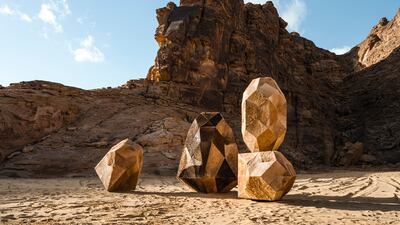
  • Zeinab AlHashemi's 'Camouflage 2.0' uses discarded camel skins on an abstract, geometric base, resembling a rock formation in the desert.
    Zeinab AlHashemi's 'Camouflage 2.0' uses discarded camel skins on an abstract, geometric base, resembling a rock formation in the desert.
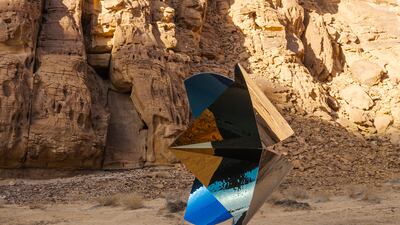
  • Shaikha AlMazrou's 'Measuring the Physicality of Void' is a steel-made inflated structure.
    Shaikha AlMazrou's 'Measuring the Physicality of Void' is a steel-made inflated structure.
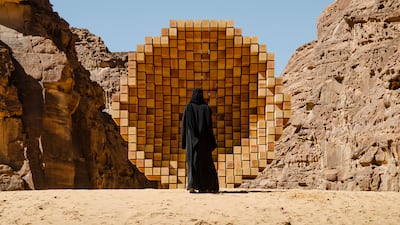
  • Dana Awartani's 'Where the Dwellers Lay' draws inspiration from the vernacular architecture of AlUla.
    Dana Awartani's 'Where the Dwellers Lay' draws inspiration from the vernacular architecture of AlUla.
  • 'Desert Kite' by Sultan bin Fahad is a mud structure.
    'Desert Kite' by Sultan bin Fahad is a mud structure.
  • Serge Attukwei Clottey's 'Gold Falls' addresses the experience of globalisation, migration and water equity.
    Serge Attukwei Clottey's 'Gold Falls' addresses the experience of globalisation, migration and water equity.
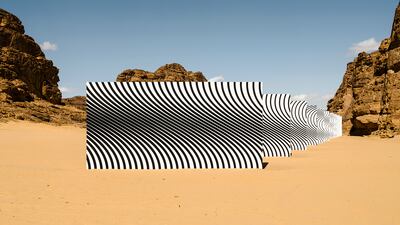
  • Claudia Comte's 'Dark Suns, Bright Waves' features a progression of walls.
    Claudia Comte's 'Dark Suns, Bright Waves' features a progression of walls.
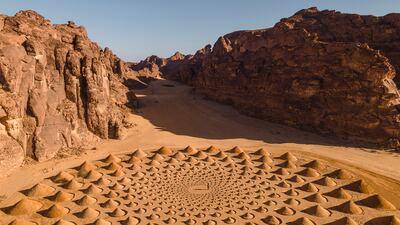
  • Jim Denevan creates ephemeral drawings in 'Angle of Repose'.
    Jim Denevan creates ephemeral drawings in 'Angle of Repose'.
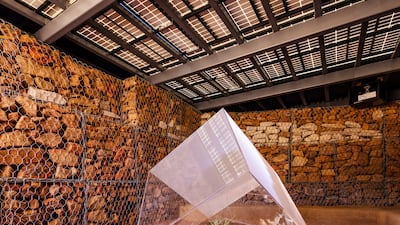
  • Stephanie Deumer has created an underground greenhouse for 'Under the Same Sun'.
    Stephanie Deumer has created an underground greenhouse for 'Under the Same Sun'.
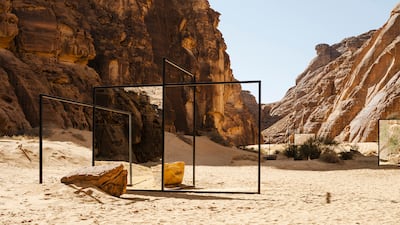
  • Alicja Kwade's 'In Blur' reflect and frame the natural artefacts she encountered on the desert floor.
    Alicja Kwade's 'In Blur' reflect and frame the natural artefacts she encountered on the desert floor.
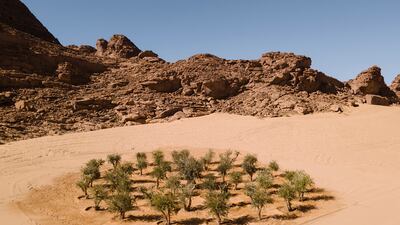
  • Khalil Rabah 'Grounding' is a mirage of an orchard of olive trees.
    Khalil Rabah 'Grounding' is a mirage of an orchard of olive trees.
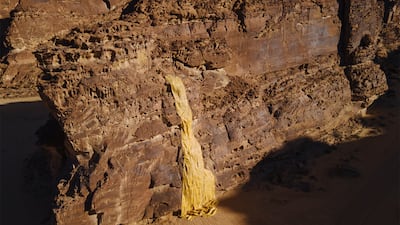
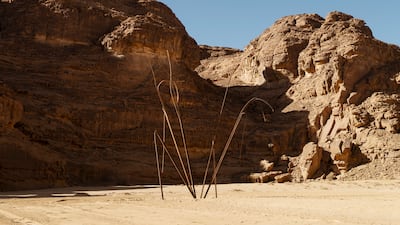
  • Monika Sosnowska's 'Silent Witnesses of the Past' uses heritage rails from the Hejaz railway, that ran from Damascus to Madinah.
    Monika Sosnowska's 'Silent Witnesses of the Past' uses heritage rails from the Hejaz railway, that ran from Damascus to Madinah.
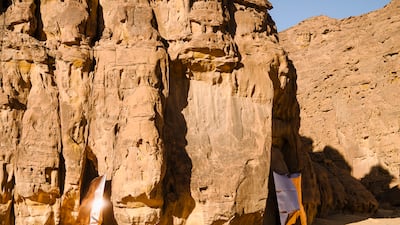
  • Ayman Zedani's 'The Valley of the Desert Keepers' is a soundscape installation in a rocky cavern.
    Ayman Zedani's 'The Valley of the Desert Keepers' is a soundscape installation in a rocky cavern.
  • Shezad Dawood's 'Coral Alchemy I (Dipsastrea Speciosa)' explores ideas of the geobiological relationship between the desert floor and nearby Red Sea.
    Shezad Dawood's 'Coral Alchemy I (Dipsastrea Speciosa)' explores ideas of the geobiological relationship between the desert floor and nearby Red Sea.

The Meg
Director: Jon Turteltaub
Starring:   
Two stars

Avatar: Fire and Ash

Director: James Cameron

Starring: Sam Worthington, Sigourney Weaver, Zoe Saldana

Rating: 4.5/5

The%20Roundup
%3Cp%3EDirector%3A%20Lee%20Sang-yong%3Cbr%3EStars%3A%20Ma%20Dong-seok%2C%20Sukku%20Son%2C%20Choi%20Gwi-hwa%3Cbr%3ERating%3A%204%2F5%3C%2Fp%3E%0A
UAE currency: the story behind the money in your pockets

Mercer, the investment consulting arm of US services company Marsh & McLennan, expects its wealth division to at least double its assets under management (AUM) in the Middle East as wealth in the region continues to grow despite economic headwinds, a company official said.

Mercer Wealth, which globally has $160 billion in AUM, plans to boost its AUM in the region to $2-$3bn in the next 2-3 years from the present $1bn, said Yasir AbuShaban, a Dubai-based principal with Mercer Wealth.

Within the next two to three years, we are looking at reaching $2 to $3 billion as a conservative estimate and we do see an opportunity to do so,” said Mr AbuShaban.

Mercer does not directly make investments, but allocates clients’ money they have discretion to, to professional asset managers. They also provide advice to clients.

“We have buying power. We can negotiate on their (client’s) behalf with asset managers to provide them lower fees than they otherwise would have to get on their own,” he added.

Mercer Wealth’s clients include sovereign wealth funds, family offices, and insurance companies among others.

From its office in Dubai, Mercer also looks after Africa, India and Turkey, where they also see opportunity for growth.

Wealth creation in Middle East and Africa (MEA) grew 8.5 per cent to $8.1 trillion last year from $7.5tn in 2015, higher than last year’s global average of 6 per cent and the second-highest growth in a region after Asia-Pacific which grew 9.9 per cent, according to consultancy Boston Consulting Group (BCG). In the region, where wealth grew just 1.9 per cent in 2015 compared with 2014, a pickup in oil prices has helped in wealth generation.

BCG is forecasting MEA wealth will rise to $12tn by 2021, growing at an annual average of 8 per cent.

Drivers of wealth generation in the region will be split evenly between new wealth creation and growth of performance of existing assets, according to BCG.

Another general trend in the region is clients’ looking for a comprehensive approach to investing, according to Mr AbuShaban.

“Institutional investors or some of the families are seeing a slowdown in the available capital they have to invest and in that sense they are looking at optimizing the way they manage their portfolios and making sure they are not investing haphazardly and different parts of their investment are working together,” said Mr AbuShaban.

Some clients also have a higher appetite for risk, given the low interest-rate environment that does not provide enough yield for some institutional investors. These clients are keen to invest in illiquid assets, such as private equity and infrastructure.

“What we have seen is a desire for higher returns in what has been a low-return environment specifically in various fixed income or bonds,” he said.

“In this environment, we have seen a de facto increase in the risk that clients are taking in things like illiquid investments, private equity investments, infrastructure and private debt, those kind of investments were higher illiquidity results in incrementally higher returns.”

The Abu Dhabi Investment Authority, one of the largest sovereign wealth funds, said in its 2016 report that has gradually increased its exposure in direct private equity and private credit transactions, mainly in Asian markets and especially in China and India. The authority’s private equity department focused on structured equities owing to “their defensive characteristics.”

Updated: July 04, 2022, 9:36 AM