


The first artist commissions have been announced for Wadi AlFann, the ambitious permanent desert art venue planned for AlUla in Saudi Arabia. The works, by the US artists James Turrell, Agnes Denes and Michael Heizer — all pioneers of the Land Art movement — and two projects by the established Saudi names Ahmed Mater and Manal AlDowayan, are scheduled to launch by 2024.
The Royal Commission for AlUla, the government commission that oversees the development of the tourist and heritage site, also named Iwona Blazwick, the former director of the Whitechapel Gallery in London, as chair of its Public Art Expert panel, advising on Wadi AlFann.
“It’s pretty spectacular to be able to have artists of the older generation who understood that the desert was not a kind of wasteland,” says Blazwick. “In America, there are whole areas called the Badlands, or indeed in the Middle East, there is Empty Quarter, which speak to this idea that deserts are just big, empty, dead places. But these are the artists who saw [the desert’s] potential, in sculptural terms.”
She says the creatives all react to the desert in myriad ways, coming from particular directions. "That openness to what an artist wants to bring is the curatorial hallmark of this whole project.”

As part of the Land Art movement of the 1960s and '70s, Turrell, Denes and Heizer sought to move art out of the studio and gallery space, working instead directly with the earth and with perceptions of the natural world. Some of their most monumental works remain as pilgrimage sites for those in the art world today, such as Turrell’s Roden Crater, set in a volcanic cinder cone in the Arizona desert.
Wadi AlFann hopes to capture a similar monumentality and integration with the landscape for its “Valley of the Arts”, a key part of the AlUla master plan.
The site has now been under development since 2017 and is beginning to receive visitors at some of its new hotels. The scale of the full project — which will include archaeological museums, the famous Nabataean tombs, a wildlife sanctuary and luxury entertainment, among other cultural assets — means it won’t open entirely until 2035.
The appointment of Blazwick to oversee the selection is a coup for Wadi AlFann. She is one of the most respected British curators, having led the Whitechapel for 20 years and established its strong reputation both critically and popularly.
Her choices for Wadi AlFann build on commissions made by earlier teams, such as that of the American adviser Allan Schwartzman, who first suggested the Land Art artists. Blazwick herself edited a book on Land Art in 1995, but her connection to the art of the Middle East is more recent. In 2015, the Whitechapel hosted four exhibitions over the course of the year, of the Arab modernist works, in Sharjah’s Barjeel Art Foundation.
“That was an absolute revelation, because we've all been aware of the rise of very prominent figures from across the region in the last 10, even 20, years, but I had no idea about the story of modernism, or the multiple modernisms, across that region,” she says. “That was the beginning of a very steep learning curve for me.”
One of the new commissions is Ashab Al-Lal, by veteran artist Mater. It's a monumental earthwork that creates an illusion of the public hovering over the ground. People enter into a subterranean cavern flanked by two large-scale parabolic mirrors that face each other. These reflect the image of the visitors — inverting it, and then turning it again so that person appears right-side-up — so that he or she floats above the sand.

Mater says the work nods to the kind of engineering feats of the Islamic Golden Age, and also to his long-standing practice of using his work to enable public discourse and dialogue. Mater was one of the founders of Al Muftaha Arts Village in Asir in the 1990s, and then ran his studio as a site of public discussion, called Pharan Studio, in Jeddah in the 2010s.
“It's talking about a new way or feeling of public art, because the artwork in this project is the people, the public,” says Mater. “The idea of public art is that it is part of the society and uses the engagement of everyone, so everyone has a platform.”
Mater is taking the idea of the platform, hoping to ultimately use the site for others to perform music or show their own work. He has been working on the project — a feat of engineering — for four years, and Athr Gallery is currently showing his models and sketch work for Ashab Al-Lal in its new AlUla gallery.
Denes, now 91, will create a series of her signature tall, pointed pyramids, which she makes out of living material. Turrell will similarly use the AlUla commission to flex his ideas around perception and phenomenology, through spaces created on the canyon floor.
AlUla’s draw, which Saudi Arabia hopes to maximise as a tourist destination, is also its dense history. It was the site of numerous civilisations through the centuries, and Heizer will respond to the early petroglyphs found in the valley, engraving figures in the sandstone rocks at a scale visible to viewers from a vast distance.
Finally, AlDowayan — whose installation Now You See Me, Now You Don’t (2020), of pool-like trampolines, was a favourite of the first Desert X AlUla — returns to the valley with the installation The Oasis of Stories, inspired by the mud architecture of AlUla’s Old Town.

Further artists will be commissioned in the future, again with a focus on the environment and the area’s history.
Wadi AlFann will be spread across 65 square kilometres and will sit alongside various other contemporary art programmes run by AlUla. Some of these aim to integrate art into the life of those living in the valley, such as the recent photography exhibition that was shown in abandoned houses in the AlUla Old Town (Cortona on the Move, 2022). Others are more oriented towards international visibility, such as Desert X Al Ula, the biennial done in partnership with Desert X, the California foundation, since 2020.
Scroll through the gallery below to see photos from Desert X Al Ula 2022
-

'Geography of Hope' by Abdullah AlOthman references theories of light refraction rooting back to the early days of desert civilization. All photos: Desert X AlUla / Lance Gerber -
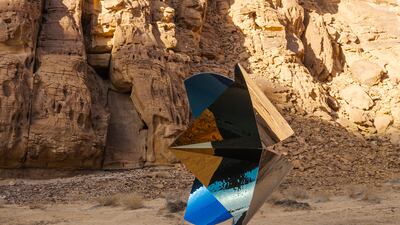
Shadia Alem's sculptural installation 'I Have Seen Thousands of Stars and One Fell in AlUla' adapts the art of origami. -
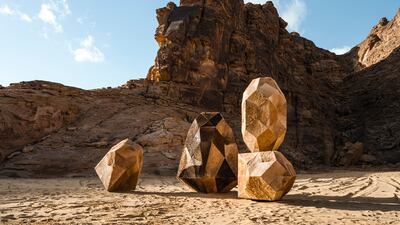
Zeinab AlHashemi's 'Camouflage 2.0' uses discarded camel skins on an abstract, geometric base, resembling a rock formation in the desert. -
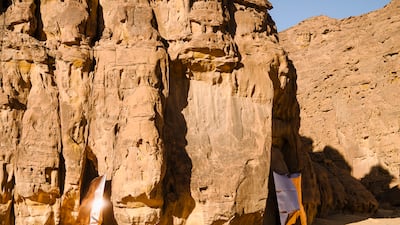
Shaikha AlMazrou's 'Measuring the Physicality of Void' is a steel-made inflated structure. -
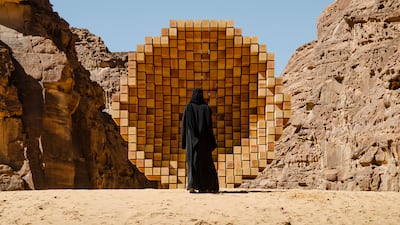
Dana Awartani's 'Where the Dwellers Lay' draws inspiration from the vernacular architecture of AlUla. -

'Desert Kite' by Sultan bin Fahad is a mud structure. -
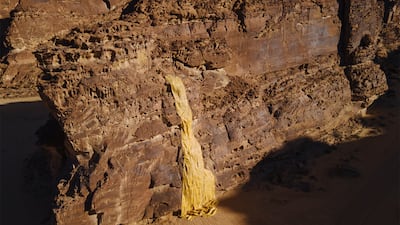
Serge Attukwei Clottey's 'Gold Falls' addresses the experience of globalisation, migration and water equity. -
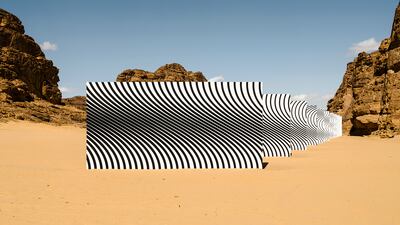
Claudia Comte's 'Dark Suns, Bright Waves' features a progression of walls. -
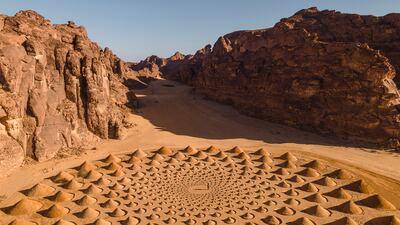
Jim Denevan creates ephemeral drawings in 'Angle of Repose'. -
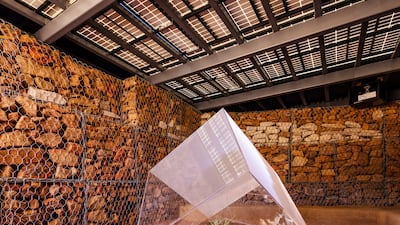
Stephanie Deumer has created an underground greenhouse for 'Under the Same Sun'. -
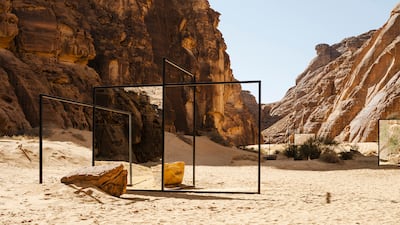
Alicja Kwade's 'In Blur' reflect and frame the natural artefacts she encountered on the desert floor. -
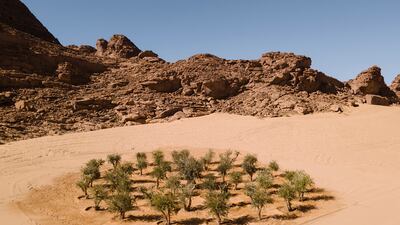
Khalil Rabah 'Grounding' is a mirage of an orchard of olive trees. -
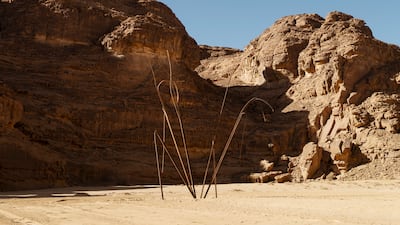
Monika Sosnowska's 'Silent Witnesses of the Past' uses heritage rails from the Hejaz railway, that ran from Damascus to Madinah. -
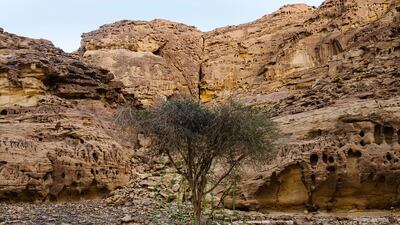
Ayman Zedani's 'The Valley of the Desert Keepers' is a soundscape installation in a rocky cavern. -

Shezad Dawood's 'Coral Alchemy I (Dipsastrea Speciosa)' explores ideas of the geobiological relationship between the desert floor and nearby Red Sea.


The remit of Wadi AlFann overlaps slightly with that of Desert X AlUla, particularly in that the last two biennials have shied away from an explicit curatorial thesis and instead have pledged their responsiveness to the desert. But they will differ with respect to permanence, says Blazwick. Desert X AlUla will remain as a testing ground for artists to make artworks — “a space for experimentation, even failure” — as well as work that is ephemeral, such as Jim Denevan's concentric circles of sand piles, which the American showed this year at the biennial.
The National also understands that some works from Desert X AlUla will, if appropriate, be acquired by the RCU for Wadi AlFann.
Wadi AlFann, on the other hand, will show work that deliberately stands the test of time — which seems both a procedural criterion, in the tough desert landscape, and part of the curatorial ethos.
“Our commitment is to work with artists to create something of a calibre and longevity that it can stand next to a Nabataean necropoli in significance and meaning,” says Blazwick. “That's a big ask. It's a big ambition. But I think there are many great artists who will be excited to rise to the challenge.”
What to expect from Jeddah's new digital art museum — in pictures
-
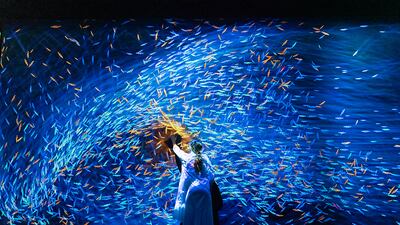
More than 50 digital artworks will feature at Jeddah's new digital art museum, teamLab Borderless, when it opens in 2023. Pictured here, 'The Way of the Sea, Flying Beyond Borders - Colours of Life'. All photos: teamLab -
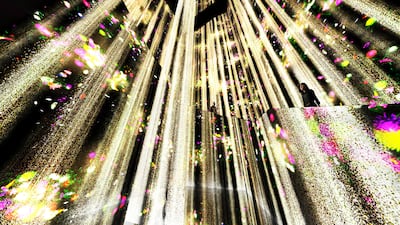
The 15-metre tall teamLab composition 'Golden Sand Waterfall' will be an exclusive installation in Jeddah. -
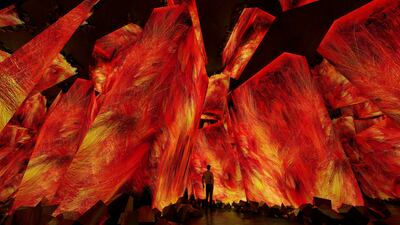
'Megalith Flames' is another artwork that will be unveiled at the museum in Jeddah when it opens next year. -
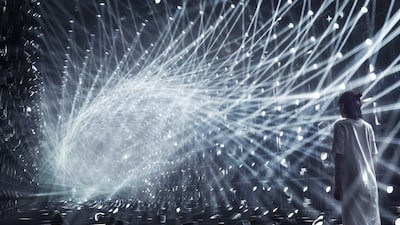
'Birth', a composition by the teamLab group, which was founded in Japan in 2001. -
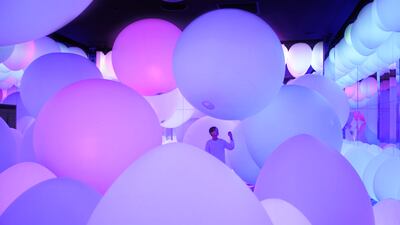
'Typhoon Balls and Weightless Forest of Resonating Life' by teamLab is another work that goes beyond conventional artistic barriers. -
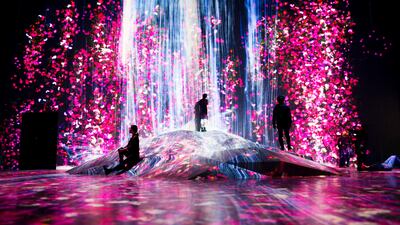
The immersive 'Universe of Water Particles on a Rock where People Gather' by teamLab. -
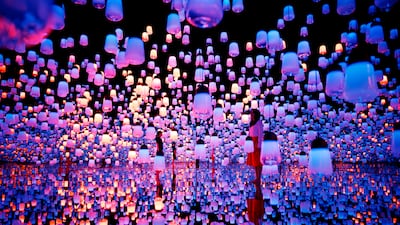
'Forest of Resonating Lamps'. -
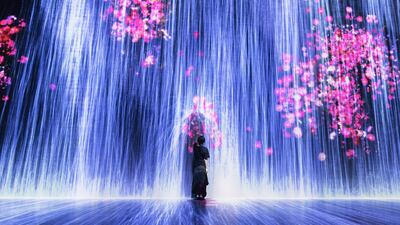
'Universe of Water Particles on Au-dela Des Limites'. -
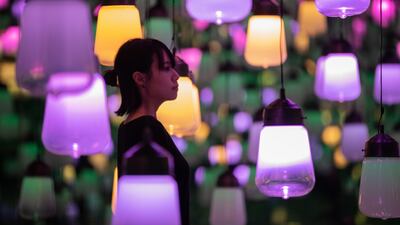
A visitor takes in teamLab's 'Forest of Resonating Lamps_Spring Mountain'. -
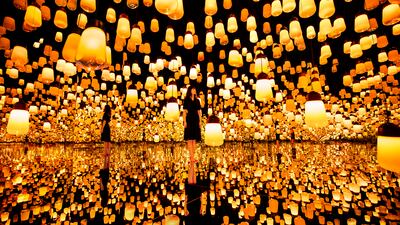
Another aspect of teamLab's 'Forest of Resonating Lamps'. -
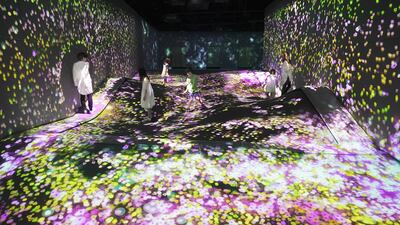
'Soft Terrain and Granular Topography_Spring'. In Jeddah in 2023, visitors will be able to experience teamLab's work for themselves. -
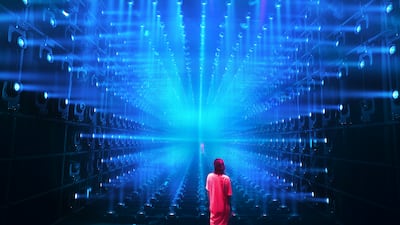
'Red in the Blue II' by teamLab. Jeddah is one of the collective's destinations as it moves outside its base in Tokyo. -
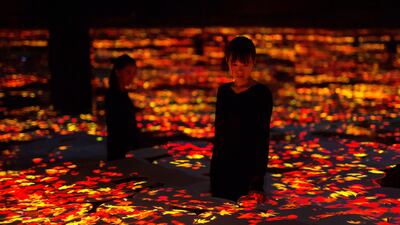
'Memory of Topography_Autumn_Autumn Leaves' by teamLab. -
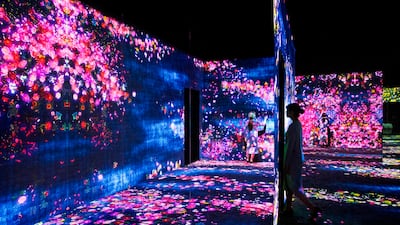
'Forest of Flowers and People' by teamLab. -
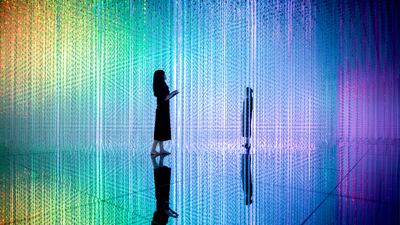
'Wander through the Crystal World' by teamLab. -
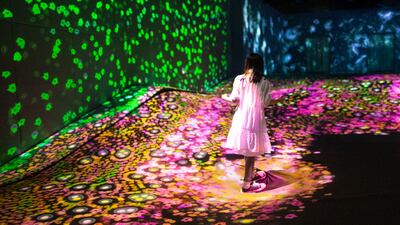
'Soft Terrain and Granular Topography_Spring' by teamLab. -
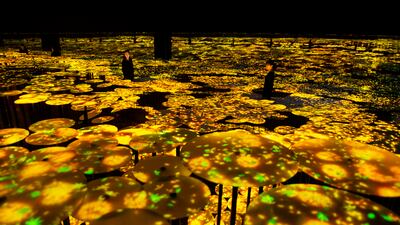
'Memory of Topography_Autumn_Sweet Olive' by teamLab. -
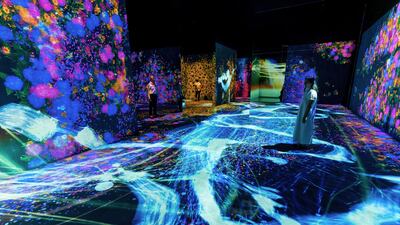
'Reversible Rotation, Flying Beyond Borders - One Stroke, Cold Light' by teamLab. -
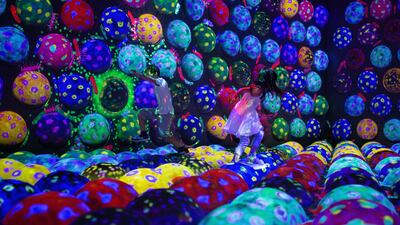
'Rapidly Rotating Bouncing Sphere Caterpillar House' by teamLab. -

'Memory of Topography_Summer_Rain' by teamLab. -
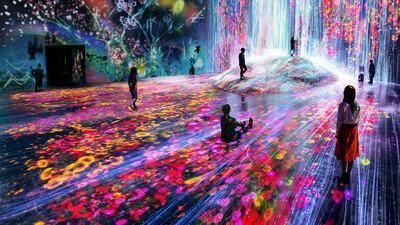
A view of teamLab Borderless Tokyo, which opened in 2018. -
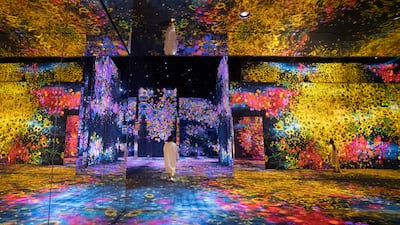
'Forest of Flowers and People Lost' by teamLab.



