New excavations of the ancient complex of Girsu in Iraq, led by the British Museum, have the potential to rewrite accepted histories of the development in Mesopotamia, according to archaeologist Sebastien Rey, after findings from the project have come to light.
For decades, historians have believed that the Sumerians' mastery of irrigation — or the ability to have regular and stable access to water — moved them from subsistence towards the extraordinary feats they are known for: writing, temple complexes, grouping into cities.
Now, the Girsu Project's discoveries suggest that irrigation was not the cause of these changes after all. But the question remains: what was it?
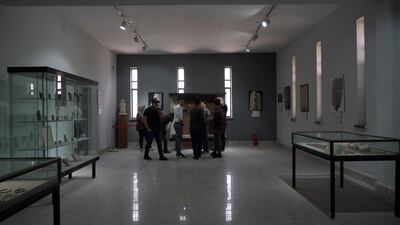
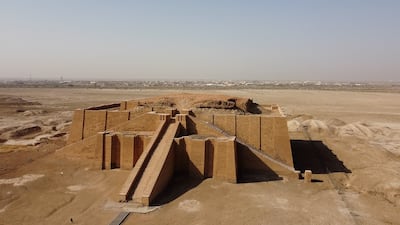
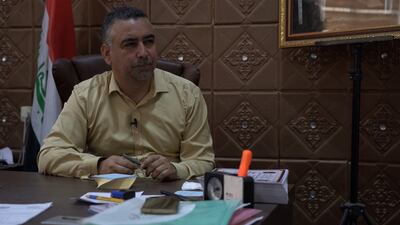
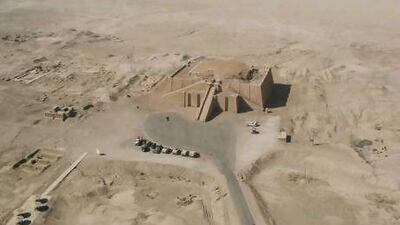
Rey, who is curator of Ancient Mesopotamia at the British Museum, was the lead archaeologist on the project. Girsu, or present-day Tello in southern Iraq, is a city and temple complex erected by the Sumerians in about 3000 to 2000 BC. A paper on the subject will be published later this year, and the British Museum has mounted the exhibition Ancient Iraq: New Discoveries, in Nottingham in the UK, to recontextualise existing artefacts from their collection that come from Girsu and other Sumerian cities.
Rey and his team used new technologies to understand the development of the city, flying drones over the vast, 250-hectare site. The images they gathered show the extent to which the irrigation system was embedded throughout the city and its surrounds.
Heavy rainfall, a product of climate change, also washed away the top layer of the soil, making the outlines even more apparent.
Working with archaeologists from five universities in Iraq, led by Jaafar Jotheri of Al Qadisiyah, the British Museum team dug out shells and other material from the bottom level of the canals to be carbon-dated. The results were startling: the canals seem to have been dug in the fifth millennium BC. .
“The big surprise is that the largest irrigation canals date to the prehistory of Mesopotamia. That means they are much, much older than the birth of the city, by about 1,000 years," says Rey. "Traditionally, what you read is that development in Mesopotamia begins at the end of the fourth millennium, around 3300 BC. That’s when there was an important transition from pre-urban to urban and the invention of writing.
"But the canals that we have dated recently sets the date back to the fifth millennium, which means that irrigation is not the key, the spark that triggered the urban construction and the invention of writing. And that's a really important discovery.”
Before, archeologists believed that once the ancient Sumerians learnt to irrigate their crops, they were able to move from subsistence farming to the social and religious hierarchy that the elaborate temples of Girsu attest to.
But the Girsu Project’s discoveries, which Rey has written up for a paper that has passed peer review but which is still to be published, show that the Sumerians were living with well-watered plains for a full millennium before they began to build the temple complexes.
What changed? What moved the needle towards a more complex society?
Rey speculates that the shift was unrelated to the environment but rather owed to the pattern of thinking of those living in Girsu: an ideological transformation. Temples and administrative buildings allowed the powers ascribed to the gods to reside in one site, which was embedded into a larger social and political structure.
“It was a domestication of the power of the gods,” Rey says, in an adaptation of the phrase usually used for Sumerian development of the domestication of water.
Girsu is accessible at last
The last time Girsu was excavated was in the 1960s, when now-standard technologies and archaeological practices were not in place. Sumerian scholars have been working off that era’s imperfect knowledge since then, as the US invasion in the 1990s and the ensuing unrest forestalled any archaeological excavation of the site.
In addition, particularly since the 2000s, Girsu had been badly looted. Cones, statues and other votive objects can be found on the black market across the world. In 2018, for instance, the British Museum returned symbolic cones that were used in the Sumerian temple of Girsu. They had been found as part of a raid on a London antiquities dealer.
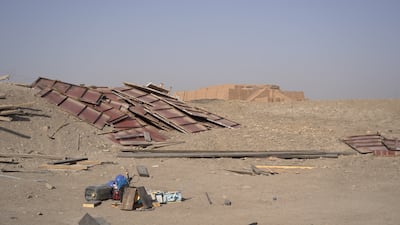
When the archaeological team arrived last year, they found Girsu pockmarked, with depressions in the soil where looters dug up items. The looting has given the excavation team an added responsibility. Their goal was both to research the site but also to practice what Rey calls “forensic archeology”, treating the dig like a crime scene.
“We are trying to rescue the site from looting but also from late 19th century and early 20th-century excavations,” he explains. “And we are using Girsu as a case study to teach, and to learn also for ourselves, a method that will help the Iraqis restore their heritage first of all.
“By re-excavating the robber holes, you can find evidence of what the looters left behind — a trail you can work on for provenance, so that when Border Force in the UK contacts us and says we found these objects in a suitcase in Heathrow, we will have a data set to know which objects came from Girsu.”
Looters tend to take unbroken objects, which fetch the highest amount on the market. These undamaged artefacts account for roughly a 10th of all the cones, votive sculptures and artefacts that have lain in the ground for thousands of years.
By scrutinising the Sumerian inscriptions on the cones that have been left behind, however, archaeologists can make connections to those that have been taken, even if they are not fragments of the same object.
The Girsu Project in context
The Girsu Project also had another goal: training and mentorship. Working in partnership with Iraq’s State Board of Antiquities and Heritage and five partner universities in Iraq — Mosul, Hillah, Al Qadisiyah, Al Simawa, and Dhi Qar — the project aims to train Iraqi archeologists and conservators and teach them the principles of surveying techniques, excavating artefacts and processing finds.
The two-year scheme, funded by a grant from the Getty, follows on from the British Museum’s previous Iraq Scheme, which likewise emphasised training. The five-year project, funded by the UK government, took place from 2016 to 2021, with an extra year because of Covid delays.
This aspect of the project is key, because in many ways little has changed in the archaeological landscape since the first age of European excavation, which began under colonialism in the late 1800s and early 1900s.
Most of Iraq's archaeological digs are still organised by Western countries, funded by Western countries, and then the information disseminated in Western journals — rarely, if ever, being translated into Arabic for the local Iraqi population to learn about the discoveries made on their watch.
Even the terms of archaeology — discovery, development and an emphasis on an object-based culture — are embedded in a European system of thought, as extensive academic work in the field of decolonising archeology has demonstrated.
Within this context, one of the most laudable elements of the Girsu Project is its ethical standards.
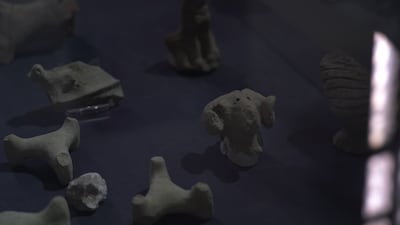
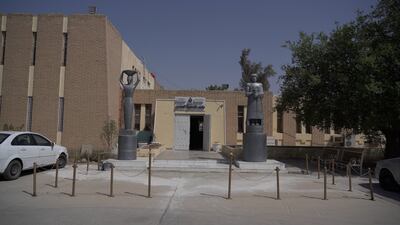
Jotheri, an eminent professor of geoarchaeology at Al Qasidiyah University who worked on the Girsu Project, highlights the importance of mentorship for Iraqi archeology. At Girsu, newly uncovered objects such as votive sculptures, figurines and carved cylinder seals, were conserved as they were being excavated, which gives trainee Iraqi archaeologists a chance to study the objects, rather than a situation where the knowledge gained from the site flows to European laboratories and archeologists. The objects were then given to the Iraq Museum in Baghdad.
“We have two sides: we have the internationals and we have the Iraqis,” says Jotheri. “From the Iraqi side, the archeologists require equipment, laptops, the training, accommodation and houses, and salaries. Unlike others, the Girsu Project actually engaged more Iraq universities, the local community. They did lots of workshops and attended conferences. They provided counterparts to the experts from the British side.”
However, Jotheri says, this is not the norm. In fact, for Iraq, where the State Board of Antiquities rarely enforces equal partnerships, there remains a two-tier situation for archaeology.
“From the international side, typically, they want everything,” he says. “It’s like colonialist times, they need Iraqi silence. We are their cheap slaves with no voice. They take everything. They treat the archeological site as an oil field. An oil field when the barrel is cheap.”
The Girsu Project might be making groundbreaking discoveries about the development of civilisation in Mesopotamia 5,000 years ago. But the project, and the Iraq Scheme before it, also shed light on the present, and are a reminder that some of the historical practices of archaeology might not be as far in the past as one might think.
Ancient Iraq: New Discoveries is on show at the Djanogly Gallery, Lakeside Arts, Nottingham, UK, until June 19. The exhibition recontextualises older works from the British Museum collection in the light of the Girsu Project's new findings.
Winners
Ballon d’Or (Men’s)
Ousmane Dembélé (Paris Saint-Germain / France)
Ballon d’Or Féminin (Women’s)
Aitana Bonmatí (Barcelona / Spain)
Kopa Trophy (Best player under 21 – Men’s)
Lamine Yamal (Barcelona / Spain)
Best Young Women’s Player
Vicky López (Barcelona / Spain)
Yashin Trophy (Best Goalkeeper – Men’s)
Gianluigi Donnarumma (Paris Saint-Germain and Manchester City / Italy)
Best Women’s Goalkeeper
Hannah Hampton (England / Aston Villa and Chelsea)
Men’s Coach of the Year
Luis Enrique (Paris Saint-Germain)
Women’s Coach of the Year
Sarina Wiegman (England)
Who was Alfred Nobel?
The Nobel Prize was created by wealthy Swedish chemist and entrepreneur Alfred Nobel.
- In his will he dictated that the bulk of his estate should be used to fund "prizes to those who, during the preceding year, have conferred the greatest benefit to humankind".
- Nobel is best known as the inventor of dynamite, but also wrote poetry and drama and could speak Russian, French, English and German by the age of 17. The five original prize categories reflect the interests closest to his heart.
- Nobel died in 1896 but it took until 1901, following a legal battle over his will, before the first prizes were awarded.
KEY HIGHLIGHTS
Healthcare spending to double to $2.2 trillion rupees
Launched a 641billion-rupee federal health scheme
Allotted 200 billion rupees for the recapitalisation of state-run banks
Around 1.75 trillion rupees allotted for privatisation and stake sales in state-owned assets
Disposing of non-recycleable masks
- Use your ‘black bag’ bin at home
- Do not put them in a recycling bin
- Take them home with you if there is no litter bin
- No need to bag the mask
WOMAN AND CHILD
Director: Saeed Roustaee
Starring: Parinaz Izadyar, Payman Maadi
Rating: 4/5
Timeline
2012-2015
The company offers payments/bribes to win key contracts in the Middle East
May 2017
The UK SFO officially opens investigation into Petrofac’s use of agents, corruption, and potential bribery to secure contracts
September 2021
Petrofac pleads guilty to seven counts of failing to prevent bribery under the UK Bribery Act
October 2021
Court fines Petrofac £77 million for bribery. Former executive receives a two-year suspended sentence
December 2024
Petrofac enters into comprehensive restructuring to strengthen the financial position of the group
May 2025
The High Court of England and Wales approves the company’s restructuring plan
July 2025
The Court of Appeal issues a judgment challenging parts of the restructuring plan
August 2025
Petrofac issues a business update to execute the restructuring and confirms it will appeal the Court of Appeal decision
October 2025
Petrofac loses a major TenneT offshore wind contract worth €13 billion. Holding company files for administration in the UK. Petrofac delisted from the London Stock Exchange
November 2025
180 Petrofac employees laid off in the UAE
Classification of skills
A worker is categorised as skilled by the MOHRE based on nine levels given in the International Standard Classification of Occupations (ISCO) issued by the International Labour Organisation.
A skilled worker would be someone at a professional level (levels 1 – 5) which includes managers, professionals, technicians and associate professionals, clerical support workers, and service and sales workers.
The worker must also have an attested educational certificate higher than secondary or an equivalent certification, and earn a monthly salary of at least Dh4,000.
A timeline of the Historical Dictionary of the Arabic Language
- 2018: Formal work begins
- November 2021: First 17 volumes launched
- November 2022: Additional 19 volumes released
- October 2023: Another 31 volumes released
- November 2024: All 127 volumes completed
500 People from Gaza enter France
115 Special programme for artists
25 Evacuation of injured and sick
Other must-tries
Tomato and walnut salad
A lesson in simple, seasonal eating. Wedges of tomato, chunks of cucumber, thinly sliced red onion, coriander or parsley leaves, and perhaps some fresh dill are drizzled with a crushed walnut and garlic dressing. Do consider yourself warned: if you eat this salad in Georgia during the summer months, the tomatoes will be so ripe and flavourful that every tomato you eat from that day forth will taste lacklustre in comparison.
Badrijani nigvzit
A delicious vegetarian snack or starter. It consists of thinly sliced, fried then cooled aubergine smothered with a thick and creamy walnut sauce and folded or rolled. Take note, even though it seems like you should be able to pick these morsels up with your hands, they’re not as durable as they look. A knife and fork is the way to go.
Pkhali
This healthy little dish (a nice antidote to the khachapuri) is usually made with steamed then chopped cabbage, spinach, beetroot or green beans, combined with walnuts, garlic and herbs to make a vegetable pâté or paste. The mix is then often formed into rounds, chilled in the fridge and topped with pomegranate seeds before being served.
Email sent to Uber team from chief executive Dara Khosrowshahi
From: Dara
To: Team@
Date: March 25, 2019 at 11:45pm PT
Subj: Accelerating in the Middle East
Five years ago, Uber launched in the Middle East. It was the start of an incredible journey, with millions of riders and drivers finding new ways to move and work in a dynamic region that’s become so important to Uber. Now Pakistan is one of our fastest-growing markets in the world, women are driving with Uber across Saudi Arabia, and we chose Cairo to launch our first Uber Bus product late last year.
Today we are taking the next step in this journey—well, it’s more like a leap, and a big one: in a few minutes, we’ll announce that we’ve agreed to acquire Careem. Importantly, we intend to operate Careem independently, under the leadership of co-founder and current CEO Mudassir Sheikha. I’ve gotten to know both co-founders, Mudassir and Magnus Olsson, and what they have built is truly extraordinary. They are first-class entrepreneurs who share our platform vision and, like us, have launched a wide range of products—from digital payments to food delivery—to serve consumers.
I expect many of you will ask how we arrived at this structure, meaning allowing Careem to maintain an independent brand and operate separately. After careful consideration, we decided that this framework has the advantage of letting us build new products and try new ideas across not one, but two, strong brands, with strong operators within each. Over time, by integrating parts of our networks, we can operate more efficiently, achieve even lower wait times, expand new products like high-capacity vehicles and payments, and quicken the already remarkable pace of innovation in the region.
This acquisition is subject to regulatory approval in various countries, which we don’t expect before Q1 2020. Until then, nothing changes. And since both companies will continue to largely operate separately after the acquisition, very little will change in either teams’ day-to-day operations post-close. Today’s news is a testament to the incredible business our team has worked so hard to build.
It’s a great day for the Middle East, for the region’s thriving tech sector, for Careem, and for Uber.
Uber on,
Dara
Semi-final fixtures
Portugal v Chile, 7pm, today
Germany v Mexico, 7pm, tomorrow
The specs: 2018 Audi Q5/SQ5
Price, base: Dh183,900 / Dh249,000
Engine: 2.0L, turbocharged in-line four-cylinder / 3.0L, turbocharged V6
Gearbox: Seven-speed automatic / Eight-speed automatic
Power: 252hp @ 5,000rpm / 354hp @ 5,400rpm
Torque: 370Nm @ 1,600rpm / 500Nm @ 1,370rpm
Fuel economy: combined 7.2L / 100km / 8.3L / 100km
The biog:
Favourite book: The Leader Who Had No Title by Robin Sharma
Pet Peeve: Racism
Proudest moment: Graduating from Sorbonne
What puts her off: Dishonesty in all its forms
Happiest period in her life: The beginning of her 30s
Favourite movie: "I have two. The Pursuit of Happiness and Homeless to Harvard"
Role model: Everyone. A child can be my role model
Slogan: The queen of peace, love and positive energy
Cryopreservation: A timeline
- Keyhole surgery under general anaesthetic
- Ovarian tissue surgically removed
- Tissue processed in a high-tech facility
- Tissue re-implanted at a time of the patient’s choosing
- Full hormone production regained within 4-6 months
Day 1 results:
Open Men (bonus points in brackets)
New Zealand 125 (1) beat UAE 111 (3)
India 111 (4) beat Singapore 75 (0)
South Africa 66 (2) beat Sri Lanka 57 (2)
Australia 126 (4) beat Malaysia -16 (0)
Open Women
New Zealand 64 (2) beat South Africa 57 (2)
England 69 (3) beat UAE 63 (1)
Australia 124 (4) beat UAE 23 (0)
New Zealand 74 (2) beat England 55 (2)
F1 The Movie
Starring: Brad Pitt, Damson Idris, Kerry Condon, Javier Bardem
Director: Joseph Kosinski
Rating: 4/5
Our legal columnist
Name: Yousef Al Bahar
Advocate at Al Bahar & Associate Advocates and Legal Consultants, established in 1994
Education: Mr Al Bahar was born in 1979 and graduated in 2008 from the Judicial Institute. He took after his father, who was one of the first Emirati lawyers
Dubai World Cup Carnival card
6.30pm: Al Maktoum Challenge Round-2 Group 1 (PA) US$75,000 (Dirt) 1,900m
7.05pm: Al Rashidiya Group 2 (TB) $250,000 (Turf) 1,800m
7.40pm: Meydan Cup Listed Handicap (TB) $175,000 (T) 2,810m
8.15pm: Handicap (TB) $175,000 (D) 1,600m
8.50pm: Handicap (TB) $135,000 (T) 1,600m
9.25pm: Al Shindagha Sprint Group 3 (TB) $200,000 (D) 1,200m
10pm: Handicap (TB) $135,000 (T) 2,000m
The National selections:
6.30pm - Ziyadd; 7.05pm - Barney Roy; 7.40pm - Dee Ex Bee; 8.15pm - Dubai Legacy; 8.50pm - Good Fortune; 9.25pm - Drafted; 10pm - Simsir
More from Rashmee Roshan Lall
Countries recognising Palestine
France, UK, Canada, Australia, Portugal, Belgium, Malta, Luxembourg, San Marino and Andorra
UAE%20Warriors%2045%20Results
%3Cp%3E%3Cstrong%3E%0DMain%20Event%0D%3A%20Lightweight%20Title%3C%2Fstrong%3E%0D%3Cbr%3EAmru%20Magomedov%20def%20Jakhongir%20Jumaev%20-%20Round%201%20(submission)%0D%3Cbr%3E%3Cstrong%3ECo-Main%20Event%0D%3A%20Bantamweight%3C%2Fstrong%3E%0D%3Cbr%3ERany%20Saadeh%20def%20Genil%20Franciso%20-%20Round%202%20(submission)%0D%3Cbr%3E%3Cstrong%3ECatchweight%20150%20lbs%3C%2Fstrong%3E%0D%3Cbr%3EWalter%20Cogliandro%20def%20Ali%20Al%20Qaisi%20-%20Round%201%20(TKO)%0D%3Cbr%3E%3Cstrong%3EBantamweight%3C%2Fstrong%3E%0D%3Cbr%3ERenat%20Khavalov%20def%20Hikaru%20Yoshino%20-%20Round%202%20(TKO)%0D%3Cbr%3E%3Cstrong%3EFlyweight%3C%2Fstrong%3E%0D%3Cbr%3EVictor%20Nunes%20def%20Nawras%20Abzakh%20-%20Round%201%20(TKO)%0D%3Cbr%3E%3Cstrong%3EFlyweight%3C%2Fstrong%3E%0D%3Cbr%3EYamato%20Fujita%20def%20Sanzhar%20Adilov%20-%20Round%201%20(submission)%0D%3Cbr%3E%3Cstrong%3ELightweight%3C%2Fstrong%3E%0D%3Cbr%3EAbdullo%20Khodzhaev%20def%20Petru%20Buzdugen%20-%20Round%201%20(TKO)%0D%3Cbr%3E%3Cstrong%3ECatchweight%20139%20lbs%3C%2Fstrong%3E%0D%3Cbr%3ERazhabali%20Shaydullaev%20def%20Magomed%20Al-Abdullah%20-%20Round%202%20(submission)%0D%3Cbr%3E%3Cstrong%3EFlyweight%3C%2Fstrong%3E%0D%3Cbr%3ECong%20Wang%20def%20Amena%20Hadaya%20-%20Points%20(unanimous%20decision)%0D%3Cbr%3E%3Cstrong%3EMiddleweight%3C%2Fstrong%3E%0D%3Cbr%3EKhabib%20Nabiev%20def%20Adis%20Taalaybek%20Uulu%20-%20Round%202%20(submission)%0D%3Cbr%3E%3Cstrong%3ELight%20Heavyweight%3C%2Fstrong%3E%0D%3Cbr%3EBartosz%20Szewczyk%20def%20Artem%20Zemlyakov%20-%20Round%202%20(TKO)%3C%2Fp%3E%0A