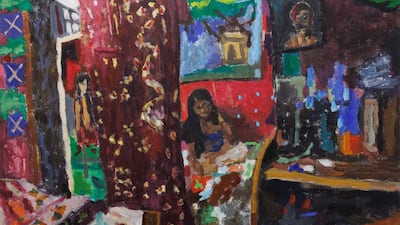

We are intruding. The woman scowls at us in the mirror as she pulls back from the man sitting next to her on the bed. Have we heard or seen something we shouldn’t have?
Our angled perspective from between the bed and the mirror certainly suggests this, as if we – as viewers – are crouching by the console table, trying to remain unnoticed.
Our place in Hisham Sharif’s paintings, however, is often uncertain. Here, in Behind the Mirror, we could very well be the woman herself, rethinking this relationship, gazing at herself in the mirror, perhaps vying to be elsewhere. The tension is thick, and the tight space between the couple is a schism, worlds apart.


Like the other works in Sharif’s solo exhibition at Ayyam Gallery, Behind the Mirror was created in the years following a turbulent break-up. The Bahraini artist was due to get married in 2023 when the wedding was called off. Spurred by heartbreak, he ventured to find love again. Many of the paintings in the exhibition are inspired by these relationships, drawing as well from Persian miniatures and stories, such as Ferdowsi’s Shahnameh.
Allusive Veil is Sharif’s first exhibition in Dubai. The series of works being presented is also one of the first times the painter experiments wholeheartedly with colour, having been known for his more monochromatic approach in the past.
“My previous body of work, which was mostly monochrome, ends at a wedding and a dancing scene,” he says, pointing out that his work is often autobiographical. “I was so close to getting married, and then my fiancee broke up with me.”
Around that same time, Sharif’s father – celebrated painter Abdul Rahim Sharif – also fell ill. Sharif stopped painting to help his father recover while grieving the end of his relationship. As his father recovered by the summer of 2023, Sharif returned to the canvas eager to “make up for lost time.”
A third of the exhibition features women in spaces overflowing with textiles and flowers. A few of these bring to mind the Orientalist painters of the late 19th century. They also seem to reinforce narratives of the male gaze. After all, the women seem to be posing for the painter, the viewer. A flair for eroticism and exoticism is present in some of the compositions.
One painting in particular features a leopard lolling on a couch beside a woman dressed in a similarly spotted dress. The scene alludes, perhaps inadvertently, to a trope often found in 19th-century European paintings of the region. It was most prominent in the works of French painter Jean-Joseph Benjamin-Constant, such as A Royal Palace in Morocco and The Odalisque, both of which suggest a sketchy metaphor between the depicted women and the captured, tamed wild cats.

But Sharif insists this isn’t the case with his work. He argues that while painters like Constant and Eugene Delacroix depicted scenes and interiors from the Arab world – most notably from Morocco and Algeria – with a detached, eroticising lens, he is very much present in his works.
“I am Bahrani born and bred. But I'm fully Persian; my parents are Persian. These are things I associate with our Persian culture,” he says. “With Orientalism, it was a western gaze into the Arab world. With this, this is my Arab-Persian gaze into our world. I can take you to houses in Bahrain that seem like Delacroix [paintings].”
There are clues to Sharif’s presence within the paintings. Mirrors and reflections have his visage, or a suggestion of it, cast back within the scene. Then there is the technique with which he paints, the feverish dabs of colour that are persuasively subjective. It perhaps also alludes to Sharif’s difficulties after the break-up. The hues ripple in the works. The forms resist coming together as a whole, evoking drama, tension and desire.
“I went through a lot of heartbreak and personal pain. And wanted to be vulnerable,” he says. “I’ve rarely encountered artists who spoke about intimacy and relationships and vulnerability. We never bring these topics up. There’s this emotional gap.”
Technically, the works are a delightful storm of textures and colours – notwithstanding the debate of whether Sharif is unintentionally falling into fantastical, Orientalist tropes or if he is cheekily subverting them in an authentic display of his own romantic experiences and vulnerability.
The women in the paintings can also very well be expounded as figments of a heart-broken imagination – distortions of Sharif’s ex-fiancee and manifestations of his longing. How the work ultimately lands may be largely dependent on which of these interpretations the viewer subscribes to.

“I understand how people could relate [the work] to Orientalism but I always say these are the things I also grew up with. I live around this furniture, these carpets. I also had the opportunity of having cheetahs. People in Bahrain, in the Arab world, have these ideas of collecting big cats.”
The second stretch of paintings within Allusive Veil lean into the animal symbolism of romantic pursuits. Painted with the same febrile energy, they depict leopards hunting gazelles – a chase, Sharif says, he often found in Persian miniature painting.
But Sharif says he has tried to impart an ambiguity as to who each of the animals represents.
The last of the works, meanwhile, are largely devoid of any figures or animals. They represent, for Sharif, the conclusion of a years-long process of recovering from his break-up, quitting drinking and finding stability in religion. These canvases are among the largest in the show and show garden scenes and plant life. They are also given self-reflective titles, such as Solitude. Though they still quiver with colour, these compositions seem to have been painted with a steadier hand.
As such, Allusive Veil, Sharif says, charts a roller coaster of emotion.
“It starts with heartbreak and trying to figure it out, going chase after chase, into then acceptance, trying to find contentment and peace of mind. I replaced the masculine and the feminine, the cheetah and the gazelle, with plants. It was the aftermath of a journey through hell to get over the break-up.”
Allusive Veil is running at Ayyam Gallery, Dubai until October 30

