Lebanese-Canadian researcher and artist Elias Nafaa has not witnessed first-hand the ongoing violence that Israel has unleashed on Palestine and Lebanon since 2023, instead watching warheads descend in social media videos and numbers multiply on news segments.
Over the past few years, Nafaa began to reflect on the nature of violence, how wars are documented and the emotional cost sometimes treated as secondary to countless information-driven headlines.
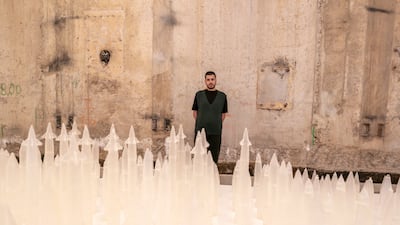
His newly opened exhibition Handle with Care at Muzeu – Thought & Contemporary Art dst – a recently opened contemporary art museum in Braga, Portugal – is a visual representation of these ideas in the form of 300 translucent resin munitions and missiles. What at first might seem like a beautiful ice sculptures or glass decorations from a distance quickly become objects of violence, forcing the viewer to adjust their thought process.


“The resin casts are based on six families of aerial munitions that I researched, which are being used in Israeli strikes on Lebanon,” Nafaa tells The National. “The experience of violence from afar developed into a process of identifying all of these munitions that circulate in the day-to-day imagery that I would receive.
“I wanted to understand these objects and how violence is designed in and of itself; how each has a particular geometry, function and an intended relationship to bodies, buildings and landscapes,” he adds. “Then I translated those forms into a very fragile material, so something that would normally be associated with destructive technology here becomes materially vulnerable.”
The 300 warheads are scaled-down replicas, multiplied based on the frequency of each type’s use. The 300 are a small demonstrative sample of the actual number of fired munitions recorded.
Using public information from the Armed Conflict Location and Event Data project (ACLED), Beirut Urban Lab, Public Works Studio and other open-source data trackers, Nafaa initially looked at 8,016 Israeli strikes recorded in Lebanon between October 2023 and September 2024, later rising to 15,520 by March this year.
The current count is likely more than 20,000, taking into account the resurgence of intense shelling since March 2026, though exact numbers are still being tallied.
“I was trying to change the power dynamic by looking at them from above and for them to appear as fragile as possible,” Nafaa says. “Beirut Urban Lab was a resource I used a lot, as they were tracking each strike as it happened, but I had to do a lot more research to identify the types of weapons used, using Human Rights Watch and online data.”
According to Nafaa’s research, artillery shells accounted for the largest share of documented weapons at 40 per cent, particularly in areas along Lebanon’s southern border. White phosphorus shells made up 20 per cent, followed by cluster munitions at 15 per cent and JDAMs, including so-called “bunker busters”, at 12 per cent.

Accompanying the exhibition is detailed information and charts about the types of weaponry, their documented use in Lebanon, the nature of the target, and a lot of mapping and tracking data to show the evidence. It also shows the meagre amount of return fire from Lebanon – highlighting the massive disparity in both numbers and weapon type damage, dismissing claims that it was an equal conflict.
Investigations into the illegal use of white phosphorus, and the lasting effects of such war crimes on the environment and the general public, are also shown, offering a well-rounded understanding of the destruction.
Beyond the visual aspects, a soundscape by Lebanese artist Cynthia Zaven titled Tender Grounds resonates through the work. The piece layers the live-recorded buzzing of drones, low-flying aircraft, and the rumble of artillery strikes, as well as the tense silences in between, with more musical elements.
“There was a lot of psychological terror, often through sonic forms like the constant MK Drones circling overhead, or the daily sonic booms from their planes breaking the sound barrier to terrorise people,” Nafaa says.
He adds that he wanted sound to have a presence in the space, despite it not being a medium he typically works with, so he commissioned Zaven to compose a score that would act as a “seventh weapon type” without a visual counterpart.
“She already has a lot of recordings of the bombings and what was happening on the ground, because she's based in Beirut, but there was this very conscious decision of not just replicating the violence and not bringing the violence of the sound into the space,” he adds.
“The composition looks at the ground and how it's absorbing the violence. It created a whole temporality for the project, where you would go in, see these almost invisible objects that disappear in the space, do the reading accompanying the work, and then understand what you're looking at, what you're hearing.”
First presented at Manif d'art 12 – The Quebec City Biennial in 2026, the project was produced and shown in February, before the onset of the current destruction in Lebanon in March. Visitors to the show were witnessing new events unfold in parallel, such as the assassination of former Iranian leader Ali Khamenei, or the expanded ground operations and occupation of villages in Lebanon.
The resources shown alongside the installation are also live, updated with recent mapping where possible. Considering the new context under which the show is being displayed, Nafaa intends to continue the project with more research and new mediums, preparing shows for next year.
“I'm working more with archival documents, moving image and again with sculptural works. It looks into this idea of care and how it lives alongside violence, but specifically into the tenderness of diplomatic language, and around moments of political and military crises in the region,” he says.
“I'm continuing this investigation between military mechanisms and infrastructures and the circulation of violence. I’m also interested in looking at the distribution of such weapons – where they come from, who supplies them, which economies they circulate through.
“For foreign audiences, it’s important to show all this information, because some of them don’t even know this aggression is happening.”
Handle with Care runs until October 18 at MUZEU – Thought & Contemporary Art dst in Braga, Portugal

