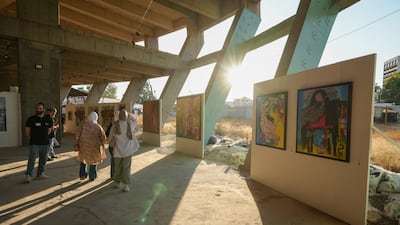
Syria’s first Art Week has brought together 47 Syrian artists who are seeking to revive a cultural landscape shaped by years of war and upheaval.
The week-long event in Damascus, founded and curated by Line Kouwatli, features artists mainly based in Syria, alongside musical performances, cinema screenings and art talks.
Syria’s creative sector has faced challenges for years. These include the limited number of exhibition spaces, lack of financial and moral support for artists and low museum and exhibition attendance among large sections of society.

The choice of the Warda Masar venue gives the event added significance. For years, the site stood abandoned and inaccessible to the public, a concrete structure marked by the traces of war and years of stagnation. Its distinctive architectural design, however, offered a unique setting for the exhibition.
“We wanted to focus on artists based in Syria who did not get the chance to expose their work to an international audience,” Kouwatli tells The National.

Works featured in the exhibition explore themes including everyday life, childhood and human emotions, using a variety of styles and techniques.
Some artists have incorporated remnants of war into their works, transforming objects once associated with death and destruction into art that speak instead of life and hope in Damascus and across Syria.
The programme includes young artists alongside established and pioneering figures who have helped to shape the Middle East art scene in recent decades.
“It was important for us to do [the event] now,” Kouwatli says. “It’s a historical moment and it’s so important for us to do things the right way from the beginning.”
She said the organisers wanted to “rebuild and revive” Syria’s art and cultural scene through a sustainable platform capable of supporting Syrian artists.

The event aims to bring an international audience to Damascus. More than 100 visitors had travelled from abroad during the first two days, including from the UAE, Kuwait, Qatar, France and Brazil, said Kouwatli.
“We really hope that this could be like an annual event,” she says. “We are keen on making it happen. We have it as a commitment and a responsibility to make [it] an annual event where we invite everyone from the whole world to come to beautiful Damascus to see the full art and cultural scene here.”
For Syrian photojournalist Ghaith Alsayed, taking part in the event is significant.
“I am really happy to be taking part in the first Art Week in Syria,” he says. “Today, standing here in Damascus next to my photographs is something I honestly never imagined.”

Alsayed is exhibiting photographs documenting pivotal moments in Syria’s recent history, including images from the military offensive by rebel forces that led to the collapse of Bashar Al Assad's regime in December 2024.
Because Alsayed was in areas held by the Syrian opposition during the war, he was unable to visit Damascus before the regime's fall.
“Being here alongside my photographs still feels surreal to me, because before December 8, 2024, I never imagined that I would be in Damascus,” he says.
“It is an incredible feeling, and I am very happy to be able to tell people about my photographs and about events that were pivotal in Syria’s history – pivotal moments in the Syrian revolution.”
For Kouwatli, culture must be part of Syria’s reconstruction.
“If we all join forces and work together, we will rebuild our country,” she says. “We want artists to be part of rebuilding Syria. They have to be part of it.”
“A country cannot be rebuilt unless its culture is being worked on,” she adds.

The organisers say they hope to create a wider ecosystem for Syria’s cultural scene, while giving artists a platform to tell their stories to audiences at home and abroad.
“Artists want to say that they have a story that they are presenting here to the world – a story of resilience, of memory, of challenges,” Kouwatli says. “But today they are even stronger than ever, and they want to show the world what they can do.”

