

Artist Leila Nseir died on August 16 in a nursing home in Latakia, Syria, where she had lived for several years. Born in 1941 in Al-Haffah, she was a pioneer, best known for her modernist works featuring female protagonists.
One month after her death, while Nseir's artistic legacy is well established across the world, those who knew her personally remember her not only for her contribution to Syrian art, but to the values traits that fed into her work; humility, dedication and generosity.
Artist Ahmad Kasha, 26, recalls he first met Nseir at his father’s exhibition opening, where he saw crowds greet an elegant lady who shared a memorable critique of the artworks on display.

“Miss Leila would always call me,” he says, “I would see her very often.” Kasha, who first met Nseir about eight years ago, describes her as a maternal figure and a teacher.
He fondly remembers her lunch invitations. He said her favourite dish to make was chicken and potatoes, but they would often end up eating it burnt or have to order in as she would forget about the food in the oven.
She would call when she was lacking inspiration, saying, “I want to recharge”, and they would stroll around Latakia visiting bazaars, bus stations and street vendors, while she studied people’s faces, observing their sadness, fatigue, poverty, and humanity. She would stop and sketch the shoe shiners and Kasha would place a chair for her to sit on as she drew them.
He describes her as a human before an artist, who gave her whole life to people.
-

Leila Nseir was awarded Syria’s State Merit Award in 2018. Photo: Saba Al Ali -
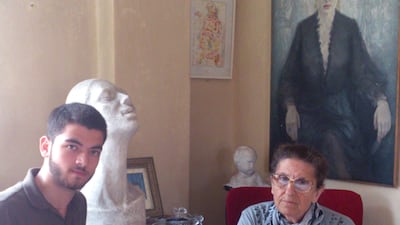
Ahmad Kasha’s first visit to Leila Nseir’s studio in Latakia in 2015. Photo: Ahmad Kasha -

Leila Nseir creating a work with pastels in 2018. Photo: Ahmad Kasha -
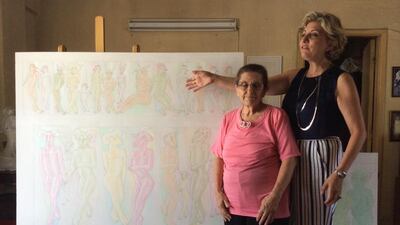
Leila Nseir with her friend, gallerist Saba Al Ali in 2014. Photo: Saba Al Ali -
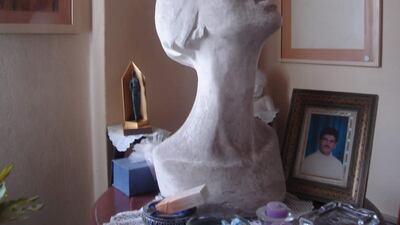
A corner of Leila Nseir’s home, featuring one of her sculptures. Photo: Saba Al Ali -

Leila Nseir (left) at an art fair in Beirut, Lebanon, in 2014 with artist Mostafa Ali and gallerists Suad Azzawi and Saba Al Ali. Photo: Saba Al Ali -

An untitled work by Leila Nseir. Atassi Foundation for Art and Culture -

Work by Leila Nseir on display at the Barjeel Art Foundation exhibition at Christie’s in London in August 2023. Photo: Sueraya Shaheen -
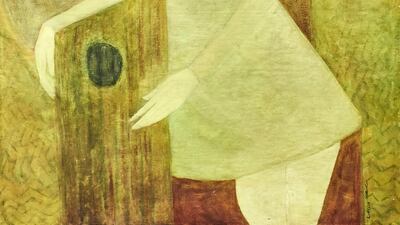
Motherhood by Leila Nseir, 1970, oil on canvas, 202 x 102cm. Barjeel Art Foundation, Sharjah. -

Leila Nseir awarded Syria’s State Merit Award, 2018, Damascus, Syria. Photo: Saba Al Ali


Although she had no children of her own, she was a second mother to her nieces and nephews, and she had maternal feelings towards everyone: to artists, family and the poor.
She also had a powerful and fiery character, Kasha adds. She was respected, strong, and cultured. She wrote poetry and short stories and taught a whole generation of artists.
She was so dedicated to her practice that she painted in oils until she became ill, poisoned by the yellow pigment she used in her depictions of Vietnam in the 1970s. When her doctors forbade her to use oil paints, she turned instead to acrylics and pastels.
She enjoyed experimenting with styles and techniques in search of a character for her work. Unfortunately, few of her works are accessible, and as a result, many people are unaware of the breadth of her practice.

However, visitors to the Kawkaba: Highlights from the Barjeel Art Foundation exhibition staged at Christie's in London in August were treated to a glimpse of her stunning work, The Martyr (The Nation).
Depicting a female martyr being mourned as her body is carried through the crowd, it challenges traditional notions of martyrdom as an exclusively male act of sacrifice, prevalent in the 20th century Arab world.
In her final years, Kasha worked to archive her history and all her photographs, press clippings, and voice recordings, with as much input from Nseir as possible. They started working on her archive in collaboration with the Atassi Foundation.
Nseir’s close friend, gallerist Saba Al Ali describes getting to know her through mutual friends in Latakia. “She is in all the details of my life,” Al Ali recounts, “everything reminds me of her". Nseir was a friend to her entire family and Al Ali's children grew to love art because of her.

In her youth, Nseir had long curly red hair and was known as the first woman to wear trousers in Syria and the first to sit alone in cafes, where she would paint. She was unabashedly herself and full of self-conviction.
She loved life immensely and took care of herself, and was simultaneously stubborn and hard-headed, elegant and proud. Her generosity knew no bounds and she would invite poor people into her home, feed them and take care of them. However, Al Ali says Nseir frequently suffered and struggled throughout her life, and did not get the appreciation nor the support that she deserved.
Remarking on her innovative practice, Al Ali highlights her particularly fascinating printmaking technique. Nseir would draw with pastels onto wood, and then use an iron to press and print these images onto another surface. She would then apply another layer of acrylic paint or oil pastels to finish off the printed works.
Afterwards, she gave away the pieces of wood, which people would take home and frame, even though Nseir didn’t see them as artworks.

Al Ali also remembers whenever someone came to sit with them, Leila would say, “One minute, I want to draw you,” before taking out an A4 sheet and sketching them in pencil.
She was so happy to receive Syria’s prestigious State Merit Award that she carried the medal in her purse wherever she went.
Al Ali affectionately recalls their many travels together, including visits to fellow artist Fatima el Hajj’s home in Beirut. Nseir's friends in Syria’s artistic community included Louay Kayyali, Nazir Nabaa and his wife Shalibeya Ibrahim, Elias Zayat and Fadi Yazigi. She sat on the advisory board of Al Ali’s Galerie Emar in Latakia which held an exhibition in her honour in 1998.

When Nseir painted Al Ali in the 1990s, people criticised the work because they felt it didn’t resemble her. Saba had gone to the artist's home four or five times to sit for her, but she could not spend much time with her because she was teaching and taking care of her children. Nseir painted what she wanted in a short period of time, in an expressive composition that her close friend understood.
Al Ali would like Nseir's legacy to be taught in art curriculums for generations to come. She wants to establish a memorial as a way for people to learn about the her, her oeuvre, and her significant contributions to art.
Kasha continues to work on Nseir’s archive with the Atassi Foundation, hoping to make her work accessible to wider audiences.

