


On the night before his death, Pablo Picasso was hosting his friends at his villa in Notre-Dame de Vie when he abruptly excused himself from the dinner table.
He was 91 years old and had been ill for weeks. Those around him recall he seemed to be in good spirits that night, however, urging his guests to drink to his health. Just before midnight, he got up and announced he had to return to work.
This was typical of the Spanish artist, who would work for long hours daily until he was physically exhausted. That night, he would go on to paint until 3am before lumbering to bed.
The next morning, on April 8, 1973, he awoke unable to move.
His wife, Jacqueline Roque, rushed to call for help, but by the time a doctor arrived, Picasso was dead. His death was attributed to a heart attack and pulmonary edema, fluid in the lungs. Saturday marks 50 years since his death.
-

Spanish painter Pablo Picasso standing in his studio, 1920s. Getty Images -
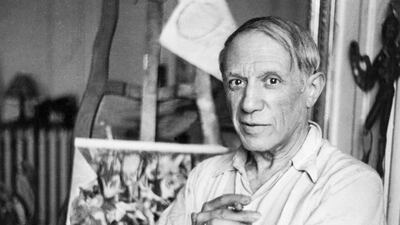
Picasso died in his Cannes home on April 8, 1973. Getty Images -

Picasso holds up a statuette of a fighting bull, presented to him by toreadors in appreciation of his art, in the stands at a bullfight at Vallauris, France, August 1955. Getty Images -
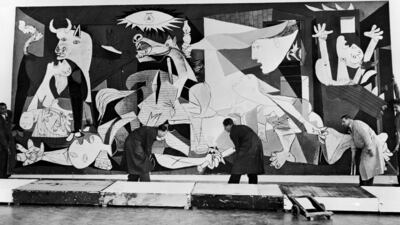
Guernica, perhaps the most famous painting by Pablo Picasso, being hung in the Municipal Museum in Amsterdam, July 1956. Getty Images -
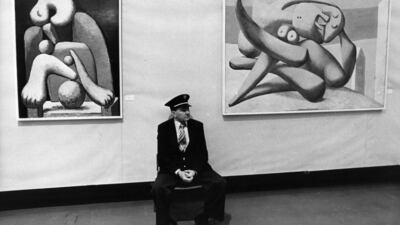
Picasso regularly painted the women in his life, including in The Woman in a Red Chair and Figures at the Seaside. Getty Images -
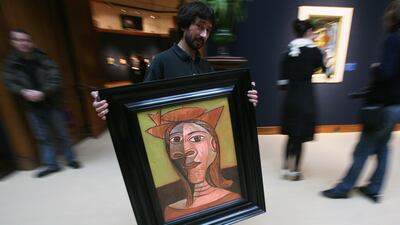
Picasso's Femme Au Chapeau at a Christie's London sale in January 2008. Getty Images -
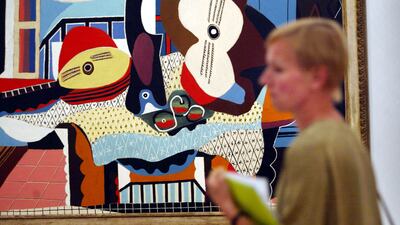
Mandolin and Guitar (1924) by Picasso. Getty Images -
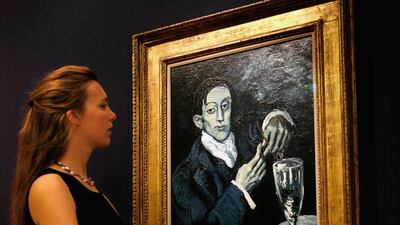
Portrait of Angel Fernandez de Soto painted by Picasso at Christie's in London, September 2006. Getty Images -

Picasso's Les Melines d'apres Velasquez. Getty Images -

Picasso's L'artiste devant sa toile. Getty Images -
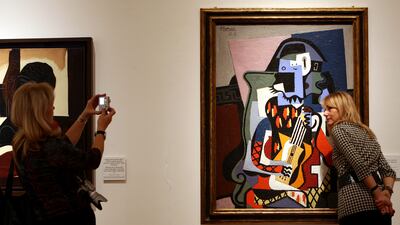
Harlequin the Musician by Picasso. Getty Images -

Picasso's Tete de Femme au Chapeau Vert. Photo by Oli Scarff/Getty Images


“Death holds no fear for me,” Picasso was quoted as saying in Time magazine's obituary of the artist. “It has a kind of beauty. What I am afraid of is falling ill and not being able to work. That's lost time."
In the years since his death, it is difficult to dispute Picasso’s influence. He was a painter, printmaker, sculptor, ceramicist, stage designer, poet and playwright. He co-founded the Cubist movement and paved the way for Surrealism. His discipline ensured him a forefront place in the pantheon of 20th-century artists. His impact on art was so seismic that historians have often spoken of art as it existed before and after Picasso.
Yes, there’s no denying the polychrome ripples Picasso, and his art, have had in the last half a century, from his first brushes with Cubism in the 1907 work Les Demoiselles d'Avignon, to the frenzied masterpieces of the 1930s that included The Weeping Woman and Guernica, and his final works, which were a combination of styles and mediums.
Despite his cultural contributions and legend, Picasso had a questionable character, driving those closest to him to despair and even suicide.
“No one in my family ever managed to escape from the stranglehold of this genius,” his granddaughter, Marina Picasso, wrote in her autobiography Picasso, My Grandfather.
“He needed blood to sign each of his paintings: my father’s blood, my brother’s, my mother’s, my grandmother’s and mine. He needed the blood of those who loved him.”
Women were often front and centre of Picasso’s works, and according to accounts from the time, those who were most familiar with the ugliness of his genius.
His affair with French photographer Dora Maar is well-documented in his paintings, including The Weeping Woman and The Portrait of Dora Maar, most of which portray her as tormented and anguished. Maar was not a fan of how she was depicted.
“All portraits of me are lies. They're Picassos. Not one is Dora Maar," she previously told the US writer James Lord. In 1993, Lord released Maar's biography, Picasso and Dora: A Personal Memoir.
Picasso’s relationship with Maar began in the mid-1930s when Picasso was married to his first wife, Russian ballet dancer Olga Khokhlova. Picasso was 54 and Maar was 28. Their affair lasted for nine years. Throughout that time, Maar says Picasso physically abused her and made her vie for his love against his other mistress.
Maar was not his first mistress. In 1927, Picasso began an affair with 17-year-old Marie-Therese Walter, a French model. He was 46. At first, Picasso kept the liaison a secret, playing the part of the dutiful husband as he ricocheted between his convalescing wife and mistress.
Khokhlova learned of Picasso’s affair from a friend in 1935, after Walter became pregnant. She took their son, Paulo, and left for the South of France, and much to the fury of Picasso, impounded his works until he agreed to pay a large allowance. The couple remained legally married until her death in 1955.
Picasso and Walter’s daughter, Maya, was born in September 1935. A matter of months later, the artist began his relationship with Maar.

Walter and Maar met each other accidentally in Picasso’s studio in 1937 while he was painting Guernica. There is a story of the encounter, which alleges Picasso told the two women to fight for him, at which point Maar and Walter began to wrestle.
In his book, Picasso: Magic Sex and Death, art historian and Picasso’s friend John Richardson denies the account, saying both Picasso and Maar said it never happened.
The story, he writes, was likely derived from Guernica itself, which depicts figures at opposite ends of the composition, facing each other in battle. If that were true, then Picasso projected the two women closest to him within the Basque town’s destruction in the wake of Nazi bombing during the Spanish Civil War.
While some critics interpret the rampaging bull or minotaur to be a representation of fascism within the work, others see it as Picasso’s ego. Perhaps it is a bit of both and it was another decisive sense of irony to depict Walter and Maar, both of whom inspired and modelled for figures within the painting, anguishing in the trail of his destructive minotaur.

In 1943, Picasso met up-and-coming painter Francoise Gilot, then aged 21, and began a relationship. By then, his relationship with Walter had ended and his relationship with Maar continued. In 1946, Picasso moved in with Gilot, and she became the subject and muse of his works. They went on to live together for a decade and had two children together.
Picasso was physically abusive towards Gilot, and she quoted him as saying: "Women are machines for suffering ... For me, there are only two kinds of women — goddesses and doormats." When Gilot left Picasso, he discouraged galleries from purchasing her works, and unsuccessfully attempted to stop her 1964 memoir, Life with Picasso, from being published. In the memoir, she recounts instances of Picasso's violence and their turbulent relationship.
“No one is indispensable to anyone else,” she writes in the book. “You imagine you're necessary to him or that he will be very unhappy if you leave him, but I'm sure that if you do, within three months he will have fitted another face into your role and you'll see that no one is suffering because of your absence.”
Gilot also quotes Picasso in the book as saying: “Every time I change wives I should burn the last one. That way I'd be rid of them. They wouldn't be around to complicate my existence. Maybe, that would bring back my youth, too. You kill the woman and you wipe out the past she represents.”

And that's only superficially grazing the misogyny and cruelty of Picasso, who for most of his life had the reputation of being a king and gentleman who abhorred violence. The far-reaching effects of his character are just as observable as his artistic legacy when we consider what happened to those closest to him soon after his death.
Picasso’s grandson, Pablito, died three months after the painter by drinking a bottle of bleach. His son Paulo, died in 1975 after a long bout with depression and alcoholism. Walter died in 1977, killing herself after being unable to bear her son Pablito’s death, and Roque, of whom Picasso created more than 400 portraits, shot herself in 1986.
Fifty years after his death and the dark details of Picasso’s influence over his family and his lovers haven’t done much to thwart his artistic lustre. There have been protests and more attention has been called to his cruel behaviour towards women, but for the most part, his legend endures.
Perhaps Picasso was fortunate to have come around a time when artists’ moral shortcomings were expected and concealed, but as conversations around art and the sins of the artist become more widespread, it is perhaps necessary to look beyond legend and his vibrant world, and into the suffering of those that loved him and bled for his works, literally and figuratively.

