There are a variety of reasons why Chinese Indians make the Achipur Pilgrimage, from preserving the traditions of their ancestors to connecting with the broader community. Photo: Puja Bhattacharjee

The annual pilgrimage honouring the roots of India's Chinese community


  • English
  • Arabic

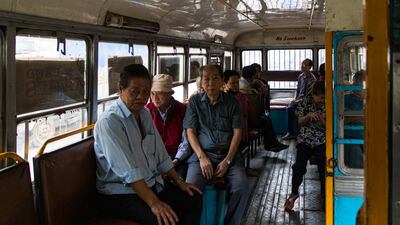
A rickety blue bus commonly seen ferrying people in the eastern Indian metropolis of Kolkata carefully manoeuvres its way through a narrow road lined with small shops and curious eyes. It stops before a temple dedicated to the Earth god and goddess in the south-west suburb of Achipur.

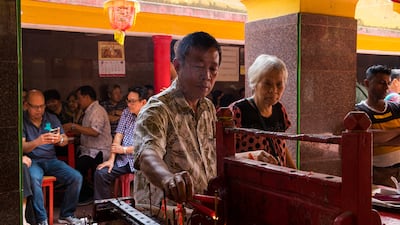
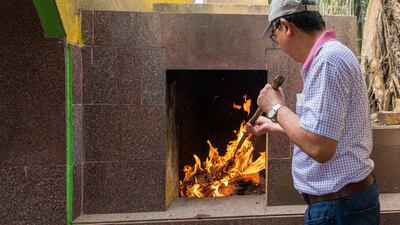
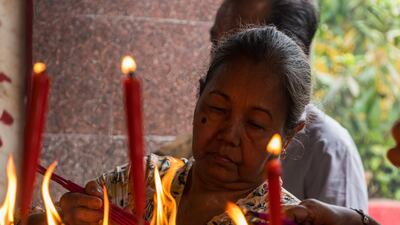
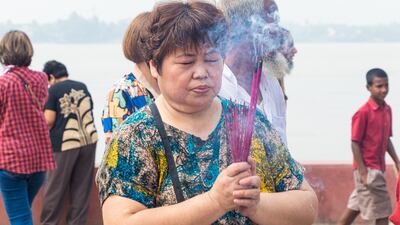
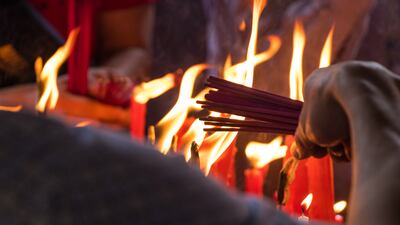
Primarily middle-aged and older people get off the bus and saunter into the main temple area. Large aluminium containers and cardboard boxes are unpacked and roasted meat, eggs, vegetables and fruits are laid on wooden tables in the temple courtyard. The pilgrims then light red candles and burn incense sticks — one for themselves, three for their family — and burn symbolic paper money to ensure that the deceased's spirit has sufficient means in the afterlife.

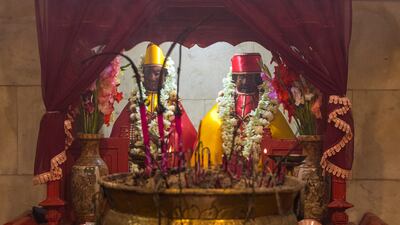
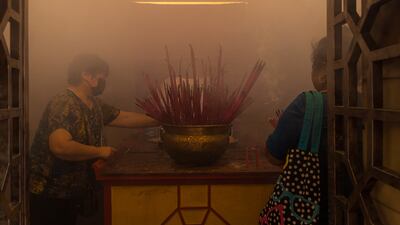
In the sanctum sanctorum, thick white smoke from burning incense clouds the idols. The smoke appears to sting the pilgrims' eyes and they struggle to say their prayers. The ringing of the bell and beating of the drums by Farooqul Haq, a caretaker at the temple, occasionally punctuates the silence.

  • Members of the Chinese Indian community board the bus which will take them to Achipur. All Photos: Puja Bhattacharjee for The National
    Members of the Chinese Indian community board the bus which will take them to Achipur. All Photos: Puja Bhattacharjee for The National
  • They travel 33 kilometres along the Hooghly river, before finally reaching a temple devoted to the Earth god and goddess
    They travel 33 kilometres along the Hooghly river, before finally reaching a temple devoted to the Earth god and goddess
  • Pilgrims burn symbolic paper money to ensure that the spirits of their loved ones have sufficient means in the afterlife
    Pilgrims burn symbolic paper money to ensure that the spirits of their loved ones have sufficient means in the afterlife
  • A pilgrim rakes the paper to ensure it is fully burned
    A pilgrim rakes the paper to ensure it is fully burned
  • Pilgrims venerate the Earth god and goddess
    Pilgrims venerate the Earth god and goddess
  • The pilgrims light red candles and burn incense sticks – one for themselves and three for their family
    The pilgrims light red candles and burn incense sticks – one for themselves and three for their family
  • The sanctum sanctorum fills with incense smoke, the ringing of bells and the beating of drums
    The sanctum sanctorum fills with incense smoke, the ringing of bells and the beating of drums
  • The pilgrimage takes devotees to the banks of the Hooghly
    The pilgrimage takes devotees to the banks of the Hooghly
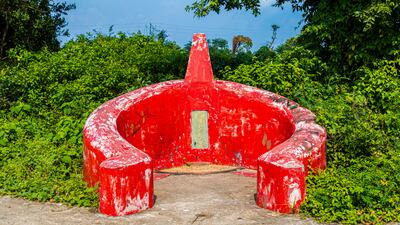
  • A pilrim burns incense and prays at Atchew's tomb
    A pilrim burns incense and prays at Atchew's tomb
  • Pilgrims lighting incense sticks
    Pilgrims lighting incense sticks
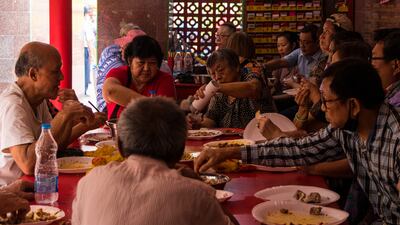
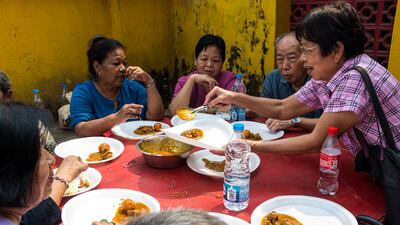
  • After offering food to the gods, the pilgrims enjoy a feast together
    After offering food to the gods, the pilgrims enjoy a feast together
  • Pilgrims bond over a hearty feast
    Pilgrims bond over a hearty feast

This was the scene at the recent Achipur pilgrimage, a one-month event that takes place annually between Chinese New Year and February 21 — the birthday of Tong Atchew, said to be the first Chinese settler in India, having arrived in 1778.

Earlier in the day, the bus carrying about 60 Chinese-Indian pilgrims set out from the congested streets of the central Kolkata neighbourhood of Tiretti Bazaar, famous for its Chinese temples and food.

It travelled 33 kilometres, running almost parallel to the Hooghly river, past the open, green centre of the city and on to narrow roads filled with potholes and dust. It takes more than 90 minutes to reach the destination and a few extra minutes to carefully navigate the narrow street where the temple stands.

After venerating the Earth god and goddess, the pilgrims proceed to the banks of the Hooghly river to light more candles and incense in front of a red horse-shoe-shaped tombstone, the symbolic resting place of Tong Atchew, said to be the first Chinese settler in India. The river washed away the original grave.

By about mid-afternoon, the food offered to the gods and ancestors is neatly chopped and arranged on plates. Some pilgrims lay out cotton sheets and enjoy a hearty feast on the grassy land adjoining the temple. Others crowd around tables under a shed and savour their meal.

The pilgrimage begins

The history of the Chinese-Indian community begins with the arrival of Atchew on the banks of the Hooghly river in Achipur. According to colonial records, in 1778 the Chinese immigrant applied to the colonial government for land in Bengal to set up a sugar mill.

Atchew brought in Chinese contract labourers to work on his mill. Local Bengali people called Atchew "Achi", and with time the place where he built his mill became known as Achipur.

Jo Kou, a pilgrim on the bus to Achipur

Atchew, also known as Yang Dazhao, was the ancestor of the other Chinese communities that would later spread across South Asia. A shared identity thus emerged among the various Chinese communities that arrived in the region during the 18th and 19th centuries.

After Atchew's death, the mill closed down and the Chinese settlers moved to the Tiretta Bazaar area of Kolkata, the capital of India under British rule, which was a hub of economic activity.

India's first Chinatown

Iftekhar Ahsan, who founded tour operator Calcutta Walks, says the British, who occupied part of the city, did not mingle much with the Bengali citizens who occupied another. But between the two distinct towns was a grey area, he says, occupied by "settlers like the Chinese, Jews, Parsis and Armenians".

He adds that being located between the two towns was lucrative. It allowed residents to conduct business with both the locals and the colonialists.

In the mid-19th century, Tiretta Bazaar became the first Chinatown in Kolkata. The neighbourhood contributed to the city's cosmopolitan nature as more Chinese families arrived from China in the 1930s and 1940s.

The pilgrims

Seated in the spacious hall of the Voi Ling Club, Chen Yao Hua, 69, president of the All India Chinese Association, reminisces about his journey to Achipur as a young boy.

Pilgims offer prayers to their ancestors and Atchew at Atchew's grave site next to the Hooghly river

"The road to Achipur had no houses back then. Only a few huts here and there. We had to traverse the mud roads that led to the village. Most of the area was covered in dense jungle and some were open fields," he says.

There are a variety of reasons why Chinese-Indians make the pilgrimage. For some, preserving the traditions of their ancestors is a serious responsibility. Others use it as a way to connect with the broader community.

Lucy Moore, 73, a Chinese Indian lady, has visited Achipur on Atchew's birthday since childhood. "It has been 300 years since Achi appa [meaning father] stepped foot in India. We get together and enjoy spending time here. We look forward to visiting Achipur every year," she says.

Her sister-in-law Suglun Moore says for her, it is a spiritual journey. "It gives me peace."

Another pilgrim, Jo Kou, says he never visited Achipur as a child because his family felt the journey would be too rough on him. He has been making the pilgrimage for the past 10 years, and for him, it's not just about paying homage to his ancestors. "It's kind of like a picnic. It's a fun thing to do."

After making their offerings, pilgrims sit down and catch up while their food is prepared

Michael Wang, 52, used to work in the Middle East, where he met his Chinese wife, whom he now lives with in Beijing with their children. He visited Achipur for the first time with his family in 2006 and still enjoys catching up with people he hasn't seen in a long time.

Sea change

Chen estimates that fewer than 2,000 Chinese-Indians live in Kolkata at present.

This change is also reflected in Achipur itself. The locals do brisk business selling food, helping pilgrims to carry objects and disposing of things on their behalf.

Sheikh Ajijul Rahman, 57, has been the temple's caretaker for decades. He now looks after Atchew's grave.

He says a few decades back, so many Chinese-Indians came for the pilgrimage that there was hardly space to move. The considerable decline in the number of pilgrims has affected him financially. "If they don't come, how will we earn extra money?"

A lady lights candles in the temple courtyard

Francis Lee misses the dragon dance that used to happen on the temple premises, a compulsory event during Chinese New Year celebrations. However, he is not too concerned about the diminishing population of the Chinese community in India. He is hopeful that some will choose to stay in India.

Chinatown in Tiretti Bazaar has witnessed a sea change in recent decades. People in the Chinese community have been migrating abroad in large numbers for economic reasons. Some have taken up Catholicism and moved away from certain Chinese customs.

Keeping traditions alive

During Chinese New Year, Chen and his family celebrate by having dinner and lunch together. "I speak [to my children] about Chinese customs and encourage them to follow Chinese traditions. I try to pass on the knowledge of my ancestors to my children," he says. Chen is the only person in his family who adheres to his ancestral religion. Everyone else now follows Catholic Christianity.

The diminishing numbers have also affected the temple's upkeep. Chen says: "Earlier, there were many members of the local Chinese clubs whose donations helped with maintenance. But now, the number of members has dwindled."

Today, there are no Chinese residents in Achipur. The temple and the grave are the only reminders of a once vibrant community and their storied ancestor who dared to seek his fortune in a faraway land.


LOVE%20AGAIN
%3Cp%3EDirector%3A%20Jim%20Strouse%3C%2Fp%3E%0A%3Cp%3EStars%3A%20Priyanka%20Chopra%20Jonas%2C%20Sam%20Heughan%2C%20Celine%20Dion%3C%2Fp%3E%0A%3Cp%3ERating%3A%202%2F5%3C%2Fp%3E%0A
Coffee: black death or elixir of life?

It is among the greatest health debates of our time; splashed across newspapers with contradicting headlines - is coffee good for you or not?

Depending on what you read, it is either a cancer-causing, sleep-depriving, stomach ulcer-inducing black death or the secret to long life, cutting the chance of stroke, diabetes and cancer.

The latest research - a study of 8,412 people across the UK who each underwent an MRI heart scan - is intended to put to bed (caffeine allowing) conflicting reports of the pros and cons of consumption.

The study, funded by the British Heart Foundation, contradicted previous findings that it stiffens arteries, putting pressure on the heart and increasing the likelihood of a heart attack or stroke, leading to warnings to cut down.

Numerous studies have recognised the benefits of coffee in cutting oral and esophageal cancer, the risk of a stroke and cirrhosis of the liver. 

The benefits are often linked to biologically active compounds including caffeine, flavonoids, lignans, and other polyphenols, which benefit the body. These and othetr coffee compounds regulate genes involved in DNA repair, have anti-inflammatory properties and are associated with lower risk of insulin resistance, which is linked to type-2 diabetes.

But as doctors warn, too much of anything is inadvisable. The British Heart Foundation found the heaviest coffee drinkers in the study were most likely to be men who smoked and drank alcohol regularly.

Excessive amounts of coffee also unsettle the stomach causing or contributing to stomach ulcers. It also stains the teeth over time, hampers absorption of minerals and vitamins like zinc and iron.

It also raises blood pressure, which is largely problematic for people with existing conditions.

So the heaviest drinkers of the black stuff - some in the study had up to 25 cups per day - may want to rein it in.

Rory Reynolds

ELECTION%20RESULTS
%3Cp%3EMacron%E2%80%99s%20Ensemble%20group%20won%20245%20seats.%26nbsp%3B%3C%2Fp%3E%0A%3Cp%3EThe%20second-largest%20group%20in%20parliament%20is%20Nupes%2C%20a%20leftist%20coalition%20led%20by%20Jean-Luc%20Melenchon%2C%20which%20gets%20131%20lawmakers.%26nbsp%3B%3C%2Fp%3E%0A%3Cp%3EThe%20far-right%20National%20Rally%20fared%20much%20better%20than%20expected%20with%2089%20seats.%3C%2Fp%3E%0A%3Cp%3EThe%20centre-right%20Republicans%20and%20their%20allies%20took%2061.%3C%2Fp%3E%0A
ICC Awards for 2021

MEN

Cricketer of the Year – Shaheen Afridi (Pakistan)

T20 Cricketer of the Year – Mohammad Rizwan (Pakistan)

ODI Cricketer of the Year – Babar Azam (Pakistan)

Test Cricketer of the Year – Joe Root (England)

WOMEN

Cricketer of the Year – Smriti Mandhana (India)

ODI Cricketer of the Year – Lizelle Lee (South Africa)

T20 Cricketer of the Year – Tammy Beaumont (England)

Mercer, the investment consulting arm of US services company Marsh & McLennan, expects its wealth division to at least double its assets under management (AUM) in the Middle East as wealth in the region continues to grow despite economic headwinds, a company official said.

Mercer Wealth, which globally has $160 billion in AUM, plans to boost its AUM in the region to $2-$3bn in the next 2-3 years from the present $1bn, said Yasir AbuShaban, a Dubai-based principal with Mercer Wealth.

Within the next two to three years, we are looking at reaching $2 to $3 billion as a conservative estimate and we do see an opportunity to do so,” said Mr AbuShaban.

Mercer does not directly make investments, but allocates clients’ money they have discretion to, to professional asset managers. They also provide advice to clients.

“We have buying power. We can negotiate on their (client’s) behalf with asset managers to provide them lower fees than they otherwise would have to get on their own,” he added.

Mercer Wealth’s clients include sovereign wealth funds, family offices, and insurance companies among others.

From its office in Dubai, Mercer also looks after Africa, India and Turkey, where they also see opportunity for growth.

Wealth creation in Middle East and Africa (MEA) grew 8.5 per cent to $8.1 trillion last year from $7.5tn in 2015, higher than last year’s global average of 6 per cent and the second-highest growth in a region after Asia-Pacific which grew 9.9 per cent, according to consultancy Boston Consulting Group (BCG). In the region, where wealth grew just 1.9 per cent in 2015 compared with 2014, a pickup in oil prices has helped in wealth generation.

BCG is forecasting MEA wealth will rise to $12tn by 2021, growing at an annual average of 8 per cent.

Drivers of wealth generation in the region will be split evenly between new wealth creation and growth of performance of existing assets, according to BCG.

Another general trend in the region is clients’ looking for a comprehensive approach to investing, according to Mr AbuShaban.

“Institutional investors or some of the families are seeing a slowdown in the available capital they have to invest and in that sense they are looking at optimizing the way they manage their portfolios and making sure they are not investing haphazardly and different parts of their investment are working together,” said Mr AbuShaban.

Some clients also have a higher appetite for risk, given the low interest-rate environment that does not provide enough yield for some institutional investors. These clients are keen to invest in illiquid assets, such as private equity and infrastructure.

“What we have seen is a desire for higher returns in what has been a low-return environment specifically in various fixed income or bonds,” he said.

“In this environment, we have seen a de facto increase in the risk that clients are taking in things like illiquid investments, private equity investments, infrastructure and private debt, those kind of investments were higher illiquidity results in incrementally higher returns.”

The Abu Dhabi Investment Authority, one of the largest sovereign wealth funds, said in its 2016 report that has gradually increased its exposure in direct private equity and private credit transactions, mainly in Asian markets and especially in China and India. The authority’s private equity department focused on structured equities owing to “their defensive characteristics.”

Mina Cup winners

Under 12 – Minerva Academy

Under 14 – Unam Pumas

Under 16 – Fursan Hispania

Under 18 – Madenat

COMPANY%20PROFILE
%3Cp%3E%3Cstrong%3EName%3A%3C%2Fstrong%3E%20SupplyVan%3Cbr%3E%3Cstrong%3EBased%3A%3C%2Fstrong%3E%20Dubai%2C%20UAE%3Cbr%3E%3Cstrong%3ELaunch%20year%3A%3C%2Fstrong%3E%202017%3Cbr%3E%3Cstrong%3ENumber%20of%20employees%3A%3C%2Fstrong%3E%2029%3Cbr%3E%3Cstrong%3ESector%3A%3C%2Fstrong%3E%20MRO%20and%20e-commerce%3Cbr%3E%3Cstrong%3EFunding%3A%3C%2Fstrong%3E%20Seed%3C%2Fp%3E%0A
Company%20profile
%3Cp%3ECompany%20name%3A%20Shipsy%3Cbr%3EYear%20of%20inception%3A%202015%3Cbr%3EFounders%3A%20Soham%20Chokshi%2C%20Dhruv%20Agrawal%2C%20Harsh%20Kumar%20and%20Himanshu%20Gupta%3Cbr%3EBased%3A%20India%2C%20UAE%20and%20Indonesia%3Cbr%3ESector%3A%20logistics%3Cbr%3ESize%3A%20more%20than%20350%20employees%3Cbr%3EFunding%20received%20so%20far%3A%20%2431%20million%20in%20series%20A%20and%20B%20rounds%3Cbr%3EInvestors%3A%20Info%20Edge%2C%20Sequoia%20Capital%E2%80%99s%20Surge%2C%20A91%20Partners%20and%20Z3%20Partners%3C%2Fp%3E%0A
Water waste

In the UAE’s arid climate, small shrubs, bushes and flower beds usually require about six litres of water per square metre, daily. That increases to 12 litres per square metre a day for small trees, and 300 litres for palm trees.

Horticulturists suggest the best time for watering is before 8am or after 6pm, when water won't be dried up by the sun.

A global report published by the Water Resources Institute in August, ranked the UAE 10th out of 164 nations where water supplies are most stretched.

The Emirates is the world’s third largest per capita water consumer after the US and Canada.

COMPANY%20PROFILE
%3Cp%3E%3Cstrong%3ECompany%20name%3A%3C%2Fstrong%3E%20Silkhaus%3C%2Fp%3E%0A%3Cp%3E%3Cstrong%3EStarted%3A%3C%2Fstrong%3E%202021%3C%2Fp%3E%0A%3Cp%3E%3Cstrong%3EFounders%3A%3C%2Fstrong%3E%20Aahan%20Bhojani%20and%20Ashmin%20Varma%3C%2Fp%3E%0A%3Cp%3E%3Cstrong%3EBased%3A%3C%2Fstrong%3E%20Dubai%2C%20UAE%3C%2Fp%3E%0A%3Cp%3E%3Cstrong%3EIndustry%3A%3C%2Fstrong%3E%20Property%20technology%3C%2Fp%3E%0A%3Cp%3E%3Cstrong%3EFunding%3A%3C%2Fstrong%3E%20%247.75%20million%3C%2Fp%3E%0A%3Cp%3E%3Cstrong%3EInvestors%3A%3C%2Fstrong%3E%20Nuwa%20Capital%2C%20VentureSouq%2C%20Nordstar%2C%20Global%20Founders%20Capital%2C%20Yuj%20Ventures%20and%20Whiteboard%20Capital%3C%2Fp%3E%0A
Brief scores:

Toss: Australia, chose to bat

Australia: 272-9 (50 ov)

Khawaja 100, Handscomb 52; Bhuvneshwar 3-48

India: 237 (50 ov)

Rohit 56, Bhuvneshwar 46; Zampa 3-46

Player of the Match: Usman Khawaja (Australia)

Player of the Series: Usman Khawaja (Australia)

Strait of Hormuz

Fujairah is a crucial hub for fuel storage and is just outside the Strait of Hormuz, a vital shipping route linking Middle East oil producers to markets in Asia, Europe, North America and beyond.

The strait is 33 km wide at its narrowest point, but the shipping lane is just three km wide in either direction. Almost a fifth of oil consumed across the world passes through the strait.

Iran has repeatedly threatened to close the strait, a move that would risk inviting geopolitical and economic turmoil.

Last month, Iran issued a new warning that it would block the strait, if it was prevented from using the waterway following a US decision to end exemptions from sanctions for major Iranian oil importers.

David Haye record

Total fights: 32
Wins: 28
Wins by KO: 26
Losses: 4

Key findings of Jenkins report
  • Founder of the Muslim Brotherhood, Hassan al Banna, "accepted the political utility of violence"
  • Views of key Muslim Brotherhood ideologue, Sayyid Qutb, have “consistently been understood” as permitting “the use of extreme violence in the pursuit of the perfect Islamic society” and “never been institutionally disowned” by the movement.
  • Muslim Brotherhood at all levels has repeatedly defended Hamas attacks against Israel, including the use of suicide bombers and the killing of civilians.
  • Laying out the report in the House of Commons, David Cameron told MPs: "The main findings of the review support the conclusion that membership of, association with, or influence by the Muslim Brotherhood should be considered as a possible indicator of extremism."
RESULT

Esperance de Tunis 1 Guadalajara 1 
(Esperance won 6-5 on penalties)
Esperance: Belaili 38’
Guadalajara: Sandoval 5’

Updated: March 27, 2023, 9:40 AM