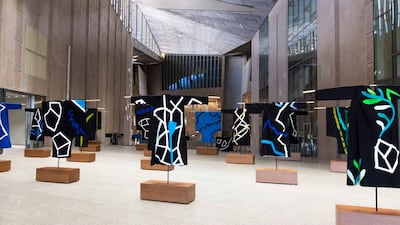
Susan Hefuna at her Traces of Egypt exhibition at the Grand Egyptian Museum. Photo: Grand Egyptian Museum

Grand Egyptian Museum arts programme begins with Susan Hefuna exhibition


Nada El Sawy
  • English
  • Arabic

The Grand Egyptian Museum has launched its arts programme with a solo exhibition by contemporary artist Susan Hefuna.

Traces of Egypt, commissioned by the museum, more commonly known as Gem, opened on March 19 and will run until June 15.

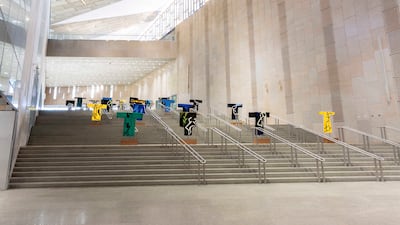
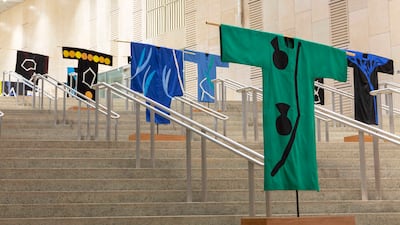
It consists of 28 costumes made of Egyptian cotton that pay homage to the Khayamiya tradition, the patterned and colourful appliques that date back centuries.

“I am very honoured to exhibit the first contemporary art exhibition at the Gem,” Hefuna, who is Egyptian-German, tells The National. “The dialogue between contemporary art and Egyptian ancient heritage is truly unique and exciting.”

The exhibition is part of a rich arts and cultural programme planned for the museum, says Saida El Harkany, cultural programming director at Gem operator Legacy Development and Management.

“We want to send a message across that the Gem is a destination and not just a museum of ancient civilisation. It’s also a contemporary art platform, where we have programming across the arts, design, crafts, even gastronomy,” she says.

Scroll through the gallery below for more pictures from the exhibition

The 500-square-metre museum complex, home to the world’s largest archaeological collection, has yet to officially open.

However, the museum began hosting small group visits and private events in a limited area in November. The interior spaces, including the galleries, are still closed to visitors and a grand opening date has not been announced.

Recent events at the Gem include a concert by opera singer Fatma Said, Art Cairo and the RiseUp start-up summit.

Traces of Egypt opened with a panel discussion featuring Hefuna, as well as Venetia Porter, former curator of Islamic and contemporary Middle East art at the British Museum, and South African architect Sumayya Vally, founder and principal of Counterspace studio.

Hefuna, born in Berlin in 1962 to an Egyptian father and German mother, grew up in Egypt, Germany and Austria.

She has had exhibitions all over the world, including New York’s Museum of Modern Art, Los Angeles’ Museum of Contemporary Art, the 2009 Venice Biennale and the 2012 Biennale of Sydney.

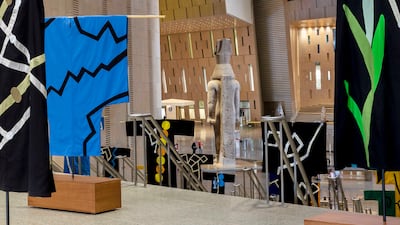
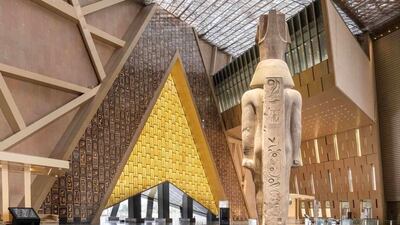
Statue of Ramesses II at Grand Egyptian Museum. Photo: Grand Egyptian Museum

In the Mena region, she has held solo exhibitions at the Townhouse Gallery in Cairo and the Sharjah Art Foundation; was included in a group exhibition at the Beirut Exhibition Centre; and participated in the 2007 Sharjah Biennial.

Her works often use Egyptian crafts techniques such as Khayamiya and Mashrabiya, a carved wood or stone architectural latticework screen.

For Traces of Egypt, Hefuna designed the shapes, designs and patterns of the dresses, and local artisans implemented the designs with their traditional technique of appliques. She has worked with the same artisans since 2007.

She says she was inspired by life in the Nile Delta, where her family home is, and “the close relationship of human beings with nature”.

The subtitle of the exhibition is, The Sound of: Earth, Sun, Water, Air, and the main title relates to her drawings on tracing paper as well.

Hefuna also created a children’s colouring book with handmade drawings of the costumes for the Gem gift shop and upcoming workshops.

The museum recently launched the Gem art space, a membership club for the creative industry that will allow artists, designers and crafts people to showcase their work in five temporary exhibition spaces.

Other plans in the works include international art exhibitions, film screenings, performances, talks, book launches and a family weekend, El Harakany says.

The goal is to make the Gem an all-inclusive cultural destination that builds Egypt’s brand name, has a social impact and is economically sustainable.

“The focus is on Egypt first and then we’re going to open it up to the region and the world,” she adds.

Visitors can see the exhibition by booking one of the museum’s guided tours online at www.visit-gem.com. The tours include the Hanging Obelisk, the Grand Hall, the Glass Hall, outdoor areas, the gift shop and retail and food and beverage outlets. Ticket prices start at 75 Egyptian pounds ($2.40) for Egyptians and 500 Egyptian pounds ($16.15) for foreigners.


SPECS
%3Cp%3EEngine%3A%20Supercharged%203.5-litre%20V6%0D%3Cbr%3EPower%3A%20400hp%0D%3Cbr%3ETorque%3A%20430Nm%0D%3Cbr%3EOn%20sale%3A%20Now%0D%3Cbr%3EPrice%3A%20From%20Dh450%2C000%0D%3Cbr%3E%3C%2Fp%3E%0A
'The worst thing you can eat'

Trans fat is typically found in fried and baked goods, but you may be consuming more than you think.

Powdered coffee creamer, microwave popcorn and virtually anything processed with a crust is likely to contain it, as this guide from Mayo Clinic outlines: 

Baked goods - Most cakes, cookies, pie crusts and crackers contain shortening, which is usually made from partially hydrogenated vegetable oil. Ready-made frosting is another source of trans fat.

Snacks - Potato, corn and tortilla chips often contain trans fat. And while popcorn can be a healthy snack, many types of packaged or microwave popcorn use trans fat to help cook or flavour the popcorn.

Fried food - Foods that require deep frying — french fries, doughnuts and fried chicken — can contain trans fat from the oil used in the cooking process.

Refrigerator dough - Products such as canned biscuits and cinnamon rolls often contain trans fat, as do frozen pizza crusts.

Creamer and margarine - Nondairy coffee creamer and stick margarines also may contain partially hydrogenated vegetable oils.

UAE currency: the story behind the money in your pockets
MATCH INFO

Manchester United v Brighton, Sunday, 6pm UAE

KEY DEVELOPMENTS IN MARITIME DISPUTE

2000: Israel withdraws from Lebanon after nearly 30 years without an officially demarcated border. The UN establishes the Blue Line to act as the frontier.

2007: Lebanon and Cyprus define their respective exclusive economic zones to facilitate oil and gas exploration. Israel uses this to define its EEZ with Cyprus

2011: Lebanon disputes Israeli-proposed line and submits documents to UN showing different EEZ. Cyprus offers to mediate without much progress.

2018: Lebanon signs first offshore oil and gas licencing deal with consortium of France’s Total, Italy’s Eni and Russia’s Novatek.

2018-2019: US seeks to mediate between Israel and Lebanon to prevent clashes over oil and gas resources.

Who was Alfred Nobel?

The Nobel Prize was created by wealthy Swedish chemist and entrepreneur Alfred Nobel.

  • In his will he dictated that the bulk of his estate should be used to fund "prizes to those who, during the preceding year, have conferred the greatest benefit to humankind".
  • Nobel is best known as the inventor of dynamite, but also wrote poetry and drama and could speak Russian, French, English and German by the age of 17. The five original prize categories reflect the interests closest to his heart.
  • Nobel died in 1896 but it took until 1901, following a legal battle over his will, before the first prizes were awarded.
Libya's Gold

UN Panel of Experts found regime secretly sold a fifth of the country's gold reserves. 

The panel’s 2017 report followed a trail to West Africa where large sums of cash and gold were hidden by Abdullah Al Senussi, Qaddafi’s former intelligence chief, in 2011.

Cases filled with cash that was said to amount to $560m in 100 dollar notes, that was kept by a group of Libyans in Ouagadougou, Burkina Faso.

A second stash was said to have been held in Accra, Ghana, inside boxes at the local offices of an international human rights organisation based in France.

T10 Cricket League
Sharjah Cricket Stadium
December 14- 17
6pm, Opening ceremony, followed by:
Bengal Tigers v Kerala Kings 
Maratha Arabians v Pakhtoons
Tickets available online at q-tickets.com/t10

The biog

Favourite film: The Notebook  

Favourite book: What I know for sure by Oprah Winfrey

Favourite quote: “Social equality is the only basis of human happiness” Nelson Madela.           Hometown: Emmen, The Netherlands

Favourite activities: Walking on the beach, eating at restaurants and spending time with friends

Job: Founder and Managing Director of Mawaheb from Beautiful Peopl

RESULTS

Mumbai Indians 181-4 (20 ovs)
Kolkata Knight Riders 168-6 (20ovs)

Mumbai won by 13 runs

Rajasthan Royals 152-9 (20 ovs)
Kings XI Punjab 155-4 (18.4 ovs)

Kings XI Punjab won by 6 wickets

Race card for Super Saturday

4pm: Al Bastakiya Listed US$250,000 (Dh918,125) (Dirt) 1,900m.

4.35pm: Mahab Al Shimaal Group 3 $200,000 (D) 1,200m.

5.10pm: Nad Al Sheba Conditions $200,000 (Turf) 1,200m.

5.45pm: Burj Nahaar Group 3 $200,000 (D) 1,600m.

6.20pm: Jebel Hatta Group 1 $300,000 (T) 1,800m.

6.55pm: Al Maktoum Challenge Round 3 Group 1 $400,000 (D) 2,000m.

7.30pm: Dubai City of Gold Group 2 $250,000 (T) 2,410m.

The specs: 2018 Nissan Altima


Price, base / as tested: Dh78,000 / Dh97,650

Engine: 2.5-litre in-line four-cylinder

Power: 182hp @ 6,000rpm

Torque: 244Nm @ 4,000rpm

Transmission: Continuously variable tranmission

Fuel consumption, combined: 7.6L / 100km

The specs

Engine: 4.0-litre V8 twin-turbocharged and three electric motors

Power: Combined output 920hp

Torque: 730Nm at 4,000-7,000rpm

Transmission: 8-speed dual-clutch automatic

Fuel consumption: 11.2L/100km

On sale: Now, deliveries expected later in 2025

Price: expected to start at Dh1,432,000

Countries recognising Palestine

France, UK, Canada, Australia, Portugal, Belgium, Malta, Luxembourg, San Marino and Andorra


MATCH INFO

Barcelona 4 (Suarez 27', Vidal 32', Dembele 35', Messi 78')

Sevilla 0

Red cards: Ronald Araujo, Ousmane Dembele (Barcelona)

Conflict, drought, famine

Estimates of the number of deaths caused by the famine range from 400,000 to 1 million, according to a document prepared for the UK House of Lords in 2024.
It has been claimed that the policies of the Ethiopian government, which took control after deposing Emperor Haile Selassie in a military-led revolution in 1974, contributed to the scale of the famine.
Dr Miriam Bradley, senior lecturer in humanitarian studies at the University of Manchester, has argued that, by the early 1980s, “several government policies combined to cause, rather than prevent, a famine which lasted from 1983 to 1985. Mengistu’s government imposed Stalinist-model agricultural policies involving forced collectivisation and villagisation [relocation of communities into planned villages].
The West became aware of the catastrophe through a series of BBC News reports by journalist Michael Buerk in October 1984 describing a “biblical famine” and containing graphic images of thousands of people, including children, facing starvation.

Band Aid

Bob Geldof, singer with the Irish rock group The Boomtown Rats, formed Band Aid in response to the horrific images shown in the news broadcasts.
With Midge Ure of the band Ultravox, he wrote the hit charity single Do They Know it’s Christmas in December 1984, featuring a string of high-profile musicians.
Following the single’s success, the idea to stage a rock concert evolved.
Live Aid was a series of simultaneous concerts that took place at Wembley Stadium in London, John F Kennedy Stadium in Philadelphia, the US, and at various other venues across the world.
The combined event was broadcast to an estimated worldwide audience of 1.5 billion.

GRAN%20TURISMO
%3Cp%3E%3Cstrong%3EDirector%3A%3C%2Fstrong%3E%20Neill%20Blomkamp%3C%2Fp%3E%0A%3Cp%3E%3Cstrong%3EStars%3A%3C%2Fstrong%3E%20David%20Harbour%2C%20Orlando%20Bloom%2C%20Archie%20Madekwe%2C%20Darren%20Barnet%3C%2Fp%3E%0A%3Cp%3E%3Cstrong%3ERating%3A%3C%2Fstrong%3E%203%2F5%3C%2Fp%3E%0A
How green is the expo nursery?

Some 400,000 shrubs and 13,000 trees in the on-site nursery

An additional 450,000 shrubs and 4,000 trees to be delivered in the months leading up to the expo

Ghaf, date palm, acacia arabica, acacia tortilis, vitex or sage, techoma and the salvadora are just some heat tolerant native plants in the nursery

Approximately 340 species of shrubs and trees selected for diverse landscape

The nursery team works exclusively with organic fertilisers and pesticides

All shrubs and trees supplied by Dubai Municipality

Most sourced from farms, nurseries across the country

Plants and trees are re-potted when they arrive at nursery to give them room to grow

Some mature trees are in open areas or planted within the expo site

Green waste is recycled as compost

Treated sewage effluent supplied by Dubai Municipality is used to meet the majority of the nursery’s irrigation needs

Construction workforce peaked at 40,000 workers

About 65,000 people have signed up to volunteer

Main themes of expo is  ‘Connecting Minds, Creating the Future’ and three subthemes of opportunity, mobility and sustainability.

Expo 2020 Dubai to open in October 2020 and run for six months

Updated: March 26, 2023, 1:38 PM