Writing about the UAE often emphasises its exceptionalism: usually in terms of the booming economy, first-rate infrastructure and embrace of innovative technology.
Less discussed among these idiosyncrasies is that the country's lingua franca, English, is not its official language, which is Arabic. It is a language phenomenon reflective of the UAE’s ambition to become a global hub, the result of a relatively open immigration policy enabling a highly diverse, transient population.
This multilingualism is rightly celebrated, and there is no doubt that the adoption of English has been central to the UAE's growth. But in practice, this widespread acceptance of English has also posed a challenge to the country's native language, and with it the cultural vitality of Arab youths and families living here. A truly multilingual UAE is still feasible, but only if Arabic is treated as indispensable.

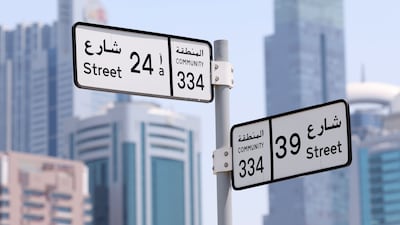
One can comfortably live in the UAE their entire life without learning any Arabic, and without ever feeling obligated to. Arabic is thus mostly contained to signage, the public sector, and the spoken language of the various Arab social circles. Native Arabic speakers, while not constituting a majority, are still sizable: the US Commercial Service estimates that they constitute 40 per cent of residents, with Emiratis included.
And yet, the domination of English has created a situation where young Arabs growing up in the UAE, Emirati or otherwise, are communicating primarily in English; many are unable to read, write, or even speak in Arabic at all. While this outcome is counterintuitive for someone raised in an Arab family and an Arab country, it is unfortunately increasingly common for Arab youth in the UAE and many cities of the Gulf.
Arab parents overestimate how much Arabic their children are absorbing at home, while other parents may be actively diminishing Arabic communication, believing that fluency in English is more advantageous for education and career prospects.

Schooling perhaps plays the single most important role in fostering language. Across the region, Arab parents who have the means to send their children to English-medium private schools, do. According to 2020 Unesco figures, 48 per cent of K-12 schools in the UAE were private. Overwhelmingly, these private schools are English-medium: Dubai’s Knowledge and Human Development Authority (KHDA) reports that the British curriculum enrolment ranks first at 37 per cent, followed by Indian (26 per cent) and US (14 per cent).
Arabic-medium private schools are statistically irrelevant, even though Arab students make up a significant share of Dubai’s private school population. Even at English-medium schools, Arabic is under-prioritised: under KHDA’s 2025–26 requirements, a first-grader with an Arab passport receives only four hours of Arabic a week. These statistics do not include the large number of Arab students holding non-Arab passports, who take Arabic as a second language instead–which is the easier option.
The question remains whether we choose to classify this neglect of Arabic as an acceptable outcome of a necessary sacrifice for global economic potential, or as a problem to be solved. How that question is answered depends on what we believe we lose when we lose the ability to communicate in Arabic.

The straightforward answer is that a part of Arab identity is lost. In his 1986 essay collection Decolonising the Mind, Kenyan author Ngugi wa Thiong’o wrote, “Language as culture is the collective memory bank of a people’s experience in history.” Language articulates heritage and carries it from one generation to the next. There is, in fact, no Arabness without Arabic: a young Arab who only speaks English will grow up internalising American or British culture, and know their own only in translation.
The UAE government has recognised this inherent connection between language and identity. In 2026, the government announced that it was drafting its first Arabic language law, with the purpose of strengthening national identity and cultural belonging, by launching reforms targeting education, advertising, technology and more. While the motivations are not elaborated in detail, it is hard, not to see its urgency.
Beyond the Emirati community, the country’s population is projected to multiply over the next decade, with expatriate Arabs making up a substantial portion of that growth. In the 2023 ASDA'A BCW Arab Youth Survey, 24 per cent of respondents named the UAE as the country they would most like to live in. The country has also become a destination for Arabs and non-Arab Muslims from the Western diaspora as political discourse in the West has recently turned hostile towards these groups.
This is to say that the UAE symbolises the future for many individuals: it represents a conscious choice to stay in the Arab world, to lay down roots and build for the region, while also seeking the safety, opportunity, and cosmopolitan society it offers. This vision of the UAE, as an inherently Arab nation, is the draw, but it is on us, too, to keep the country and our communities, Arab. This begins with Arabic, normalising its use at home, in the workplace, and in public.
The author is a Dubai-based education and culture strategist working across the Arab world

