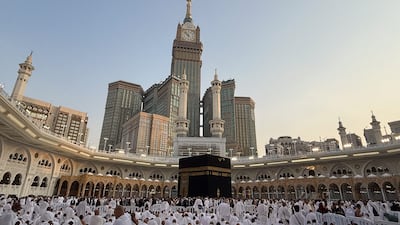

Umrah brings together pilgrims from around the world who often speak different languages and arrive with very different levels of familiarity with Arabic.
Despite that cosmopolitanism, little is lost in translation. That is often because pilgrims arrive aware of what to expect, including the Arabic words and phrases that can make performing Umrah less arduous. Some describe the rituals themselves, others signal where you are in the journey, and a few are terms you may hear from guides, fellow pilgrims, airline crews or people working around the Grand Mosque.
With the cooler months traditionally bringing more pilgrims to Makkah, it is a useful time to understand the language of Umrah. Here are some of the key Arabic words that help to make sense of the journey, from entering ihram to completing the final rites.

Ihram

One of the most important words to know applies before you arrive at the holy site.
Ihram is deeper than the way the word is often used practically, to describe the two white pieces of cloth men wear during the ritual. The threads are there to amplify what is a deeper personal sacred state of ihram. More than simply not doing impermissible acts, it is about refraining from things that can disrupt your state of worship.
That means not getting into arguments or behaviour that interrupts your spiritual state. It does not mean reaching a higher plane. It is more about being in a state of awareness about why you are fulfilling a spiritual duty, which in turn affects your behaviour.
Once in ihram, there are also specific restrictions, such as not using perfume or cutting the hair and nails, while men also follow rules around clothing.
It is perfectly natural to hear someone in Makkah say they are still “in ihram”, sometimes to indicate they are still performing Umrah, or as a friendly plea not to engage in unnecessary banter or argument.
Niyyah
While a word used as a bedrock for all actions inspired by the faith, the Arabic word for intention – niyyah – is particularly relevant in the context of Umrah.
Often made silently, performing Umrah with intention focuses the pilgrim on understanding that the pilgrimage is more than the physical actions of fulfilling its pillars, but also how each can be carried out consciously and well.
If you are in an Umrah group, you may hear the guide declare that it's time to make your niyyah as you begin your journey to Makkah, more as a reminder that intention is paramount to fulfilling Umrah.
Miqat

You may hear the word miqat hundreds of kilometres from Makkah, whether travelling by road or air. Depending on the route, the designated points range from about 90km to more than 400km from the city.
Miqat is the geographical point that a pilgrim intending to perform Umrah should not cross without entering ihram. There are different miqat points depending on the direction of travel.
Those flying to Jeddah, the main air gateway for pilgrims travelling on to Makkah, may hear the word on the plane when the flight deck announces that the aircraft is approaching the relevant miqat, signalling pilgrims to be ready to enter ihram and make their intention before crossing it.
Those approaching Makkah by road can stop at designated miqat locations, many of which have mosques and facilities where pilgrims can prepare before continuing their journey.
Talbiyah
After entering ihram, pilgrims begin reciting the talbiyah, a declaration of prayer commonly translated as: “Here I am, O Allah, here I am.”
The word itself stems from labbayk, which carries the sense of answering or responding to a call. In this context, it expresses the pilgrim's response to God's call to pilgrimage and is recited on the journey towards Makkah.
Its resonance also underscores the gratitude inherent in making Umrah. The understanding is that it is not merely having the time and means that allows someone to make the pilgrimage, but that the opportunity itself comes through God's providence. Repeating the talbiyah is therefore also a declaration of humility and gratitude for having been able to answer that call.
Tawaf

One of the most striking images of the Grand Mosque is that of worshippers circling the Kaaba at its centre. For pilgrims performing Umrah, this action is carried out in a series of seven anticlockwise circuits and is known as Tawaf.
The word comes from an Arabic root associated with going around or encircling something. Pilgrims may hear a guide say it is time to “go for Tawaf”, simply meaning it is time to begin circling the Kaaba.
Sai

The completion of Tawaf signals the next stage of Umrah, known as sai.
The Arabic word carries the sense of striving or moving with purpose. According to Islamic tradition, the rite recalls Hajar's search for water for her son Ismail as she moved between Safa and Marwa, the route between the two small hills now incorporated into the Grand Mosque complex. Pilgrims retrace that journey seven times, beginning at Safa and ending at Marwa.
Those heading to perform sai should look for signs inside the Grand Mosque marked Masa'a, meaning the place where sai is performed. The term refers to the designated area between Safa and Marwa rather than the ritual itself.
Halq and taqsir

While they are different words, halq and taqsir are used so closely together at the end of Umrah that it helps to know both.
They are also words you may hear called out as you leave the Grand Mosque after completing sai, particularly from barbers or guides pointing pilgrims towards nearby shops. Halq means shaving the hair, while taqsir means trimming it.
These are the final physical acts before leaving ihram. Men can shave their heads or trim the hair, while women cut a small amount from the ends. For men, a barber asking “halq or taqsir?” is simply asking whether they want to shave or trim.
Tahallul
Tahallul means leaving the state of ihram and being released from its restrictions. The word carries the sense of something that was restricted becoming permissible again.
For someone performing Umrah, it comes after the rites are completed and the hair is shaved or shortened. But the word is not only procedural. It marks the moment the pilgrim steps out of the disciplined state of ihram and returns to ordinary life, with the restrictions lifted.
That gives tahallul a sense of release and transition. Not a spiritual rebirth in the literal meaning of the word, but the closing of one state and the return to another.

