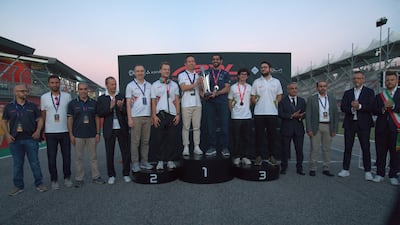

The UAE’s Kinetiz won the Abu Dhabi Autonomous Racing League’s first international race at Imola, Italy, on Saturday, with its driverless Sparkz car finishing almost 11 seconds clear of the field.
Germany’s Constructor Racing was next across the line, 10.963 seconds behind. Italy’s PoliMOVE finished third, while fellow Italian team Unimore Racing was fourth after their two cars collided during the race. Germany’s TUM completed the five-team field.
The teams competed in autonomous versions of the Dallara Super Formula SF23 at the Autodromo Internazionale Enzo e Dino Ferrari, marking A2RL’s first race outside the UAE after two years at Yas Marina Circuit in Abu Dhabi.

The event formed part of the ACI Racing Weekend, alongside the Italian GT Endurance Championship, FIA Formula Regional European Championship, Italian F4 Championship and GT4 Italy Series.
New audience

Many fans who arrived in Imola for the other races for the autonomous event, giving them achance to experience a very different form of motorsport.
Raffaele Giammaria, director of operations at ACI Sport, says seeing the cars on the track made an immediate impression. “If you tell someone that there is no driver inside the car, I think it is difficult to realise,” he tells The National.
Beyond the novelty of seeing a car race without a driver, Giammaria says the race shows how quickly the technology is developing. “Looking at the performance they are achieving, and in particular at the gap between their lap times and those achieved by a real driver, I think it is real proof of how big a step the technology is making,” he says.

Driverless challenge
The 12-lap race featured autonomous cars capable of exceeding 250kph. The cars had to race alongside one another, respond to changing situations and determine when and how to attack or defend.
The collision between Unimore’s Gianna car and PoliMOVE’s Eva was also a reminder of the challenges that remain as autonomous cars compete wheel-to-wheel at racing speeds.
Michael Sonderby, chief executive of Abu Dhabi autonomous mobility company SteerAI, says decision-making remains the biggest challenge for the technology.
“There are still certain situations where an error can happen,” he says. “It’s really the speed at which the decision-making needs to take all the inputs and process that into actions. That is truly the big challenge.”
What can human drivers learn from AI?
Giammaria sees the potential for autonomous racing to influence how human drivers are trained. As director of the Scuola Federale, the Italian federation’s racing school, he is interested in studying how the cars approach corners and use their throttle and brakes.
“If we are able to transmit to young drivers the way the computer approaches every single corner and every single use of the throttle and brakes, I think this is an added value for young drivers,” he says.
The school’s training and research department is now exploring what lessons could be taken from the project.

Giammaria says there are differences in how a computer and a human driver manage a race, particularly over longer distances, but he believes that studying the autonomous approach could provide another reference point for young competitors.
Beyond the track
SteerAI helped develop the original autonomy stack used by A2RL, covering decision-making, localisation, navigation and perception. The two projects have since diverged, with A2RL pursuing high-speed racing while SteerAI focuses on autonomous vehicles for difficult off-road environments.
“You could say that we had the foundation, then they built one annexe and we’re now building another annexe,” Sonderby says. “The foundation is essentially the same.”
He says that pushing autonomous systems at racing speeds can eventually contribute to more complex applications away from the circuit. “Doing it at speed means that, over time, we will be able to enable full autonomy and much broader use cases, higher speeds, more complexity in the environment,” he says.

SteerAI is already exploring applications that could reduce the need for people to work in dangerous environments. “We’re having a lot of discussions with large energy producers who are saying, ‘Look, we are basically having to move chemicals, dangerous materials, and we have people doing that,’” Sonderby says.
He adds that autonomous vehicles could eventually take over such work, reducing human exposure to risk.
For Giammaria, bringing A2RL’s first international race to Imola also carries significance because of the circuit’s place within Italy’s Motor Valley. “I think being able to have the first autonomous race outside Abu Dhabi in Italy, and in particular at Imola, is a big honour,” he says. “We as the Italian federation are really proud to host this kind of race.”
Imola sits in Emilia-Romagna, a region closely associated with car makers including Ferrari, Lamborghini, Maserati and Pagani.
Sonderby says taking the series from Abu Dhabi to Italy also reflects the wider ambitions behind technology developed in the UAE. “Those offshoots are now beginning to spread,” he says.

