


There is an Arabic proverb which translates to: “A day of honey and a day of onions,” which expresses how life has both good days and bad days. In this instance, onions are used to refer to the negative facets of life.
There is also another colloquial idiom that translates to: “Onion after onion.” This is often used to describe a person or situation that has many layers, some of them hidden, referring to the layered anatomy of an onion.
This week’s Arabic word of the week, bassal, which means onion, has duality in its meaning. Derived from the three Arabic letters Bah, Sad and Lah, bassal is technically a collective noun, meaning it is the plural variation of the singular onion, which is bassala. However, while there is this distinction in classical Arabic, colloquially in most dialects, bassal is used interchangeably to mean a singular onion or more than one.
Officially, bassal refers to a vegetable whose leaves are supple and tube-like and whose roots grow underground. It is a round bulbous vegetable that can be eaten raw or cooked and has strong flavours and great health benefits. Aside from being unique for its bulbous and layered form, bassal is also recognised for its strong aroma that causes the eyes to water.
There are variations of bassal such as bassal akhthar, which translates to green onions, and bassal asfar, which translates to yellow onions. There is also basal al loulou, which translates to the pearl onion, a reference to any coloured onion of a smaller size.
-
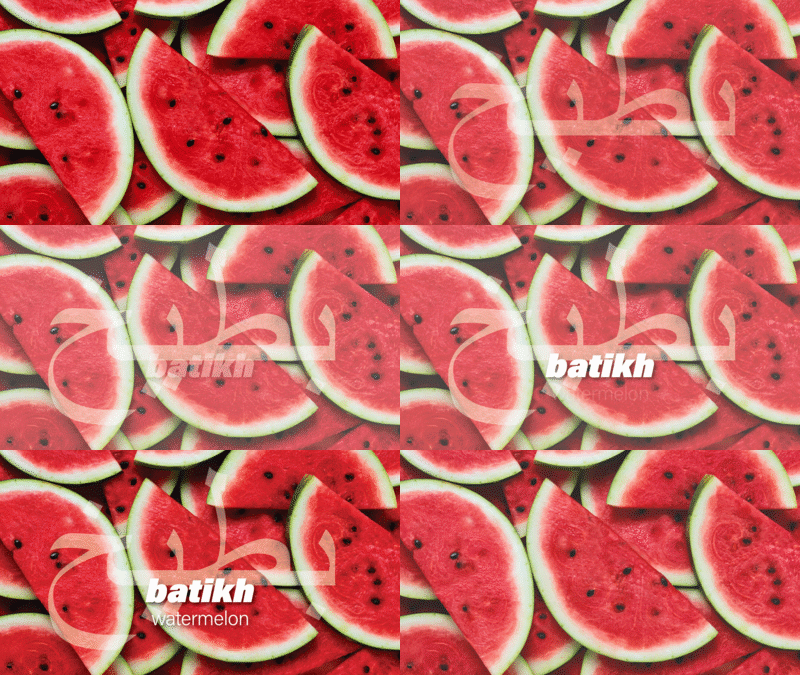
The Arabic word for watermelon, batikh, has become a symbol of Palestine. All photos: The National -

The Arabic word for union, etihad, is intrinsically connected to the UAE -

The Arabic for water, ma'a, is a universal symbol for rebirth -

The Arabic for echo, sada, is a literary device in poetry -

Aasal, the Arabic word for honey can also be used in a complimentary manner -

Jisim, the Arabic word for body extends across chemistry, medicine and aphorisms -

Jawab, the Arabic for answer resonates with knowledge -

Fikir is the Arabic word for think or to think -

The Arabic word for hissan or horse can have more than one origin -

The Arabic word shaghaf or passion refers to intense love -
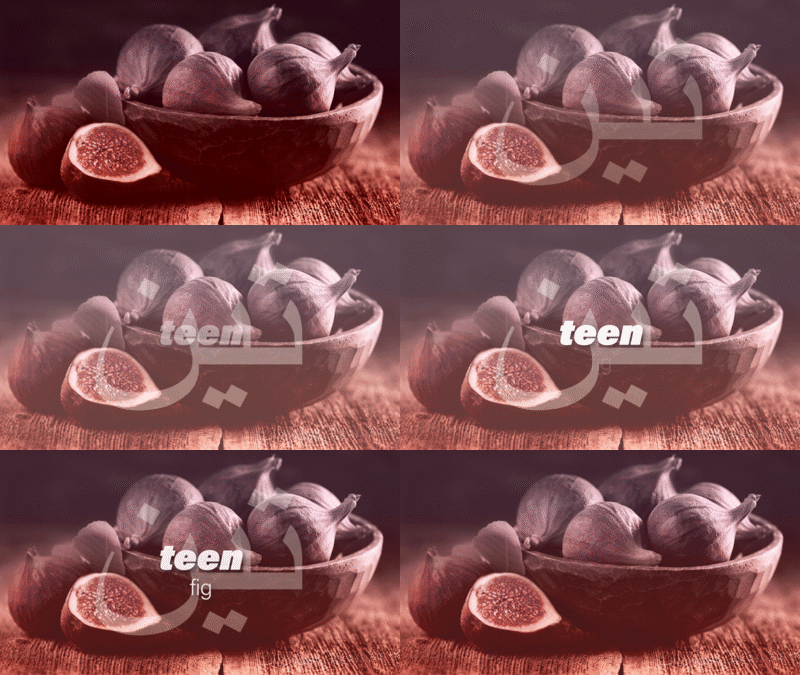
The Arabic word teen or onion doesn't have a clear Arabic source -

The Arabic word saraha means honesty -

Tamir, the Arabic word for date is a fruit that has over 400 variations -

The Arabic word for tongue, lisan, is connected to the idea of truth -

The Arabic word for olive, zaytoon, is also the word for olive tree -

The Arabic word for sign, alama, has several meanings


Like many cultures around the world, bassal is a staple ingredient in recipies. Not only is it an ingredient that makes part of a larger dish, it can also be a dish in itself. One such popular dish is stuffed bassal. This is where the onion is boiled until softened after which layers are peeled apart, stuffed with a rice or meat filling and then cooked in a sauce or with other stuffed vegetables.
Other dishes include mansaf, a traditional Jordanian meal made with lamb and sauteed onions. The Palestinian national dish musakhan consists of roasted chicken and is served with flatbread, topped with caramelised onions. And of course, there's shawarma, the popular street food that uses both cooked and raw onions.
Two other words that come from the same three Arabic letters used to form bassal are also closely linked to the physical form of onions. The first is tabasal, which refers to when the shell, cortex or peel of something solidifies or covers something. The second is tabasalahou, which is when someone removes the clothing of someone else, for example when a fashion designer is helping a model or client remove garments. This refers again directly to the idea of layering within the onion’s form.
If someone is prone to crying, has a bad odour or has a lot of facets to their personality, bassal is used as a character trait to mean these different things. The diversity of meaning in how bassal is used in Arabic is a testament to the versatility of the vegetable itself.

