


In a masterclass at the Amman International Film Festival, two admired actors from the Arab world met to discuss the nuances of acting, touching upon how artificial intelligence may have an impact on the film and TV industry in the future.
The session, which took place on Thursday, featured Georges Khabbaz, a Lebanese actor, scriptwriter and theatre director with more than two decades of experience, and Tunisian actress and director Afef Ben Mahmoud.
For both, taking on a character means examining their lives before the events in a particular script, from figuring out the way they walk and interact with others, to the depth of their inner lives.
“As an actress, it is very important for me to know what has happened [to my character] before the beginning of a film,” Ben Mahmoud said. “So that I know what leads her to act in one way and not in another.”
This preparation shouldn’t take place in isolation, she added. “It’s important that these conversations take place with the director, so that when we come to the set, we are on the same page.”

Khabbaz echoed the importance of exploring characters beyond their script, saying that each role requires its own specific approach and that it is pivotal for actors and directors to find “harmony” in their vision of a project.
Lebanese actor, scriptwriter and theatre director
“We search for the environmental, social and psychological specifics of a character,” Khabbaz said. “We live within them for a long time. If there isn’t a clear history of a character within the script, I tend to invent a history. And I try to love a character, regardless of their nature. I try to justify their actions so that it is communicated honestly to the audience.”
Khabbaz distinguished acting as a form of deception. “An actor is a person who is capable of lying with utmost honesty,” he said. “An audience, on the other hand, is one who decides to be deceived with decency.”
Having acted across a variety of media in the Arab world, Khabbaz said he has a special affinity for theatre. While he described cinema as being timeless and television as the most omnipresent medium in the region – the ephemeral nature of theatre and its dynamic with a live audience is what makes acting on stage an “euphoric” experience for him.
“It is the interaction of the mutual energies, the sanctifying of a moment,” he said. “Even if you are doing 1,000 shows, there is a daily challenge of discovering the audience, unifying the audience in a single tear, laugh or applause. A theatre show is like a sunset. Every day we see the same concept, but every day this sunset has its specificity, with its own moment and its own colours.”
While Khabbaz has enjoyed regional stardom with recent projects such as Perfect Strangers and Brando El Sharq, he has also had a dedicated following among theatregoers in Lebanon for almost two decades – celebrated for how his plays reflect upon his country’s social issues.
-

Lebanese actor Georges Khabbaz, left, Egyptian actress Bushra Rozza and film director Yousry Nasrallah at the Amman International Film Festival. All photos: AFP -
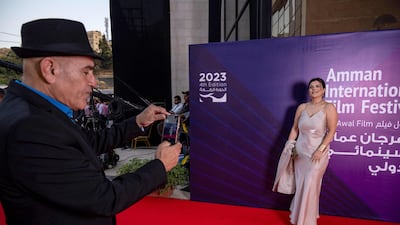
Palestinian film director Rashid Masharawi takes a photo of Tunisian critic Henda Haouala -

Jordanian actress Saba Mubarak at the 4th AIFF in Jordan's capital -
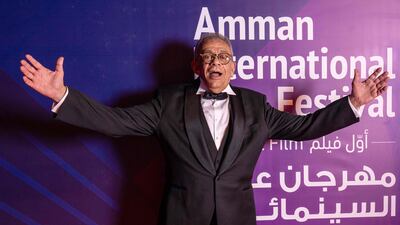
Nasrallah at the 4th AIFF in Amman -

Algerian actress Imen Nouel at the AIFF -

Lebanese actress Rita Harb poses on the red carpet in Amman -
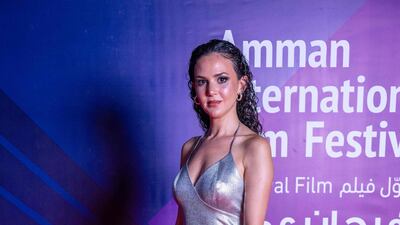
Jordanian actress Rakeen Saad on the film festival's red carpet -
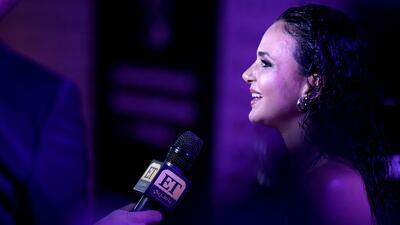
Saad talks to the media on the red carpet at the AIFF -

Harb attends the 4th AIFF in Amman -

Rozza and Jordanian actor and director Eyad Nassar arrive on the red carpet -
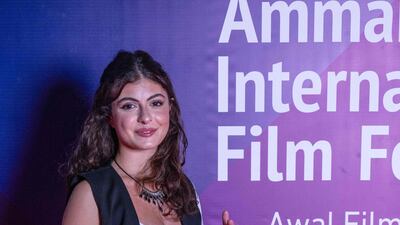
Jordanian actress Tara Abboud at AIFF -

Palestinian film director Najwa Najjar attends the film festival -
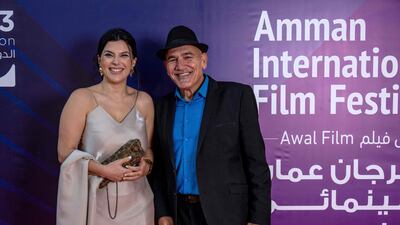
Haouala and Masharawi at the AIFF in Amman -
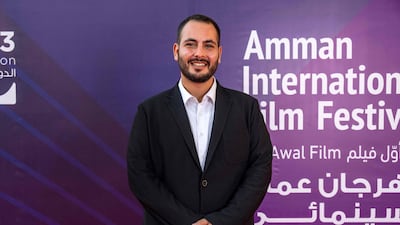
Lebanese film director Zakaria Jaber attends the 4th AIFF -

Tunisian film director Raja Amari at the international film festival -

Khabbaz arrives at the AIFF -

Lebanese actress Yumna Marwan


Ben Mahmoud also said that working in the theatre scene in Tunisia helped lay the strong foundations for the craft that she has since transposed to the big screen.
“The theatre helped me a lot in cinema,” she said. “There are techniques you learn while preparing for a play that are invaluable when working on film. There are techniques you learn on stage that become second-nature after some time.”
These techniques are not confined to the instruments in an actor’s toolbox. Theatre helps actors learn how to occupy a space and find balance with other performers, but it has also informed Ben Mahmoud’s work as a director, from lighting a set to precision of emotion.
Khabbaz touched upon the difficulties of being a theatre actor in Lebanon, particularly how to keep working under conditions spanning from economic uncertainty to the horrors of war. The theatre scene in Beirut was affected by the Beirut port explosion in August 2020, with several notable stages damaged.
“There have been moments that were funny and which were also tragic. In 2005, there would be explosions on a weekly basis. We would hold shows despite it all,” he said. “Once there was an explosion some 500 metres from the theatre. The hall, which was packed with 600 people, cleared almost entirely.
“We came out to apologise to people and tell them we would have to delay that performance. There was a couple that stayed back. The man insisted we carry on with the play. Even as his wife insisted they leave; he was stubborn and wanted us to finish the piece.”
Ben Mahmoud and Khabbaz were also asked about what they thought the impact of artificial intelligence would be on actors.
A Reuters report in July stated the rise of AI posed an “existential crisis” for actors who worried that technology could take their place. Issues around the use of AI are one reason Sag-Aftra decided to join the writer’s union strike last month. The move marked the first Hollywood “double strike” since 1960.
Ben Mahmoud said she envisions the technology being applied more in the post-production phases of a project.
“In post-production, there is overdubbing and sometimes an actor may stutter, or something may not be perfect in the scene and the actor is not capable of returning to overdub. I think for us, in our field, an actor needs to be there in person,” she said.
Khabbaz said he still had no clear answer about how the technology would affect actors. “We are still in the beginnings,” he said. “Everything is still mixed up in our minds. Some people are comparing it to the era of transition from silent films to talking pictures.
“Many directors and actors initially refused the chance, among them Charlie Chaplin. I don’t know how much it resembles that, and towards where this is going, and how much danger there is to directors, actors and filmmakers. I hope direct human creativity remains the hero in this subject.”

