

It's 2.30am in southern Kashmir’s Anantnag district and most Muslims have yet to wake up for their predawn Ramadan meals..
With a drum slung around his neck, two drumsticks in hand, 60-year-old Muhammad Yousuf steps out of his home in the Janglat Mandi area and wanders the dark alleys and lanes, covering about 10 localities on foot.
“Waqt-e-sahar [it’s time for suhoor],” he shouts, beating his drum rhythmically to wake up the area's Muslim residents.
Yousuf walks for more than an hour, his drumming and calls heard by more than 200 households in various neighbourhoods. Homes fill with light as their inhabitants slowly arise.
Later, he returns home to have his own meal before heading to the nearby mosque to perform early morning prayers.
He has been working as a night drummer, locally called a Sahar Khan, for the past 27 years, learning the traditional Ramadan practice from his father.
Accompanying his father in his youth, Yousuf would light the dark pathways with a torch held aloft.
Yousuf is quick to point out that he doesn’t do this work to earn a living. Instead, he sees it as a noble practice, performed for its spiritual rather than its remunerative value.

“I feel happy and fortunate that I’m able to help the faithful to wake up at Sehri [suhoor] time to observe their fast,” Yousuf says. “People have always appreciated and respected me for doing this noble work.”
Yousuf has worked through several difficult years. During the early 1990s, as the Kashmir conflict escalated, his hometown was subject to frequent military crackdowns and night curfews. At times, he says, while walking around drumming, he was questioned by troops on night patrols.
“I would explain my Ramadan practice to them and then they would let me go,” he says. “Sometimes the troops would say I should rush back home quickly, as they had to enforce a strict curfew.”
It is believed that the tradition of Sahar Khan came to Kashmir from Central Asia, and the people of the valley later assimilated the tradition into their culture.
Scroll through images of more Ramadan drumming traditions from around the world below
-
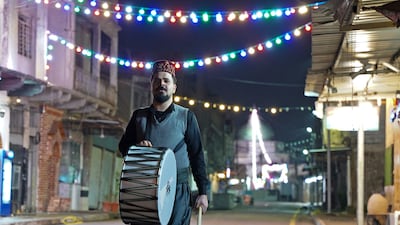
A traditional Iraqi 'musaharati' bangs his drum to wake Muslims for their suhoor meal during Ramadan, near Al Nuri mosque in Mosul's old city. AFP -

A drummer walks along a street in Enfidha, Tunisia, to wake Muslims for their predawn meals. Reuters -

A Ramadan drummer makes his way through the town of Cukurkoy, Turkey. Reuters -
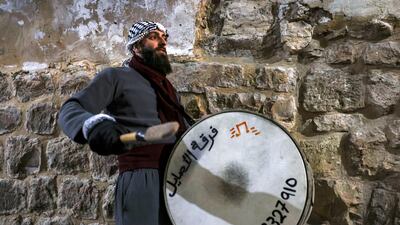
A member of a troupe of young Palestinian drummers walks through the streets in the old city of Hebron in the occupied West Bank. AFP -
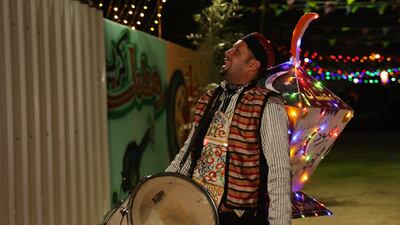
A Palestinian drummer walks through the streets of Rafah in the southern Gaza Strip on the first night of Ramadan. AFP -
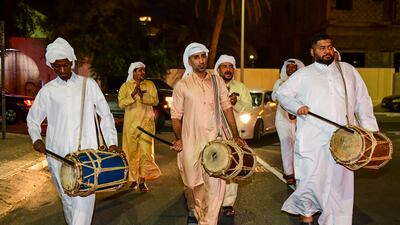
Qatari men play drums and sing traditional songs to awaken people for suhoor in Doha. Getty


Muhammad Abdullah, from the Rainawari area of Srinagar city, has been working as a Sahar Khan for more than 30 years.
“There have been times when I was also stopped by the army at night, ,” Abdullah recalls. “They were initially suspicious and often questioned me.
“Then the local police station would inform the patrolling army personnel and nearest army camps to not bother me as I was performing my religious duty.”
Abdullah says the Sahar Khans see their work as a higher calling, as they are helping people to observe their fast.
Abdullah says despite increased use of alarm clocks and smartphones, the role remains as appreciated as ever. People, he adds, are generous and welcoming, and inquire about the drummers' welfare the next day if they don’t turn up on time.
Yousuf and Abdullah traditionally visit each home at the end of the month a few days before Eid to collect donations from each household. Sometimes they’re given a sack of rice, others a few hundred rupees.
“We take whatever people give us, never asking for more,” says Yousuf.
Wasim Rashid, a college student and a resident of Srinagar city, grew up listening to the drums and unique wake-up calls of the Sahar Khans during Ramadan. He says the night drummers enrich the unique experience of Ramadan in Kashmir, lending it a distinct character.
“Although people also use alarm clocks and smartphones to wake themselves at Sehri time, our Ramadan feels incomplete without the noise of drums and wake-up calls by Sahar Khans,” Rashid says.
Many Sahar Khans come to serve the Srinagar city localities from north Kashmir days ahead of the holy month. A significant number hail from the remote village of Kalaroos, known as the village of the Sahar Khans.
They rent rooms in neighbourhoods close to the areas where they plan to walk with their drums every night.

The drums cost between 3,000 rupees (Dh135) to 10,000 rupees (Dh450) to purchase, though sometimes the Sahar Khans will rent them and return them at the end of the holy month.
The drums are brought from areas such as Lolab in the Kupwara district of northern Kashmir, where such drums are produced by master craftsmen. Sahar Khans also often customise their drums, adding covers and decorative items in accordance to their taste.
Although back-to-back lockdowns and restrictions over the years has somewhat disrupted their work and donations, the drummers have carried on nevertheless.
Even before the 2020 lockdown to contain the spread of Covid-19, the region had endured several prior issues — beginning with a months-long lockdown and communications shutdown following the revocation of the region's special status by the ruling Bharatiya Janata Party in New Delhi in August 2019, and the subsequent bifurcation of the former state into two union territories
.
Despite these restrictions on civilian movements, night drummers like Yousuf continued to come out every night during Ramadan, determined to keep the tradition alive.
Waking up at midnight and walking out in the darkness, beating drums for the whole month of Ramadan year after year takes a physical toll. But is Yousuf ready for retirement?
“I don’t think so,” he says quickly, with a smile. “I’ll continue to be a Sahar Khan while I’m alive and as long as I can.
“I’ll be a Sahar Khan until my last breath.”

