


The caws of seagulls punctuate the gently lapping of water against the banks of the creek. In the distance, men can be heard shouting as they load up dhows, while camels grunt, hauling people around Dubai Creek to the bustle of the Deira souk in the north.
In the centre stands the 19th-century Al Maktoum Residence — the historic home of Dubai’s ruling family — marked by three courtyards, vaulted high-beam ceilings, arched doorways and ornate decorative flourishes.
This is a historic snapshot of Al Shindagha, the birthplace of Dubai, where Al Maktoum family settled in 1833 and went on to build one of the world’s great cities. Straddling the western bank of Dubai Creek, today the 31-hectare neighbourhood has been transformed into the UAE’s largest heritage museum, documenting the history of Dubai.
This month, Sheikh Mohammed bin Rashid, Vice President and Ruler of Dubai, who was born and spent the first decade of his life in the neighbourhood, opened the newly renovated museum, saying: “Our museums serve as cultural beacons that embody our heritage. We want the world to know Dubai’s story and its history.
"Dubai has always been a hub for traders and those pursuing a better life, and it will continue to thrive as a centre of global civilisations on both cultural and humanitarian fronts.”
Scroll through the gallery below for more pictures of the newly renovated Al Shindagha Museum
-
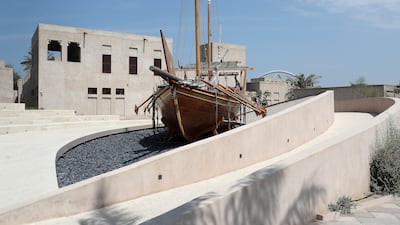
The newly renovated Al Shindagha Museum, the UAE's largest heritage museum, recently opened in Dubai. Pawan Singh / The National -
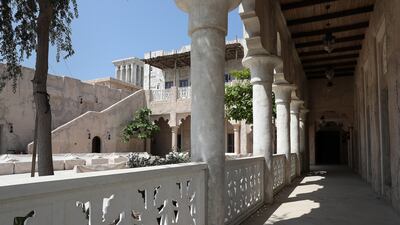
Al Maktoum family settled in 1833 and went on to build one of the world’s great cities. Pawan Singh / The National -

The museum houses many rare items, such as Sheikh Rashid’s radio, on display at the Al Maktoum Family Residence. Pawan Singh / The National -
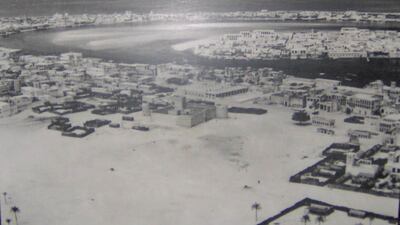
This picture shows Dubai in 1950; with Bur Dubai in the foreground (centered on Al-Fahidi Fort); Deira in middle-right on the far side of the creek; and Al Shindagha (left) and Al Ras (right) in the background across the creek from Deira. Alamy -

Located on the western bank of Dubai Creek, Al Shindagha is the modest neighbourhood is where Sheikh Mohammed bin Rashid, Vice President and Ruler of Dubai, was born and spent the first decade of his life. Photo: Wam -
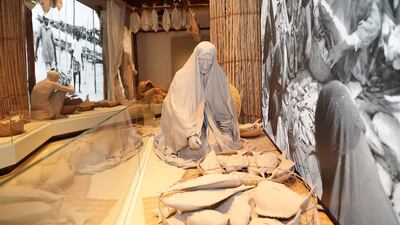
The museum offers a modern snapshot of Dubai's history. Pawan Singh / The National -

Abdalla Al Obeidli, acting manager at Al Shindagha Museum says it is a 'museum from society to society'. Pawan Singh / The National -
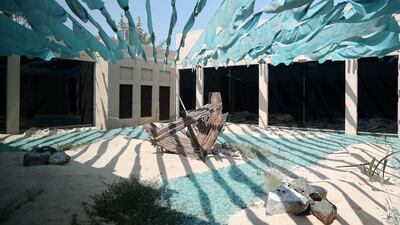
An old boat on display at the Culture of the Sea pavilion. Pawan Singh / The National -
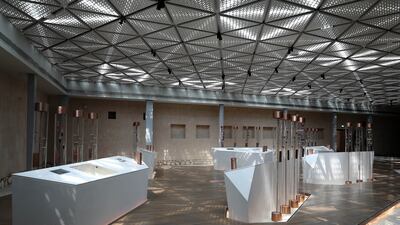
The Perfume House is located in the former house of Sheikh Rashid’s sister, Sheika Shaikha, who was a prolific perfumer. Pawan Singh / The National -
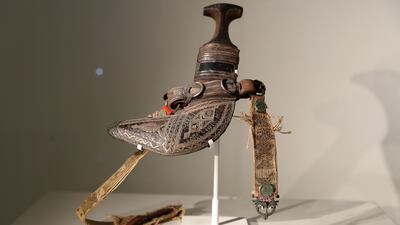
Sheikh Rashid’s dagger and belt on display at the Al Maktoum Family Residence. Pawan Singh / The National -
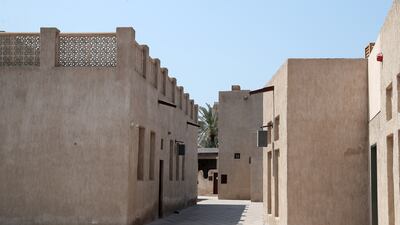
Each pavilion is themed around different aspects of the emirate’s history, immersing guests in different aspects of Emirati heritage and culture. Pawan Singh / The National -

Sheikh Rashid’s binoculars on display at Al Shindagha Museum. Pawan Singh / The National -
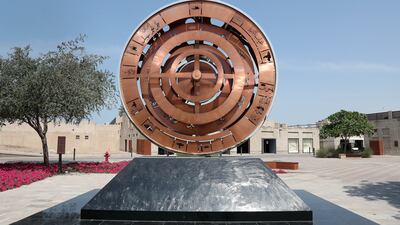
The museum features a sculpture by Emirati artist Mattar bin Lahej. Pawan Singh / The National -
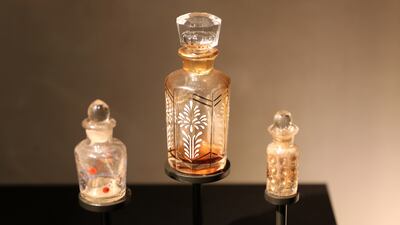
Bottled scents on display at the Perfume House. Pawan Singh / The National -
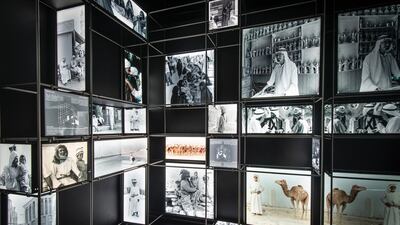
Al Maktoum Residence tells the story of generations of rulers from Dubai's Al Maktoum family. Photo: Wam


The museum’s inauguration comes as Dubai prepares to host the International Council of Museums General Conference in 2025. By that date, Al Shindagha hopes to draw more than one million visitors. Aside from its core exhibitions, the museum will also be hosting workshops and educational programmes, catering to school and university students — alongside special seasonal five-day camping trips in summer and winter.
The project takes an innovative approach towards its curatorial journey by grouping clusters of 80 of the area’s 162 historic houses into 22 pavilions, each dedicated to a different subject. This approach allows the museum to dive into each aspect of Dubai’s history with unprecedented depth.
Each pavilion is themed around different aspects of the emirate’s history, broadly spanning governance, society, living off land and sea, creativity and well-being. As well as the emirate’s remarkable journey under the rule of Al Maktoums, each pavilion immerses guests in different aspects of Emirati heritage and culture, going back to the 1800s, from poetry to perfume and pearl diving to pottery.
Abdalla Al Obeidli, acting manager of Al Shindagha Museum tells The National the space aims to reflect the emirate’s rich heritage through an array of exhibits, collectables, rare objects, interactive screens, films and archive photographs — spanning the mid-19th century to the 1970s.
“It is a museum from society to society,” Al Obeidli says. “This comes from the people who contributed to the exhibits in the museum and contributed to this project.”
Many aspects of the museum’s curation were produced with the support of former residents, including video testimonies of what life was like in the past.

Formerly a strategic peninsula at the mouth of the creek — Al Shindagha — the serene neighbourhood is believed to be among the oldest inhabited sections of Dubai, established by members of the powerful Al Bu Falasah branch of the Bani Yas tribal federation.
Under the leadership of the young Sheikh Maktoum bin Buti bin Suhail, the town flourished, sprawling out to nearby Bur Dubai, and farther afield to the large commercial centre of Deira.
Before the arrival of electricity, residents used kerosene lamps for lighting and Omani charcoal for cooking, making coffee with fresh water drawn from wells across the emirate. Most people lived in huts built from palm fronds, known as barastis or arish, with sturdier houses built from coral stone and gypsum mined from the salt marshes at the end of the creek. Overlooking them were barajeel wind towers, which functioned as natural air conditioning systems.
The most notable of these coral stone structures, Al Maktoum Residence, was built in 1896 by Sheikh Saeed bin Maktoum Al Maktoum. It would serve as the family home until 1958, when Sheikh Saeed died and was succeeded by the late father of modern Dubai, Sheikh Rashid bin Saeed Al Maktoum.

Today, the building houses exhibits outlining the fascinating lives and reigns of Al Maktoum rulers — tracing Dubai’s path back to events such as the 1892 Exclusive Agreement with Britain, Sheikh Maktoum bin Hasher’s invitation to merchants from across the Gulf, the discovery of oil in under Sheikh Rashid, and how their collective legacy survives to this day, through Sheikh Mohammed.
Included in the exhibition is a rare pocket watch, belonging to Sheikh Maktoum bin Hasher, who was described by the British as “liberal and enlightened”. It also features various items owned by Sheikh Rashid such as a khanjar, a barometer, binoculars and various works of literature.
Describing Al Shindaga’s various collections, Al Obeidli says: “There are many unique and rare objects and pieces in the museum. In the Perfume House, you can find pieces of oud from Sheikha Shaikha bint Saeed Al Maktoum, along with perfume mixes made especially for her, and perfumes she created herself.”
The Perfume House is located in the former house of Sheikh Rashid’s sister, Sheika Shaikha. A prolific perfumer, she would create her own scents, bury them in her private courtyard for fermentation and preserve them beneath her bed.

The perfume exhibition is a fitting tribute, documenting not only the development of the art, but the various roles that scents played in Emirati society — from the burning of dukhoon incense during Friday majlis gatherings to the use of liban, or frankincense, for ritualistic purification.
“All of these houses were renovated here, and many of them became experimental museum spaces renovated by specialists in heritage architecture of the Emirates of Dubai,” says Al Obeidli.
Acciona Cultura carried out the partial design, technical development and museographic implementation of four of the museum’s pavilions —Traditions, Life on the Land, the Traditional Food House and the House of Poetry. Together, the spaces span 7,980 square metres and 17 historic houses.
Over the course of seven years working on the museum with two companies, Acciona Cultura creative manager Ghazwa Al Sawaf fell in love with the site. “Shindagha taught me my passion in museum design,” Al Sawaf says.
The museum, she explains, was initiated by Dubai Culture and Arts Authority in association with Dubai's Department of Economy and Tourism in Dubai and Dubai Municipality. Acciona, she says, wanted to contribute to a museum that would revive the spirit and spaces of Old Dubai.

“We wanted it to be accessible to people, and we wanted to make sure it wasn’t traditional or boring. We didn't want people to come and think it was just another museum — we wanted it to leave an impact, so people would keep coming back.”
It was also important, she adds, to not only produce a museum for tourists. “We wanted people from the city to come too.”
She says the pavilion concept was a game-changer, allowing visitors to enjoy immersive, yet varied experiences. “The beauty of it is that you get a chance to immerse yourself into a topic instead of going from room to room, as you would in a traditional museum This is really significant. Every house is actually a full theme. So you get the chance to actually understand the details.
“And I find this extremely fascinating because the UAE is a new country but you can see how much history it has, to the point where we can have a standalone house for each topic.”
More information and tickets are available at alshindagha.dubaiculture.gov.ae

