



Several cultural customs, traditions, skills and events from across the Arab world have been newly inscribed on to Unesco’s list of Intangible Cultural Heritage.
In total, 47 new traditions or customs from across the world were inscribed on to the list at the 17th session of the intergovernmental committee for the safeguarding of Intangible Cultural Heritage, held in Rabat, Morocco, over the past few days.
Though it is known for its preservation of physical monuments all over the world, Unesco also does a lot of work to preserve traditions and ways of living that are at threat of being erased amid increasing levels of globalisation.
The agency considers “oral traditions, performing arts, social practices, rituals, festive events, knowledge and practices concerning nature and the universe” as intangible heritage that it seeks to preserve.
As opposed to physical monuments, intangible heritage is not merely important as a cultural manifestation, but rather because it constitutes essential knowledge, skills or ethics transmitted from one generation to the next.
Traditions from the UAE, Oman, Saudi Arabia, Kuwait, Jordan, Syria and North African nations have been inscribed on to 2022’s list. Here’s a closer look at them.
Al Talli, traditional embroidery skills - UAE

Talli, also known as Alseen, is a traditional form of embroidery, usually done by combining six cotton threads separated with silver running through the middle.
“These are skilfully woven into colourful shapes with symbolic meanings tied to life in the desert and at sea,” Unesco says in announcing the inscription to the list. “A time-consuming craft, talli is transmitted informally from mothers to daughters, as well as formally through courses and workshops held in schools, universities and heritage-development centres.”
Unesco also notes the social element of talli, which brings women across communities together ahead of cultural events such as Eid and weddings, where garments featuring talli embroidery would usually be worn.
Al Khanjar, craft skills and social practices – Oman

Oman’s khanjar or dagger, part of traditional dress worn by men during national and religious events in the sultanate, has also been added to the list.
“An essential element of Omani culture, its manufacture requires significant knowledge and skills that are transmitted from one generation to next,” Unesco said.
The dagger is attached around the waist, and traditionally includes a belt, handle, blade, scabbard and cover, usually made from wood, leather, cloth or silver.
“Historical sources and archaeological discoveries indicate that Omanis have worn the khanjar for centuries,” Unesco says.
There are formal workshops and training offered across Oman to ensure the craft of the khanjar is passed down through generations, and the item is often gifted to official guests of the country as an expression of culture.
Alheda'a, oral traditions of calling camel flocks – Saudi Arabia, Oman, UAE

Alheda’a, the oral expression accompanied by gestures or musical instruments played by herders to communicate with their camels, has also been inscribed to the list.
Inspired by poetry, the rhythmic expression is used by herders to signal camels to drinking or feeding areas, as well as in specific directions through the desert.
“Herders train their camels to recognise the difference between right and left, to open their mouths when asked, and to kneel down to be ridden,” Unesco says. “The practice creates a strong bond between the camels and their herders, as well as among the herders themselves.”
The practice is passed down through family members, with children often joining parents on daily trips.
Knowledge and practices related to cultivating Khawlani coffee beans — Saudi Arabia

Khawlani tribes have been cultivating coffee beans for more than 300 years and those skills and techniques have been passed on to younger generations, leading Unesco to add it this year to its representative list for intangible heritage. The agency says the planting and processing of Khawlani beans "encourages social cohesion and provides a sense of shared identity".
Seeds are planted in mesh bags filled with soil and then they're stored in a shaded area for three to four months, the Unesco description explains. After that, they are transferred to agricultural terraces that conserve water and soil, then the fruit grows for about two to three years.
It's then harvested by hand and laid out to dry, before the beans are extracted and the dried fruits hulled.
Coffee is an integral part of Saudi society and "viewed as a symbol of generosity", explains Unesco. "Serving guests the coffee beans harvested from one's own farms is considered a sign of honour and respect."
Al Mansaf, a festive banquet — Jordan

Also making the list is mansaf, a festive dish traditionally served at banquets across Jordan. The dish features large chunks of sheep or goat meat, boiled with spices in a yoghurt sauce and served with rice over a layer of thin bread.
“The preparation itself is a social event,” Unesco says, “with cooks discussing common concerns, telling stories and singing.”
There are different variations and takes on the dish in certain regions of the country, with recipes traditionally passed down through generations. Culinary institutes and universities also contribute to the dish’s transmission.
Date palm knowledge, skills and traditions – UAE, Bahrain, Egypt, Iraq, Jordan, Kuwait, Morocco, Oman, Palestine, Qatar, Saudi Arabia, Sudan, Tunisia and Yemen

Date palms, which grow in oases in desert areas, have been associated with the Arab world for centuries.
“Today, the communities, groups and individuals in the areas where the date palm has spread still maintain the related practices, knowledge and skills,” Unesco says. “These include caring for and cultivating the date palm tree and using its parts (leaves, fronds and fibres) for traditional crafts and social rituals.”
The plant is also a long-standing source of cultural inspiration across the region, and has been featured in poetry and songs for centuries.
Festivals related to the Journey of the Holy family - Egypt

Two festivals held annually to commemorate the journey of Jesus, Joseph and Mary from Bethlehem to Egypt while fleeing King Herod have been added to the list. The event is memorialised by two festivals in which Egyptians, including Muslims and Coptic Christians of all ages and genders, participate in large numbers.
The first is the Festival of the Advent of the Holy Family in Egypt, a one-day event held at the beginning of June annually. The second, the Nativity of the Virgin, is a feast celebrated between May and August of each year in several localities in Cairo as well as in various provinces.
“The festivities are replete with social functions and cultural meanings, including the unified social and cultural fabric between Coptic Christians and Muslims evidenced during the preparations and festivities. The events are also associated with the provision of voluntary services to visitors by local residents and the exchange of gifts,” Unesco said.
The festivities include singing, traditional games, body painting, re-enactments of the journey, religious processions, artistic performances and the sharing of traditional foods.
Al Sadu Educational Programme: Train the trainers in the art of weaving — Kuwait

This education programme, which was established in 2018, has been newly added to the Register of Good Safeguarding Practices by Unesco.
The Al Sadu Society developed the Educational Programme: Train the Trainers in The Art of Weaving in collaboration with the Arts Department in the Ministry of Education in Kuwait. The aim is to raise awareness of traditional Al Sadu weaving among the younger generations.
A national curriculum was developed, alongside training workshops for teachers.
Since its inception, the programme has had 30,959 students complete the course, as well as 60 art teachers from six school districts finish training at Sadu House and go on to train another 220 teachers.
"The programme has had a significant impact on students and art teachers, many of whom have demonstrated a high level of manual ability and creativity in traditional weaving," reads Unesco's description. "The positive effects of the programme are evident in the students’ artwork and in the teachers’ enthusiasm to instruct and arrange end-of-year exhibitions revolving around Al Sadu weaving."
Harissa, knowledge, skills and culinary and social practices — Tunisia

Also added to the Representative List of the Intangible Cultural Heritage of Humanity is the skills and knowledge around harissa, the chilli pepper paste ubiquitous in Tunisia.
It's an important part of culinary traditions in the North African nation's society.
"It is usually prepared by women in a convivial and festive family or neighbourhood setting," states Unesco.
Chilli peppers are dried in the sun, then split, stalks removed and deseeded. They're then washed, ground and seasoned with salt, garlic and coriander before they're made into a paste using a pestle and mortar or manual meat mincer.
"The cultivation of chilli peppers follows an agrarian calendar that prohibits sowing during certain periods, which are considered unlucky. Chillies are hung on looms and replicas are made from coral to avoid bad luck. The knowledge and skills related to chilli pepper growing are passed on within communities of farmers or through agronomy schools and institutes."
Crafting and playing the oud — Syria

The traditional, lute-like instrument, the oud, has made it to the Unesco list on behalf of Iran and Syria, where it is a pear shape made of walnut, rose, poplar, ebony or apricot wood.
Crafting one of these instruments takes up to 25 days, explains Unesco, whereby the process includes leaving the wood out to dry and harden before it's treated with water and steam for 15 days to make it more durable.
They can be of different sizes, with five or six twin strings, the body most often decorated with wooden carvings and mosaic patterns.
"Its practice is transmitted through apprenticeships and in musical centres, colleges and universities in urban areas," reads Unesco's descriptions. "Crafters are mostly men, although in recent years young women have developed an interest as well."
Rai, popular folk song — Algeria

Rai, a type of popular folk song from Algeria, was added to the Representative List of the Intangible Cultural Heritage of Humanity.
"A means of conveying social reality without taboos or censorship, Rai music touches on topics such as love, freedom, despair and social pressures," says Unesco.
It originated from rural areas, where poetic prose were sung in the vernacular Arabic with a traditional orchestra, but it was modernised in the 20th century and then was practised at national rituals and weddings, before artists such as Khaled and Cheb Mami took it global, to cultural events and religious festivals.
"Its message of freedom and transgression has become universal, borne by young women and men who sing and dance for the youth of their country and the rest of the world. Rai music is thus viewed as a genre for young people, representing a channel for them to express their feelings in their quest to break free from social constraints."
From falconry to sadu, the UAE traditions on Unesco's intangible heritage lists — in pictures
-

Arabic calligraphy is the latest addition from the UAE, among other countries, to Unesco's intangible cultural heritage lists. AFP -
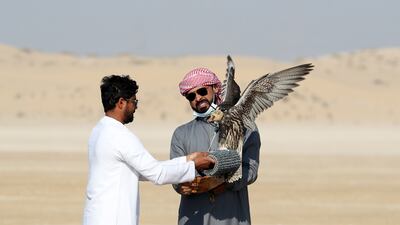
Falconry has been practised in the Arab region for 4,000 years, mainly by desert-dwelling Bedouins as an important form of hunting and fishing in a land with scarce natural resources. Pawan Singh / The National -

Learn more about al aflaj system in Al Ain in 'Emirates from Above', a National Geographic film. The traditional irrigation network system in the UAE has been added to Unesco's list. -
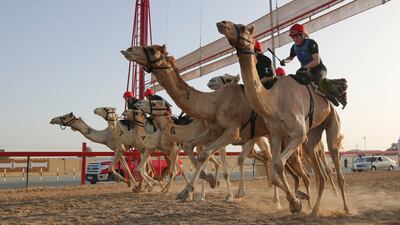
Camel racing, an age-old tradition in the region, is still as popular today. EPA -
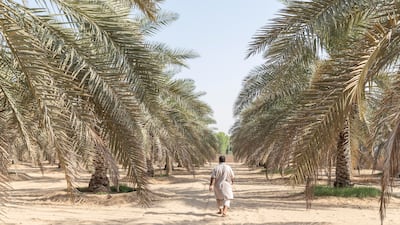
Date palms have been used for centuries for myriad purposes around the Gulf, including the UAE. It was added by Unesco in 2019. Antonie Robertson / The National -
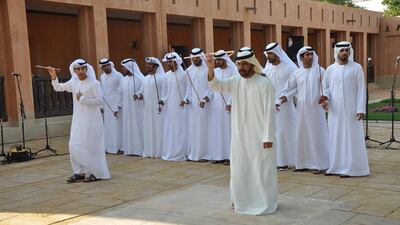
Al azi poetry has been offered protected status by Unesco to develop a clear national identity in the UAE. -
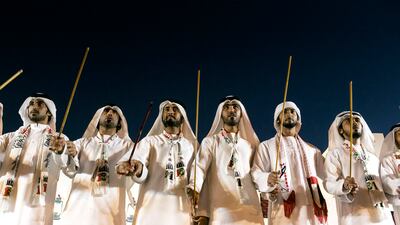
Al rafza is a traditional art form performed by men during special occasions, from weddings to national festivals. Reem Mohammed / The National -

The serving of Arabian coffee is a vital part of hospitality in the region and 'considered a ceremonial act of generosity', says the Unesco inscription. Khushnum Bhandari / The National -
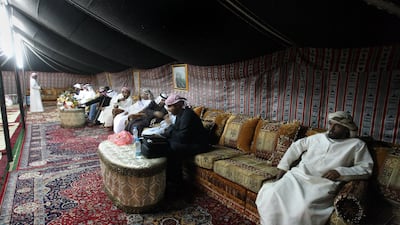
The majlis, a cultural and social space prevalent throughout the region, was added in 2015 on behalf of the UAE, Saudi Arabia, Oman and Qatar. Jaime Puebla / The National -
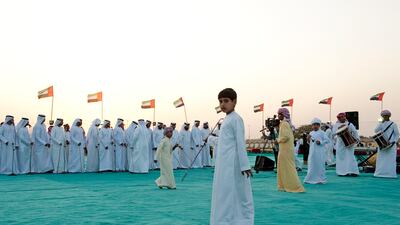
Al ayyala is a cultural performance practised in north-western Oman and throughout the UAE. It was added in 2014. -
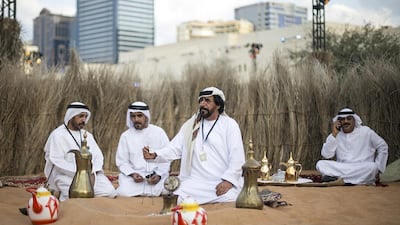
Al taghrooda, traditional Bedouin chanted poetry, was added in 2012. Mona Al Marzooqi / The National -
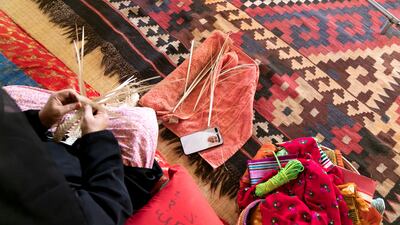
Sadu, a traditional weaving technique, is on the list twice, once for the UAE and once for Saudi Arabia and Kuwait. It was added for the UAE in 2011. Reem Mohammed / The National



