


The past few Venice Biennale events, in which countries nominate artists as representatives of their nations to compete with each other for the title of Golden Lion, have shown that the idea of geographical boundaries is becoming outdated. From the fact that many people make their homes outside of their native countries to the sheer Disneyesque pavilion buildings themselves, artists and the commissioners have been quietly dismantling the concept of a "national pavilion".
This year, Simone Leigh, representing the US, has covered the American pavilion's Neoclassical architecture in grass thatching, suggesting its links to Africa. The Nordic pavilion, usually shared by Sweden, Norway and Finland, was given over to an ethnic minority group who live across the three nations (and Russia).
For some countries with art scenes that are emerging on the global stage — such as Saudi Arabia — the Biennale was a chance to foreground the best of their art scenes. For others, the pavilions took the chance to situate their country's histories in a global context. The National Pavilion of the UAE was represented by an exhibition from acclaimed Emirati artist Mohamed Ahmed Ibrahim, whose latest show, Between Sunrise and Sunset, is an homage to his home town of Khor Fakkan
A total of 58 countries are represented in national pavilions showcasing 213 individual artists this year at the Venice Biennale, one of the world's most prestigious art exhibitions.
Here are four of the most intriguing pavilions:
The Sami Pavilion: Pauliina Feodoroff, Maret Anne Sara and Anders Sunna

In a phenomenal presentation, the Nordic pavilion features Pauliina Feodoroff, Maret Anne Sara and Anders Sunna, on behalf the Sami people, a tribe of semi-nomadic herders who live across Norway, Sweden, Finland and Russia. (The Nordic pavilion usually rotates among Norway, Sweden and Finland, but this was termed the Sami pavilion.) Sami culture has been systematically suppressed since the 1600s, and the artwork at the pavilion is part-activist, part-elegiac, such as Sunna’s installation of his legal fight for the right to graze his reindeer.

The opening of the 2022 biennial is likely to be remembered either for its surprisingly cold temperatures or for the sight of the Sami in their bright red traditional dress who had come down to support the national pavilion. The group were fully aware of their role in performing visibility and the context in which they operated, at times with admirable courage. At the gala dinner held for the pavilion, in the presence of Queen Sonja of Norway, a performer sang a dirge for a Sami activist beheaded 150 years ago. “A reminder that our history is also your history," the singer said.
France: Zineb Sedira

France’s pavilion is a stunner, with a confident and cutting video installation, Dreams Have No Titles, by French-Algerian Zineb Sedira. The video shows Sedira’s cultural education, mediated through film and musical inspiration. Sedira, alongside the pavilion’s curators Yasmina Reggad, Sam Bardaouil and Till Fellrath, and some of her friends, acted out scenes from different national cinemas, layering her own memories of being an “outsider” in France and Britain against scenes representing Algerians and other immigrant populations.

The film sets were then included in the pavilion, for visitors to mill about in, mucking in with the fiction. Bardaouil and Fellrath seem to be developing a sub-speciality in mise en abyme — to put it simply, image within an image — productions, after a similar self-awareness was used in Nujoom Alghanem’s Passage for the National Pavilion of the UAE at the 2019 biennial.
Belgium: Francis Alys
The Belgian pavilion is showing the long-running series of children's games by Belgian artist Francis Alys, who now lives in Mexico City. Shot in Afghanistan, the Democratic Republic of the Congo, Iraq, Denmark and elsewhere, the videos document the endless hand-clapping, ball-throwing, foot-stepping ways that children organise movement into patterns.
Competition and collaboration become almost indistinct as children pick up from each other's rhythms and slowly ramp up the pace, seeing who can stay with the rhythm the longest. This was the world of global childhood with a light touch.
Estonia: Kristina Norman and Bita Razavi

Kristina Norman and Bita Razavi explore the life and work of Emilie Rosalie Saal, an Estonian artist of the 19th century who travelled the world and brought back so-called exotic plant specimens to her native country in their exhibition Orchideliurum — An Appetite for Abundance.
Norman's video trilogy Orchideliurum looks at how the 19th century craze for botanical gardens constituted its own form of colonialism and sensationalism, with European visitors gawking at "exotic" plant species such as orchids, planted in greenhouses that mimicked more temperate climes.
In the centre of the pavilion, an industrial-looking kinetic sculpture by Razavi evokes a kratt, an enslaved creature from Estonian mythology, that produced botanical drawings for visitors. While showing the small nation of Estonia's connection to wider currents of colonialism, Orchideliurum — An Appetite for Abundance also reflects on the class politics in the country. Saal herself was a member of the German Baltic elite, which traces their history to the powerful medieval Hanseatic League.
The 59th Venice Biennale runs until November 27
Scroll through the gallery below for pictures from the Venice Biennale's main exhibition The Milk of Dreams:
-
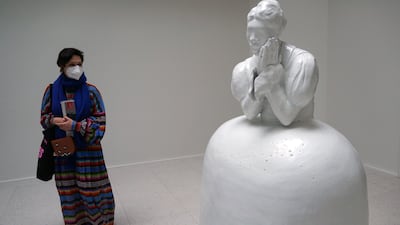
The sculpture 'Anonymous' is part of the Sovereignty exhibition at the Venice Art Biennale, featuring works by US artist Simone Leigh at the US pavilion. Leigh was awarded the Golden Lion for the best presentation. EPA -
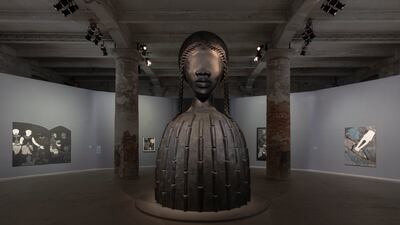
Simone Leigh's sculpture of an eyeless African-American woman, surrounded by Cuban artist Belkis Ayon's prints of a secret Afro-Cuban society in the main exhibition The Milk of Dreams. Photo: Roberto Marossi -
Francis Alys’ 'The Name of the Game' at the Belgian pavilion. Photo: Roberto Ruiz -
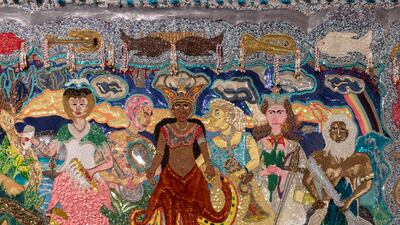
Textiles, and their evocations of craft and slow, painstaking labour, were an important theme, as was spirituality. Both came together in Myrlande Constant's Voodoo flags. Photo: Roberto Marossi -
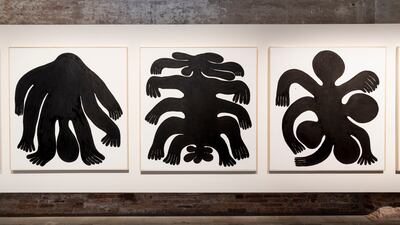
Brazilian artist Solange Pessoa paints creatures on the verge of transformation in 'Sonhiferas, I, 2020', on view in the Arsenale. Photo: Roberto Marossi -
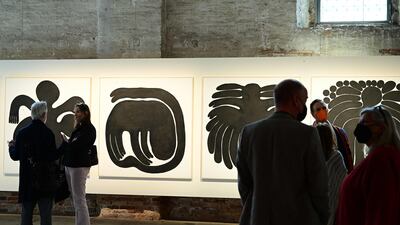
Visitors take in Pessoa's work. EPA -
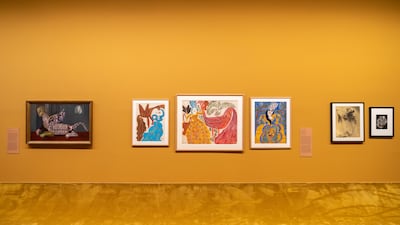
The Milk of Dreams had several 'capsule' shows. One of the best explored the work of female surrealists, or women whose work can be considered in line with Surrealism, such as the Algerian artist Baya Mahieddine. Photo: Marco Cappelletti -
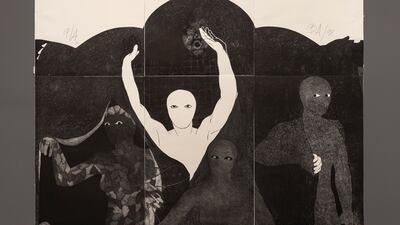
Belkis Ayon's prints document the secret Afro-Cuban society known as Abakua. Photo: Roberto Marossi -

Cecilia Alemani, the Italian curator of the 59th Venice Art Biennale. AFP -
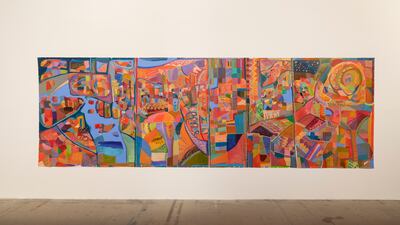
The Milk of Dreams is notable for its wide geographical representation. In the Arsenale, the late US artist Ficre Ghebreyesus shows memories of his youth in Asmara, Eritrea. Photo: Roberto Marossi -
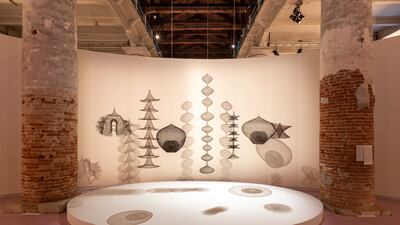
In the section focused on organic forms, this installation by Ruth Asawa is called 'A Leaf a Gourd a Shell a Net a Bag a Sling a Sack a Bottle a Pot a Box a Container'. Photo: Roberto Marossi -
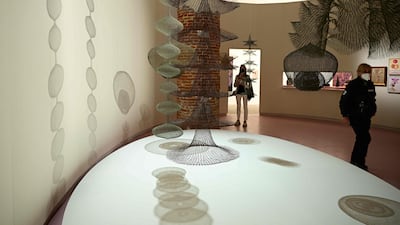
Visitors at Asawa's installation. AFP -
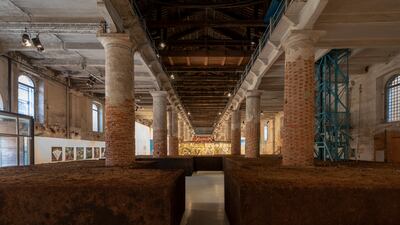
Delcy Morelos' 'Earthly Paradise, 2022', fills the cavernous Arsenale with packed, redolent earth. Photo: Roberto Marossi -

Monira Al Qadiri's drill bits, 'Orbital, 2022', resemble a trio of sci-fi temples. Photo: Roberto Marossi -
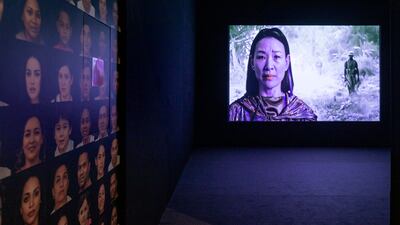
A video and collage by Lynn Hershman Leeson, who connects digital culture to new modes of identity. Cyborgs and digital art are a major sub-theme of the Venice Art Biennale. Photo: Roberto Marossi -
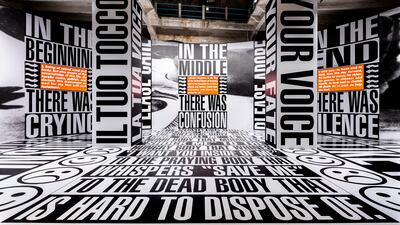
Veteran New York artist Barbara Kruger has been given a whole room to fill with her cutting proclamations on politics and social responsibilities. Photo: Roberto Marossi -
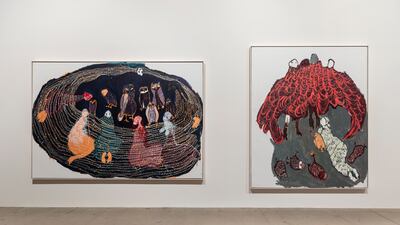
Portia Zvavahera creates oil-based stencils on linen, in invocations of animals and subjects. Photo: Roberto Marossi -
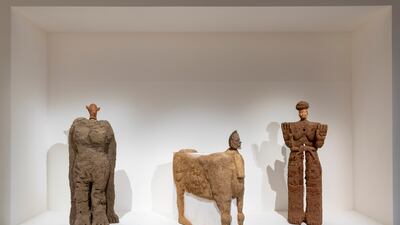
Lebanese artist Ali Cherri's 'Titans, 2022', resemble gods made from the earth itself. Photo: Roberto Marossi -
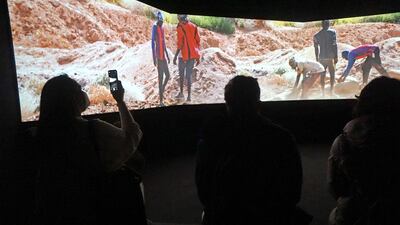
Visitors look at the 'Untitled' installation by Lebanese artist Ali Cherri. EPA



