


UK gas and oil industry’s trade body has warned the UK government against a new windfall tax on companies, saying it would put investment and jobs at risk.
Prime Minister Boris Johnson has come under pressure to ease the cost-of-living crisis by issuing a one-off levy on energy companies that have gained from high oil and gas prices.
The government plans to use the revenue to help households struggling with bills.
But Offshore Energies UK said it already expected to pay £7.8 billion ($9.6bn) in taxes as a result of the boom and the industry required “stability and predictability” in the fiscal regime.
“The offshore oil and gas industry and its supply chain work to long-term investment cycles with multiple and complex risks, that result in projects having to be worked for many years before a commitment can be made,” its chief executive, Deirdre Michie, said in a letter to UK Business Secretary Kwasi Kwarteng.
A “stable and predictable regime” had historically resulted in increased investment and activity, leading in turn to a growth in tax revenue.
“When ‘windfall taxes’ have been used in the past, data demonstrates that investment has fallen away, undermining capex and opex activities, jobs and production.
“Therefore, we continue to reinforce the need for stability and predictability in the fiscal regime to be maintained.”
The £7.8 billion in tax payments for 2022-2023, predicted by the Office for Budget Responsibility, were equal to about £279 each UK household.
They also represent a 20-fold increase on the revenue in 2020-2021 when plummeting demand and prices saw a UK tax take of only £400 million ($494m), OEUK said.
-

Experts say motorists should be aware of the “sweet spot” of their car on longer journeys in top gear. Cars consume more fuel if the speed goes beyond 80 to 90kph because of air resistance. Photo: Unsplash/ Chuttersnap -

Using a roof box can increase fuel costs substantially as it disrupts the aerodynamics of the car it is on, making its impact on air resistance greater. Getty Images -

Keeping your tyres properly inflated is extremely important. If your tyres are a little bit softer, that will damage your fuel efficiency a lot. Getty Images -

In heavy traffic, such as when stuck in a logjam between Sharjah and Dubai, the important thing is to try to maintain a constant speed for optimal fuel consumption. Chris Whiteoak / The National -
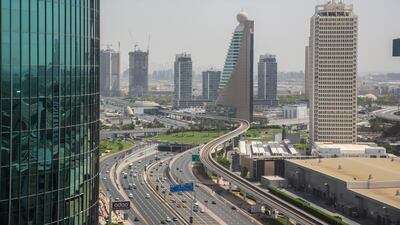
When in traffic, try to move forward slowly. This way, you may avoid having to use the brakes and wasting the energy used in accelerating if vehicles in front of you halt again. Antonie Robertson/The National -
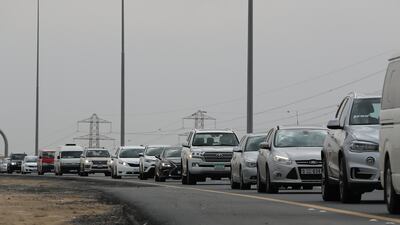
When stuck in a traffic jam, avoid going faster because you will always be stuck behind the car in front of you. This will avoid unnecessary use of the brake and accelerator and save on fuel. Pawan Singh / The National -
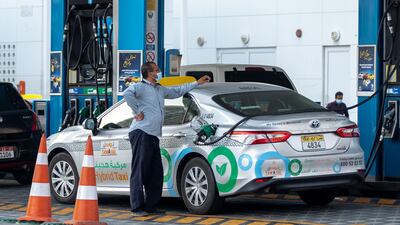
Petrol prices in the UAE have fallen slightly in May. Prices rose more than 10 per cent in February, a further 10 per cent in March, and then 16 per cent in April as global oil prices surged beyond $100 a barrel. Victor Besa / The National


Chancellor Rishi Sunak has not ruled out a one-off levy on the windfall profits, but Mr Johnson told MPs on Wednesday that “this government are not, in principle, in favour of higher taxation”.
“What we want to do is take a sensible approach, governed by the impact on investment and jobs,”he said.
The letter from OEUK appears aimed at spelling out to the government that there will be an impact from a new tax.
“Tax increases make it more expensive to borrow money for big projects, and that can make them unviable," Ms Michie said.
“It’s why periods of fiscal stability are associated with increased investment, whereas sudden tax increases are often followed by decreased investment.”
At Prime Minister’s Questions, Labour leader Sir Keir Starmer called for Mr Johnson to make an “inevitable U-turn” on imposing a windfall tax.

