

Live updates: follow the latest news on Russia-Ukraine
The West's fusillade of sanctions on Russia following its invasion of Ukraine has been likened to the detonation of a “nuclear weapon” by a leading economist.
Speaking at an investment summit in London, Dr Mohamed El Erian, chief economic adviser at Allianz, said “most national security people I know didn't realise how powerful the disruption of a payment system can be”.
Unlike trade sanctions, global payments networks don't have an organisation such as the World Trade Organisation acting as mediator and regulator. It is this regulatory absence that worries Dr El Erian.
“We have entered a world in which we have weaponised something without all the infrastructure that comes with weaponising something that's so powerful.”
He doesn't envisage an immediate collapse of the existing dollar-based world economic order, but he does foresee a “much more fragmented system” in future, with countries who don't full ascribe to the western view of the world left feeling vulnerable by the payment system's weaponisation.
Nouriel Roubini, chief economist at Atlas Capital Team, says Russian sanctions have irreversibly widened an already emerging global economic fissure and that countries with a foot in both camps will soon have to pick a side.
“I think there is going to be a process where these countries try to decouple themselves from the US dollar as their reserve currency, and from the dollar planning system,” Mr Roubini said.
Like Dr El Erian, Mr Roubini doesn't think the process will “happen overnight” but that countries are now seeking viable alternatives to dollar assets such as gold.
Chinese new order
China's ambitions to form a counterweight to the West and its worries over the Washington-led weaponisation of finance mean it is at the forefront of this dollar divestment.
Mr Roubini said President Xi Jinping could even seek to persuade Saudi Arabia to price oil and make payments in Chinese yuan, as well as increasing its reserves of China's official currency.
He sees such manoeuvring as the start of the establishment of a “bipolar world in which there are going to be two areas of influence separate from each other”.
“There will be a separate trading system, a separate monetary system, a separate financial system,” he said.
“One area is going to be around US, Europe and their own allies. Another one is going to be around China, Russia, North Korea, Iran, Pakistan and many emerging markets that are sympathetic.”

Bob Browder, chief executive of Hermitage Capital Management, is less convinced the West's Russia sanctions will have such a schismatic effect.
“I don't think there's any way round the dollar, euro, sterling system,” he said.
“Russia has said we don't need dollars, we'll just deal with the Chinese currency or gold. But the reality is that almost all the economic activity in the world is conducted with the US, the European Union and with Japan.”
Against this backdrop, he sees sanctions against Russia as being a very effective ploy.
“I think Russia won't be able to survive just with China, India, South Africa and Brazil,” he said.
He compared the dollar-based hegemony to democracy, paraphrasing the famous Winston Churchill quote in which the former UK prime minister called democracy is “the worst form of government — except for all the others that have been tried”.
Mr Browder's analogy is questionable given that many countries have eschewed democracy and so could just as well do the same with the US dollar.
Money talks
The flaw was highlighted by Mr Roubini, who said many countries would be wooed by the Chinese offer.
“I remember I was at a conference a few years ago, and there was the president of an African country … and somebody asked him, 'Are you going to use the Chinese 5G system?' He said, 'Absolutely, it costs 50 per cent less than the western version.”
The leader in question was unconcerned about any influence Beijing would gain, suggesting if it weren't China, it would be the US.
IMF reform needed
The task facing the West to prevent the dollar's obsolescence in much of the world is a steep one, but Dr El Erian had some practical tips.
“You start with the [International Monetary Fund] and the World Bank, you give better voice and representation to developing countries,” he said.
“You take away the feudalistic rule that the head of the IMF has to be European and the head of the World Bank has to be American.
“[You take] seriously what's going to be happening in the developing world and put a framework for orderly restructuring.
“There's going to be a lot of depth restrictions coming out and you need a cover of a multilateral system for that.”
Oligarchs sanctioned by the UK — in pictures
-
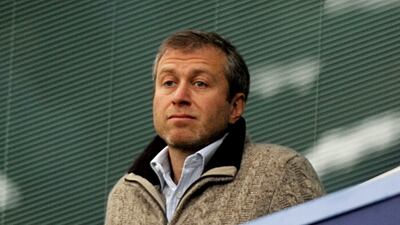
The UK has sanctioned more than 1,400 individuals and businesses, including 100 oligarchs and their relatives, since Russia invaded Ukraine in February. The list of oligarchs includes: Roman Abramovich, 55. PA -

Katerina Tikhonova, left, and Maria Vorontsova, unseen, also known as Maria Putina, daughters of Russia President Vladimir Putin. Reuters -
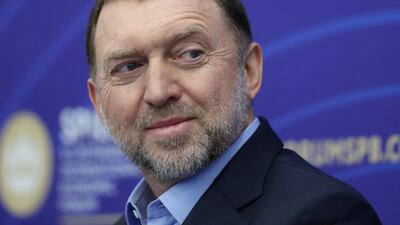
Oleg Deripaska, 54. The industrialist is worth £2 billion and has had close links with the British political establishment. He has a multimillion pound property portfolio in the UK. Reuters -

Igor Sechin, 61. Officials described Mr Sechin as Mr Putin's right-hand man and the second most important person in the country. Reuters -
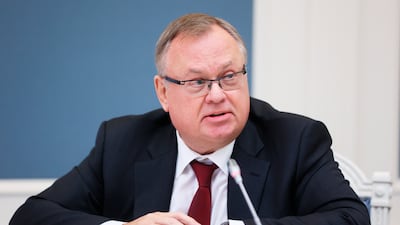
Andrey Kostin, 65. The chairman of VTB, a Russian state-owned bank. Mr Kostin is also a member of the supreme council of the United Russia political party and deemed a close associate of Mr Putin. AP Photo -
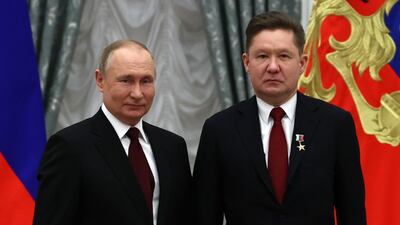
Alexei Miller, 60. The chief executive of energy company Gazprom, Russia's largest company and the world's biggest public energy supplier. AFP -
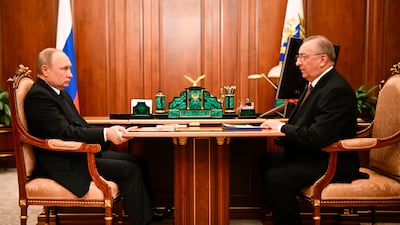
Nikolai Tokarev, 71, president of the Russia state-owned pipeline company Transneft. Mr Tokarev is a former KGB officer who served with Mr Putin in East Germany towards the end of the Cold War. AP Photo -

Kirill Shamalov, 39. He is Russia's youngest billionaire and the ex-husband of Mr Putin's daughter Katerina Tikhonova. Reuters -

Pyotr Fradkov, 43. He is head of the sanctioned Promsvyazbank, which finances Russian defence industries, and the son of Mikhail Fradkov, a former prime minister of Russia and chief of its foreign intelligence service. Reuters -
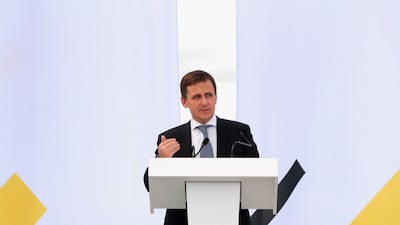
Denis Bortnikov, 47. The deputy president of government-affiliated VTB bank. His father, Alexander Bortnikov, is head of the Federal Security Service. Getty Images -
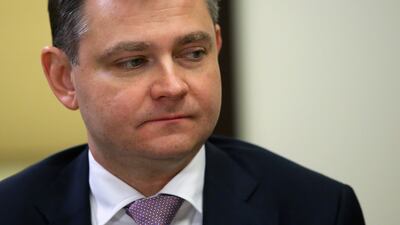
Yury Slyusar, 47. The director of United Aircraft Corporation, one of the major defence organisations that has also been sanctioned. Getty Images



